The Enormous Potential For Microsoft Frontier Fine Tuning
One of the most interesting (and disruptive) aspects to enterprise AI is the simple fact that AI Agents and Superagents (read our HR 2030 architecture for more) are not “systems” or applications in the traditional sense. They are “your systems” that learn, grow, and “become your company.”
In other words, an AI Agent that does recruitment, or training, or employee service delivery gets smarter and smarter about your company’s uniqueness over time. In an enterprise setting this has massive implications.
Think about the “tacit knowledge” or historic experiences, policies, and practices you have. These things, many of which are implicit but not written down, are your competitive advantage. Many of these include policies, cultural behaviors, rules, risk management processes, or just basic “how we do business.”
What we’ve done with Microsoft is embedded our entire Galileo intelligence into MS Copilot, and the system “injested and retrained itself” on our intellectual property. The Microsoft HR team tested this implementation and the results were astoundingly more useful, detailed, and trusted (because a knowledgeable source is cited in all inquiries). So the Microsoft Copilot is now a world-class HR business partner and HR and management consultant.
Now Microsoft is productizing this, so you can “fine tune” your Copilot yourself. This means your IT team (or HR team) can put your policies, hiring guides, pay practices, onboarding, or whatever else you want and it is “institutionalized” and embedded into the system.
And there’s more. Unlike a RAG implementation, which does not “train” the system per se, the Frontier Tuning system can learn on its own. Microsoft calls this the “Reinforcement Learning Environment,” which enables you to update the agent from real-world feedback from users.
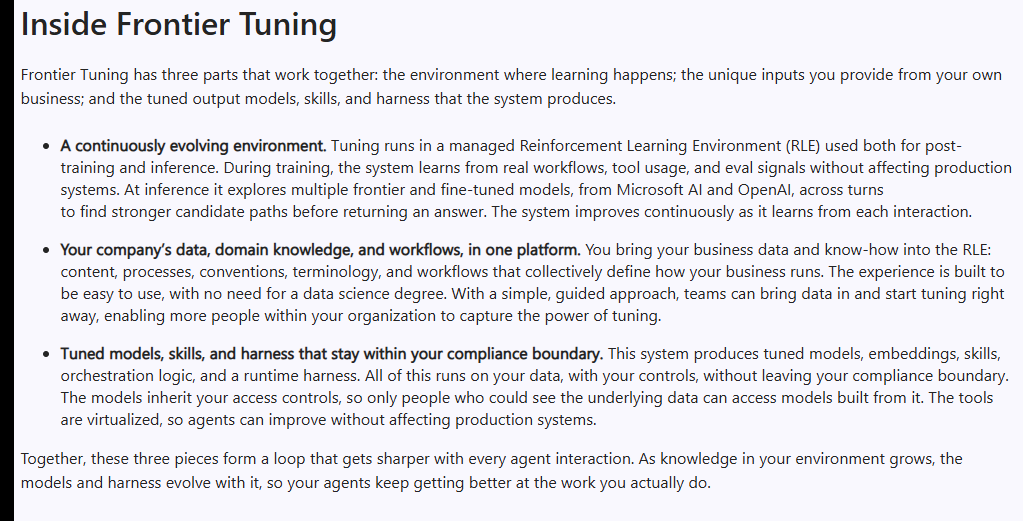
This was all demonstrated at Build 2026 this week in San Francisco (go to 1:45 to see it) and you can see how powerful it is. Not only can you embed Galileo and similar offerings, but you can embed your own company practices.
Satya Nadella discussed this in his CEO council keynote and I’m in full agreement: the value of an AI model is making it unique and customized to your company, not sharing it online with a million others. In the Enterprise AI space this means making it easy for IT (and HR) to tune, optimize, and personalize the system.
With MS Copilot’s new “harness” (listen to my podcast for definition), you can use Copilot to host OpenAI, Anthropic, Microsoft (below) and your own fine tuned models. I could see a situation where R&D teams have their own fine tuned model, for example, with internal confidential data they use every day.
Reinforced Learning Makes Agents Self-Improving
And there’s more. The Frontier Tuned model uses autonomous reinforced learning to train itself to get smarter over time. You can read more about it in the “Agent Lightning” overview. You, as a user or admin, can “turn on” this reinforcement learning agent to get feedback on the utility of all actions so your model trains itself over time. Just like how humans learn!
One example from Microsoft is the company’s internal agent for crisis management. While it worked well for many situations, the war in Ukraine and then war in Iraq introduced many new problems. (Employees with no internet, no phones, and families that needed to be relocated.) They are using the Reinforcement Learning feature to let this agent “update itself” on new policies needed.
(Here is a demo of Microsoft’s Fine Tuned Copilot for HR Onboarding.)
Now there are other ways to “train” the MS Copilot, including the Microsoft Graph Connector (which we also support) and others. These interfaces let the Copilot see and use all your Sharepoint, Powerpoint, Word, Outlook, and now Work IQ data. But this is not tightly integrated into the agent, and the “reinforcement learning” would not apply.
Microsoft Launches Its Own Models
I was also impressed with Microsoft’s announcements from Mustafa Suleyman to deliver 7 new models, optimized for specific use-cases in business.
The contract with OpenAI previously prevented Microsoft from developing its own cutting-edge models. Now it’s racing to build rivals to models like Anthropic’s Claude and OpenAI’s GPT. This gives Microsoft a clean, low cost set of AI models to sell, making Copilot even more valuable as an open harness.
Plus it’s cheaper. “We pay a lot of money to Anthropic — so our goal is to reduce and ultimately eliminate that cost,” Suleyman said.

These new models are focused on high levels of efficiency, clean and licensed without “stealing” internet content. For me as a business person, this is the type of model I would prefer to use.
He made the point that these models do not “share your IP with other customers” like the Anthropic and OpenAI businesses do. If you don’t “uncheck” Claude’s learning box, for example, you will find that everything you do in Claude is available to Anthropic to be sold to others. As an IP company CEO, I like the idea that maybe I could build a solution that doesn’t accidentally leak data to someone else.

Mayo Clinic, for example, is working with Microsoft to build a “New Frontier Model for Healthcare” using these Microsoft tools.

This Frontier Model for Healthcare can be used by any doctor or clinician, and it goes deep into real clinical practices that work. This, to me, is identical to our business in HR and management: observing, studying, and documenting world class best practices in all areas of human capital management, HR, and leadership.
In another example, Land-O-Lakes has been testing out Microsoft’s new reasoning model, called MAI-Thinking-1, to automate tasks in its butter formulation process.
The company used Fine Tuning to customize a copy of the model by feeding it thousands of internal documents, as well as Teams messages and Outlook emails, that human employees had previously written as part of the process. The company found that the customized version of MAI-Thinking-1 was more accurate and ten times more cost-efficient than OpenAI’s GPT-5.5, according to Microsoft senior product manager Tanaya Yadav.
If you’re geeky and you want to see how it works, watch this clip, we will be working closely with Microsoft on this offering. If you’re looking for an employee self-service or other related AI solution and you’re a Microsoft shop, reach out to us and we’ll show you what we’ve built.
While all this takes time, I think Microsoft’s direction here is solid – and with the staying power and leadership in place, I think this approach to Enterprise AI has enormous potential.
Additional Information
Podcast on this topic:
(Note that all our research and podcasts are in Galileo)
The Reinvention of Workday: From System of Record to Platform of Agents
Could Microsoft Win The War For Enterprise AI?
The AI vs. Labor Economy, Why Benefits Are Being Cut, The Role of Legacy Systems
The Context Layer (Semantic Layer) In Enterprise AI (And Where Business Rules Go)