How “No Tax On Tips” Disrupts Frontline-First Companies and Workers
Wages play a huge role in frontline work. The 70%+ of employees who work in these roles often jump from job to job, employer to employer, just to make a few more dollars per hour.
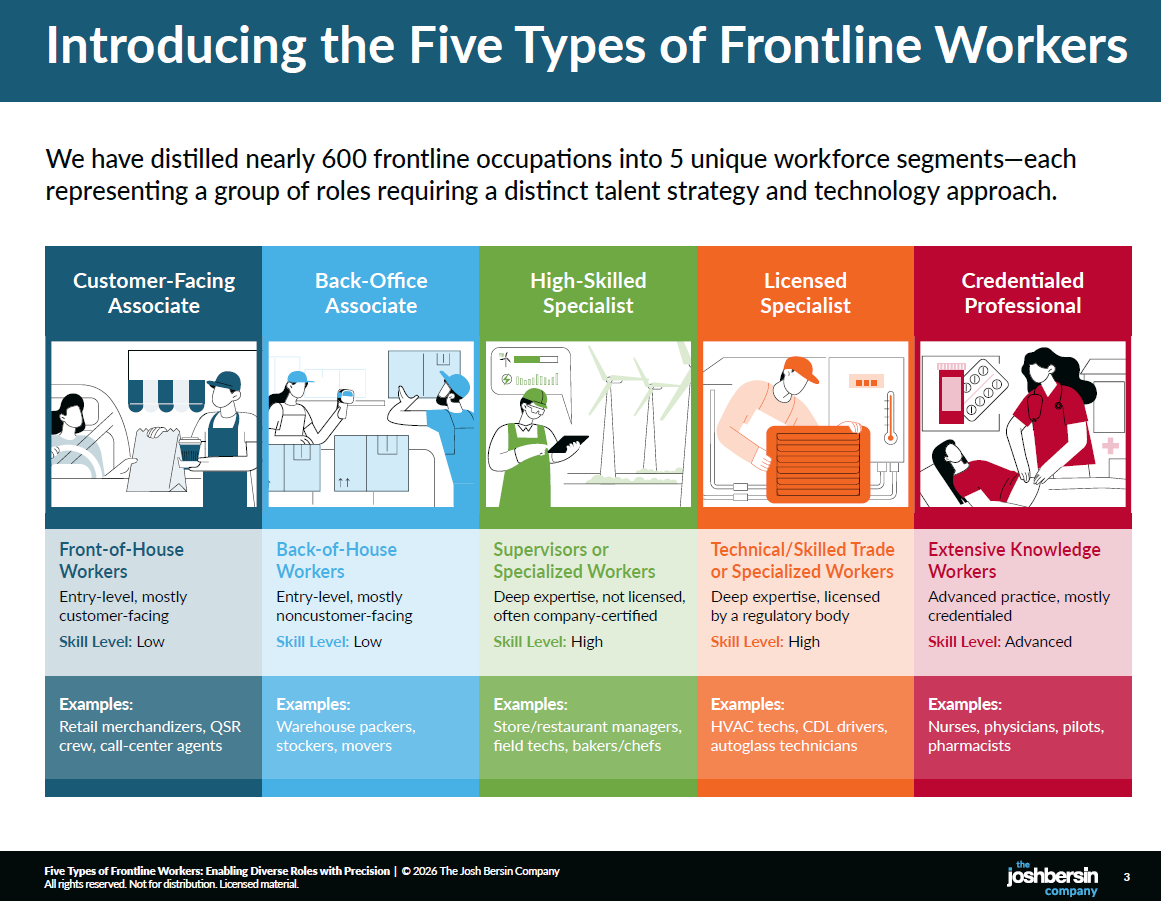
Here’s the dynamic: a typical restaurant, retail, service, or transportation job requires no deep pre-requisite skill (Type 1 and Type 2 in our frontline worker model below), so each applicant who applies is likely applying to 40-50 other jobs. If you get back to them fast enough it’s largely about pay.
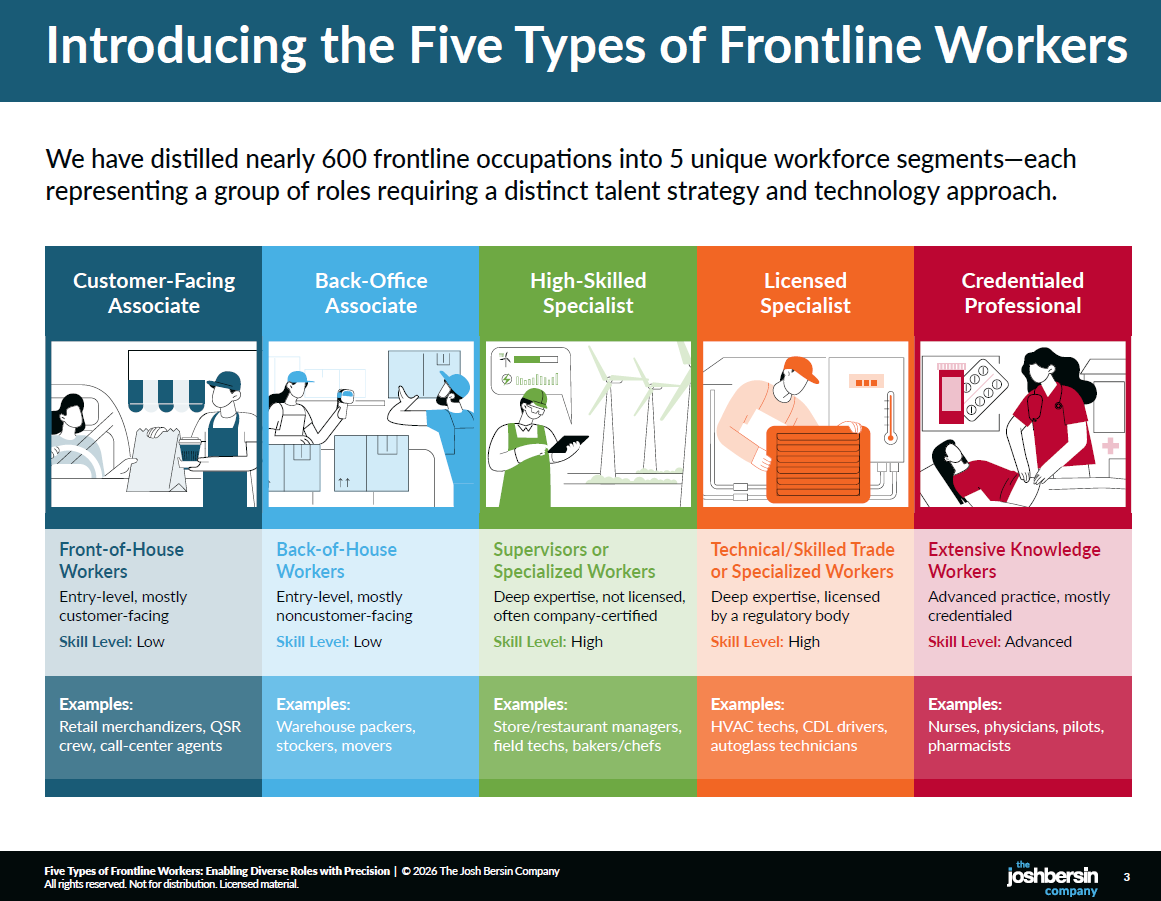
Employers receive hundreds of applicants, then try to screen them, interview, and background check quickly (otherwise store managers are bogged down) and speedily offer them a job.
The job candidate accepts a job on Friday and starts on Monday. Suddenly on Monday they don’t show up because on Saturday they found a position that paid $5 an hour more in a peer or competitor.
This is more common than you may think.
Same thing happens once they join.
Workers use websites like jobhire.ai, jackandjill.ai, aiapply.co, applyblast.com, and hundreds more to automatically apply to these jobs, and these apply-bots are always out there looking.
One day the worker gets a message from the bot that they’ve been approved for a job that pays $10 more per hour. Adios, they’re gone.
So my point is simple: in lower skilled roles pay makes a huge difference. Obviously other things matter: the job, the brand, the hours, working conditions, etc. But pay is like a floor or base need.
Now consider the role of tips. Let’s assume we categorize companies into those who collect tips and those who don’t. (More and more are doing this, thanks to the Feds.)
Companies who collect tips (by cash or machine) account for tips as an employee liability, not revenue or expense. So they have no impact on profit, revenue, or capital requirements. So they’re kind of “free” for employers, and we can assume they encourage employees to perform good service. (Here in the US I sense we’ve lost that impact and people feel pushed to tip thanks to apps, but ignore that for now.)
So we end up with “tipping” companies (ie. Starbucks, Uber) and “non tipping” companies (Target, Walmart, Costco, Fedex). The “tipping” companies now have an advantage: they can deliver higher pay for lower expense. How big is the difference?
Thanks to the new IRS rules, it’s a LOT.
Here’s the math, and this is going to blow your mind.
According to the IRS, the “no tax on tip” bill generated 3.5 million filings in the first half of 2026, with an average tax refund (or reduction) of $1,300 each. That’s a total subsidy by the IRS of $4.5 Billion.
As a first partial year, this looks like a massive benefit, but does it go to the employee or the employer? Here’s some analysis.
If the IRS press is true that means that 2.1% of all US workers filed and they each got tip amounts of $7-11 or more per hour. The BLS tells us that the average non-manager wage for hourly work is $32 per hour. So could tips be adding almost a third or more to this?
(Here’s how I calculated this. The average US worker tax rate in 14.5% but a third of hourly workers are low paid and pay no taxes at all. So let’s consider that the average hourly worker pays 8-10% of their income in federal tax. Take $1300 and divide it by this number and you conclude that these tipped workers get $13,000-16,000 in tips per year. Those numbers are astounding and make me wonder if the IRS was inflating their numbers, but let’s go on.)
Now according to the BLS hourly workers put in around 1500-2000 hours a year with an average around 1,700. So this tip amount translates to $6-10 an hour in tip income. Now add the additional $1300 tax return and it turns into a tip of $7 to $11 per hour.
How big is this? Quite large.

Average hourly wages across major frontline employers vary significantly by geography, role, and local minimum wage laws (such as state-mandated fast-food wage floors):
- Starbucks: Average hourly pay for baristas and shift supervisors typically ranges between $16.00 and $19.50 per hour, heavily influenced by location, tips, and tenure.
- Chipotle: Crew members and shift managers generally average between $15.50 and $18.50 per hour, with urban and high-cost-of-living markets scaling higher.
- McDonald’s: National averages for crew members and shift staff cluster around $14.50 to $18.00 per hour, though states with specialized fast-food minimum wage laws (like California’s $20/hr mandate) push base pay significantly higher.
- Amazon Delivery Drivers (DSP): Delivery associates typically earn between $19.00 and $23.50 per hour, depending on regional competition and seasonal volume incentives.
- FedEx Drivers: Delivery and courier drivers average roughly $20.00 to $26.00 per hour, varying based on whether they operate under direct corporate employment (Express/Freight) or independent contractor models (Ground Service Providers).
So as you can see, the “tipped worker” companies are getting almost a 35% lower cost workforce than the “non-tipped” worker companies.
What Are The Implications Of This Change? Is the benefit going to workers or employers? And if tips are subsidized by the government, should more companies encourage tip income?
We’re just beginning to hear from employers now, but the main message from restaurant and fast food companies is “yikes!” Do we have to implement a tipping policy to keep up? Maybe so.
So the first implication is how employers can use this benefit to their advantage.
Employers who do not collect tips must pay more to attract lower skilled hourly workers. And employers who do collect tips could pay less.
In other words, the Federal benefit to workers makes the “tipping” companies more profitable because they can pay less to compete. (And that also implies that the Federal benefit may not result in higher overall worker earnings.)
Second issue is consumer experience: every app, every credit card machine, and every checkout process now asks for tips. I’ve noticed that Uber and Doordash no longer give you the option of “skipping tips” – and the drivers complain to me that their pay has been steadily dropping.
I always feel guilty if I don’t tip, because I realize that these hard working folks aren’t making much. But now I’m worried that the Feds make it easier for employers to keep wages low.
And then there’s the issue that we “hope” the employer distributes tips to the folks who helped you. Lots of studies have looked at this and there’s a mixed story of how well companies truly distribute tips fairly (it’s easier now that more are digitally collected). Most consumers want the tip to go to the server, not a pool.
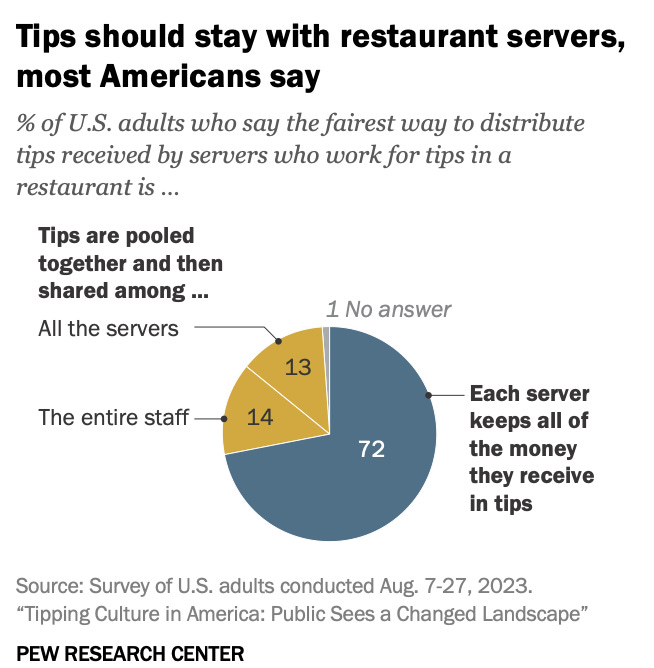
And then there’s our consumer backlash: 30% or more of Americans think tipping is out of control according to this survey.
Third is the income inequality impact.
With this law around $4.5 Billion of US tax receipts are going into these “employer or employee subsidies.” One may wonder if this is the best way to allocate government funds – supporting companies who pay employees with tips, and not those who don’t.
Of course the political goal was to honor hourly workers. But I’m really wondering if that’s happening, and the massive numbers promoted by the IRS were a surprise.
Fourth is the societal impact.
By incenting more tipping we’re moving more toward the “work for hire” model of employment. As I detail in my article about the Great Decoupling between worker and employer, this pushes that further. Tips do encourage employees to focus on the customer, but the employer is kind of a benefit by default.
Honestly I’m not sure what the long term impacts of this will be, and I’m looking for any non-partisan studies to explain. As with all “good ideas,” the long term implications are very hard to predict.
All I can say is tipping is on the rise, and we can expect to see tip buttons on everything we do before long.
Additional Information
- The Five Types Of Frontline Workers, and how our HR and workforce strategies must change.
- The Budget Lab at Yale – Tipped Worker Demographic Analysis – Provides foundational research on the share of tipped workers, age distributions, and zero-tax threshold rates.
- The Budget Lab at Yale – Tax Rate Dispersion & Horizontal Equity Report – Analyzes distributional effects, income brackets, and tax rate variations across service sectors.