Are Frontier Models Becoming A Commodity?
While Anthropic and OpenAI have massive valuations, the ROI from enterprise AI is coming from applications and data, not the model itself. It’s not unlike the relational database market, which went through a similar shift in the 1990s.
Podcast here: Is AI Becoming A Commodity? Or Is it Just A Normal Enterprise Technology like other?
Here’s the basic idea. Now that we have Frontier models from OpenAI, Anthropic, Google, and Microsoft (MAI), and we also have free open source (GLM, Deepseek, Kimi, Mistral, IBM’s Granite…) as well, can we stop “buying AI” simply because it’s cool and start looking at this as just one more amazing tool for building solutions?
I think we’re at that point. And today Satya Nadella, in his article We Can’t Let AI Giants Eat the Economy, agreed with this premise.
We are just finishing a report (Enterprise AI Playbook) and our research (200+ companies) found that only about 8% are building real enterprise apps and many assume that individuals will figure out what to do with it.
In other words, many companies buy AI as an employee benefit, hoping that good things will happen. And as I’ve seen with our own use of Galileo (which uses Claude but works with most models), if you don’t focus on a specific domain and problem area, it’s easy to waste time playing with these tools.
Just look at how economists are losing their inflated expectations.

What Normally Happens With Enterprise Technology
In a “normal technology” purchase this would never happen. Someone finds a tool, builds a business case, works with IT to build security and data support, and then buys the system with a clear goal and ROI in mind. This does happen when companies buy Paradox or Eightfold or Radancy or Sana, which are AI applications, not AI platforms, but it doesn’t necessarily happen when you just buy Claude and turn people loose to play around.
And along the lines of “normal….” Even if you are amazed at Gen AI’s ability to write code, create images, analyze spreadsheets, or answer a question – that innate “fun and interesting” ability does not always produce business value when you’re paying a high cost for consumption. It’s your data, your applications, and your context that makes AI pay off.
I don’t want to rain on any parades, but a lot of the “playing around” with AI has been subsidized by $1.5 Trillion of forward-looking investors.
These pragmatic industrialists paid for the engineers, data centers, NVIDIA processors, and power plants we use. And soon enough they won’t let their companies give the AI away any more, so more and more of our “playing” and “experimenting” will cost money. (And now we can all pay for this with Apple’s 20% price increase.)
Last week the WSJ published two articles on AI “price wars,” which kind of make me smile. Not only are the Frontier vendors worried about competing with each other, they’re threatening a price war. Isn’t this what happens in commodity markets where switching costs are low?
This is precisely Satya Nadella’s point: Microsoft’s MAI models (“Microsoft AI”) are designed to be 1/10 the cost of the Frontier offerings. Here’s one of his comments from the WSJ interview.
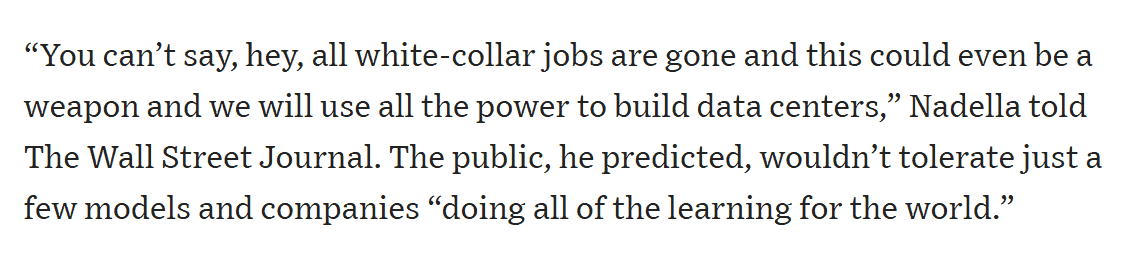
Welcome to a “normal technology market,” where the price and cost is commensurate with the value and problems it solves.
(By the way, even the velocity of “model improvement” is slowing, as this capability evolution chart shows.)

This slowdown is actually good, because we now see companies taking the time to focus on problem solving, not just “buying tech and hoping the fairy dust creates value.” In other words, in the corporate space, we all have to dig in and really focus on solutions, not “implementing AI.”
How Does This Shift Play Out?
It’s pretty clear from our HR 2030 model, which is a reference blueprint for high-value AI solutions in human resources, that most of the high-ROI use cases require more strategic investment than we thought.
If you want to transform and speed hiring, for example, there are a series of agents and Superagents you can buy – but it will require partnering with IT and re-designing how your talent acquisition works. (Hot vendors here include Paradox, Maki, Radancy, Smartrecruiters, and others.) And you’ll change a lot of roles in talent acquisition.
If you want to transform your employee service centers, you can build solutions on MS Copilot, Workday Sana Core, ServiceNow, or smaller vendors like Leena.ai and others. But again this is a “project” that requires policy consolidation, governance, data management, and cross-functional teamwork. And you’ll end up reorganizing L&D.
If you want to build a high performance onboarding program, as both Rolls Royce and Lockheed Martin are doing, you have to build consensus on program elements, develop a lot of global and role specific use cases, and build a governance model to bring tactical and strategic content together in a way it can stay up to date. Again it’s a very powerful use case, but the LLM itself is only a tiny fraction of the solution.
And on and on.
We have identified about 130 Agents in our HR 2030 blueprint, and some you can buy and others you can build. So if you want to make AI pay off, you’ll be spending time prioritizing where to start, working with IT, and preparing your team for new roles, skills, and interesting workflows.
Enterprise AI Is A Reengineering Process, not Magic from an LLM
In many ways the LLM market reminds me of the relational database market in the late 1990s. Oracle, Sybase, Informix, Ingres, Postgres, were amazing – and they competed on fancy features like stored procedures and vertical indexing. Over time, however, it didn’t matter which RDBMS you used and we focused on the applications not the database.
A similar shift is likely here.
We’re huge fans of AI in our company – we now have Galileo modeling entire organizations and solving problems in reorganization, pay structure, and skills, pay, and organizational analytics that used to take months from a consulting firm.
But all that “problem solving” took us almost four years of work to build. The system didn’t magically learn how to do this without our painstaking effort to train it, add workflows, and leverage the features of the LLM.
That’s what you, as an HR or IT person will be doing in the coming years: finding high value problems and “applying AI” to build, buy, or customize these solutions. The “magic” inside the LLM is becoming less and less interesting and important by the minute.
All this is good, because the $1.5 Trillion invested is going to want a return! So we, as buyers and implementers, have to move from experimentation to architect and engineering. And then the payoffs become enormous.
Join us on this journey by signing up for Galileo, take our HR 2030 training, or get certified in our new Global HR Excellence Certification.
Here’s the podcast if you want to hear more. And this week I talk about how to build rules and policies into your AI applications.