US Workforce In 2035: A Few More Workers, A Lot More Output
Despite the talk about job losses from AI, we now know the opposite is true. The new Bureau of Labor Statistics Employment Projections: 2025-2035. shows that we are likely to have labor shortages in the future, despite growth in AI productivity ahead.
The bottom line is this: the US labor market will only grow by 3.5% in ten years, yet GDP is expected to grow by 22%. This means we are expected to grow labor productivity by almost 2% per year, forcing all companies to accelerate our AI transformation agenda.
Under the covers of this transition we will see labor shortages in many areas, job and skills transformation, and the need for CEOs and CHROs to build what we call a “Dynamic Organization.” And for HR professionals, the job market is hotter than ever.
2035 Projections: Top Findings About US Job Market
1/ The US Workforce is growing much more slowly than in prior decades.
The workforce will grow by only 3.5%, almost a third slower than the 10.9% growth in the last decade. This means many companies will have shortages, even as AI automates work.
Our analysis shows that around 61% of US Jobs by population require physical or human centered work (healthcare being the largest segment), and today AI has the potential to fully automate around 13% of jobs.
So ignoring the impact of physical robots, AI is not wiping out jobs, but rather giving us all Superworker opportunities. (Our new book Superpowered, launching in October, explains.)
Despite this, the US administration’s anti-immigration policy is further constraining our workforce, and The Economist notes that this will further exacerbate our workforce shortage.
There are three reasons for the slowdown in labor: anti-immigration policies, low birth-rate, and aging.
2/ The US Workforce is aging, with over 65 workers one of the fastest growing segments.
Today 7% of the workforce is over 65: in ten years this will be 8.5% of the workforce, a 21% growth rate (7 times the rate of overall workforce growth.)
Studies by AARP show that almost 10% of workers over 65 are “unretiring,” and this trend will continue, elongating the length of careers.
For HR leaders this points out the need for generational diversity programs, since many studies show that employers discriminate against older workers in pay and hiring. (Nearly a quarter of workers over the age of 50 believe they’ve been “left behind.” Clearly this must change.)
3/ Healthcare and home health dominates US labor market growth.
Home health and personal care aids will make up 5.5 million people, growing by 18%.
Registered nurses will make up 3.7 million, and they have the highest wage growth by percentage of any segment.
Nurse practitioner jobs will grow in number by 41% and average wage will go from $132,000 to $181,000. In fact 37% of all job growth is in healthcare and overall US employment in healthcare will expand from 13.3% to 14%.
4/ AI will continue to automate low wage administrative jobs.
We looked at the 830 job titles in the BLS taxonomy and grouped them into four groups: human-touch, human-centric, AI-enabled, and AI-automated.
What you find is that job titles decreasing most rapidly include cashiers, clerks, bookeepers, secretaries, receiving clerks, retail managers, secretaries, tellers, and other administrative positions. This makes up around 13% of jobs today.
The BLS believes this will accelerate, and we will likely see similar trends in human-touch work as robots mature.
Some IT jobs are now “administrative.” Jobs such as computer support specialists, programmers (not software developers), testers, and data entry are declining in number and wages.
On the other hand, high-touch and human-centric jobs are growing in demand.
These human-centric jobs, which make up 61% of the workforce, include laborers, electricians, plumbers as well as jobs in home health, counseling, and psychology.
We will also see new jobs in energy and power production, aerospace, health science, and bio-engineering, which are fast-growing industries.
5/ Management, sales, and teaching jobs remain stable.
Despite dreams of AI eliminating middle management, the BLS (and we agree) see management jobs growing. Superworkers need Supermanagers, as we detail in our research.
Retail sales jobs will shrink by 3-5%, but high value sales jobs will grow. And teaching jobs, despite the slowing birth rate, will continue at a steady rate, driven by the massive need for new skills and new modes of learning.
6/ Wage premiums are moving to the Superworker job families.
Our look at wages shows that jobs which are “AI enabled” go UP in value (not down).
A software engineer who is AI powered is no longer a “programmer” but now a product leader, problem solver.
An HR business partner who uses AI no longer has to look up data or policies, they are a consultant and advisor.
These Superworker job families have wages growing at twice the rate of inflation today.
For more details, read the detailed report.
The “Superworker” Effect Explained
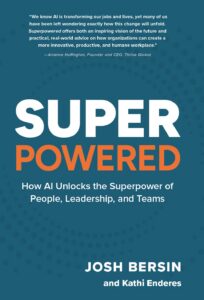 The big story is the “Superworker” effect, as we detail in our book “Superpowered.” AI and automation is not eliminating but rather “superpowering” jobs.
By eliminating “routine” work (and the definition of what is routine is changing), the job of cashier, clerk, customer service rep, administrative assistant, or even bookeeper is vanishing.
These individuals won’t be unemployed. They’ll be doing reinvented work focused on the core of their role, not the “tasks” which consumed their time.
Here is how we analyzed the Superworker effect.
For each of the 830 job titles in the BLS data we categorized jobs into four categories:
Human Touch (a human must touch another person or the work by hand)
-
- Nurse, pediatrician, plumber, electrician…
Human Centric (a human must empathize, listen, teach, or support)
-
- Psychologist, counselor, judge, line manager, HR advisor, policeman…
AI Enhanceable (AI can significantly enhance this job)
-
- Analyst, accountant, executive, software engineer
AI Replaceable (most of this job can be eliminated by AI)
-
- Cashier, clerk, data entry manager, IT support agent.
As we apply these definitions to the 830 job titles in the BLS, you see the following: today 61% of jobs involve human touch or human centric work, 26% are heavily AI-ready, and 13% could be “automated away.”
Of the 61%, many of these jobs (ie. policeman, contractor, social worker) can be aided by AI, using tools for improved scheduling, training, or support. So even these jobs become Superworker roles over time.
 |
If you look at these categories over time, the BLS does project some job destruction. But as a percentage of the 160 million+ working Americans, it’s small.
In the last year, for example, job destruction was only about 1/3 of a percent. So automation may be scary, but total job loss takes place slowly.
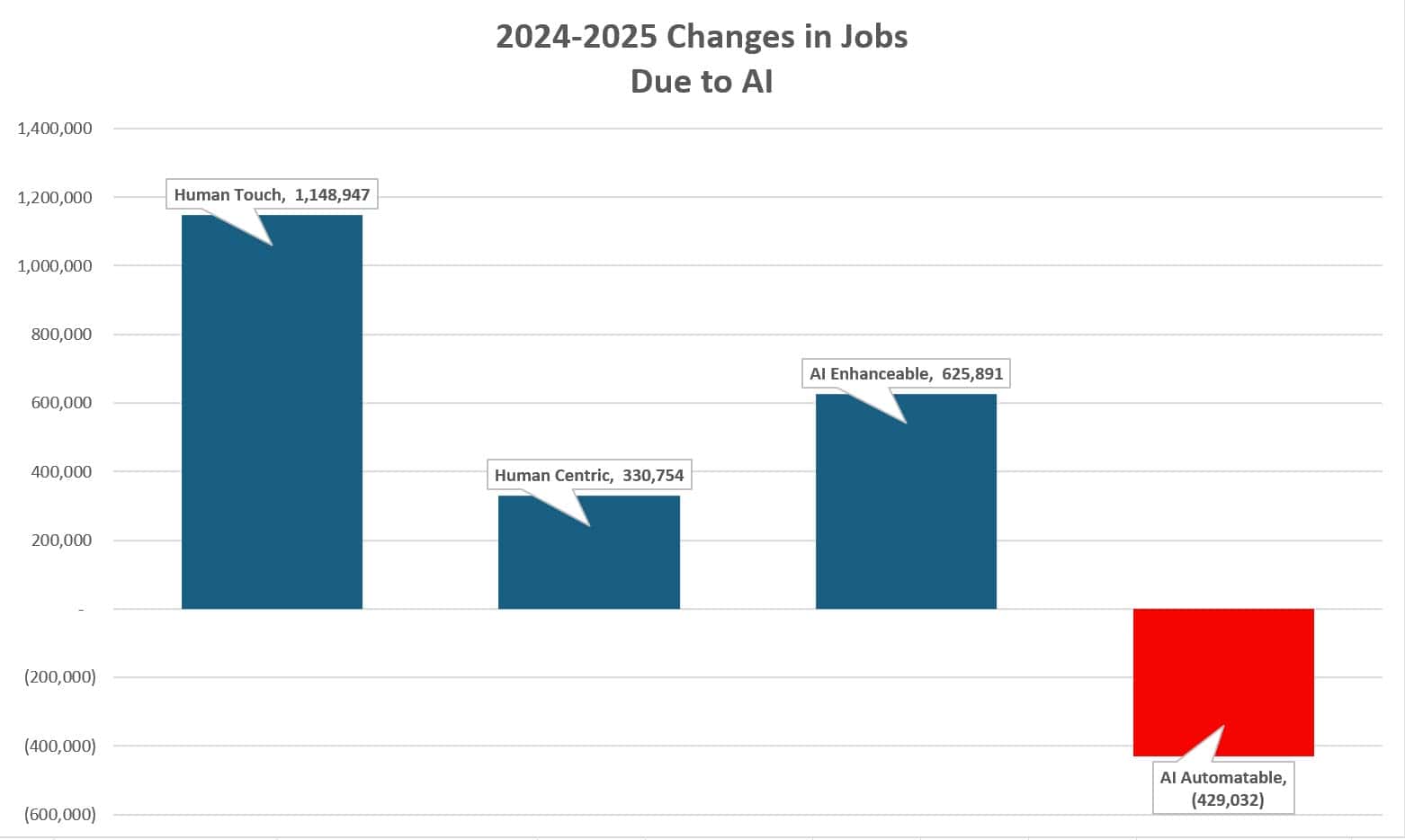 |
Over time these categories will change. Robots will impact the human touch jobs and more and more “human centric” jobs will be impacted AI.
Looking Ahead to 2035
I encourage you to read the source BLS research for your own situation, and consult Galileo for personal advice (Galileo has all this data).
The bottom line is clear: contrary to predictions, over the next decade we will see worker shortages in the US. Human-touch and human-centric jobs will become more important and more Superpowered. And those of us in knowledge and information-intensive roles will see growth.
Companies in healthcare, manufacturing, logistics, retail, entertainment, hospitality, and transportation are going to continue to focus on hiring, training, and enablement. Routine jobs will vanish, to be replaced by jobs which require more thinking and feeling. And the US economy as a whole may slow or struggle as shortages continue.
As we implement AI, it’s clear that CEO and CHROs must drive the productivity agenda. Over the coming decade managing people for growth, skills, retention, and engagement will be more important than ever.
Additional Information
Galileo Analysis of BLS Occupational Forecast
Get Galileo: the AI Intelligence for HR and Management