AI Prices Are Going Up, Up, Up – And What This Means For Enterprise AI
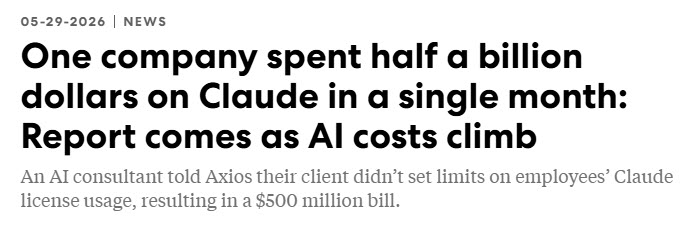
Let me pose a controversial (but logical) premise: the price we pay for AI tools is going to start to skyrocket. And this price increase is going to have some very disruptive effects.
First, why will AI prices likely rise?
It’s pretty simple: this is extremely expensive technology to deliver. Already,spending on data centers, adjusted for inflation, has far surpassed the cost to to build the entire 47,000-mile highway network over four decades ($670B).
Here’s the last 12 months of investment, and I think I’m under-estimating this by a lot.
Big 4 hyperscalers — Amazon, Alphabet, Microsoft, Meta: about $370B–$410B in 2025, depending on whether you use strict capex, finance leases, and fiscal-year adjustments. Reuters cited Bridgewater’s estimate that these four invested about $410B in 2025 and are expected to invest about $650B in 2026.
Adding Oracle, CoreWeave, and xAI/SpaceX AI infrastructure, the practical “AI data-center builder” universe is now around $500B of recent annualized investment and moving toward $700B–$750B+ in 2026 run-rate spending. The broader market including Stargate-style multi-year commitments is much larger, but those numbers should be treated as contracted or announced capacity, not spent capital.x
Now add others like Nvidia, TSMC, Micron, Intel, SK Hynix, Seagate and you easily get another $200-300 Billion, so the 2026 run-rate is close to $1 Trillion.
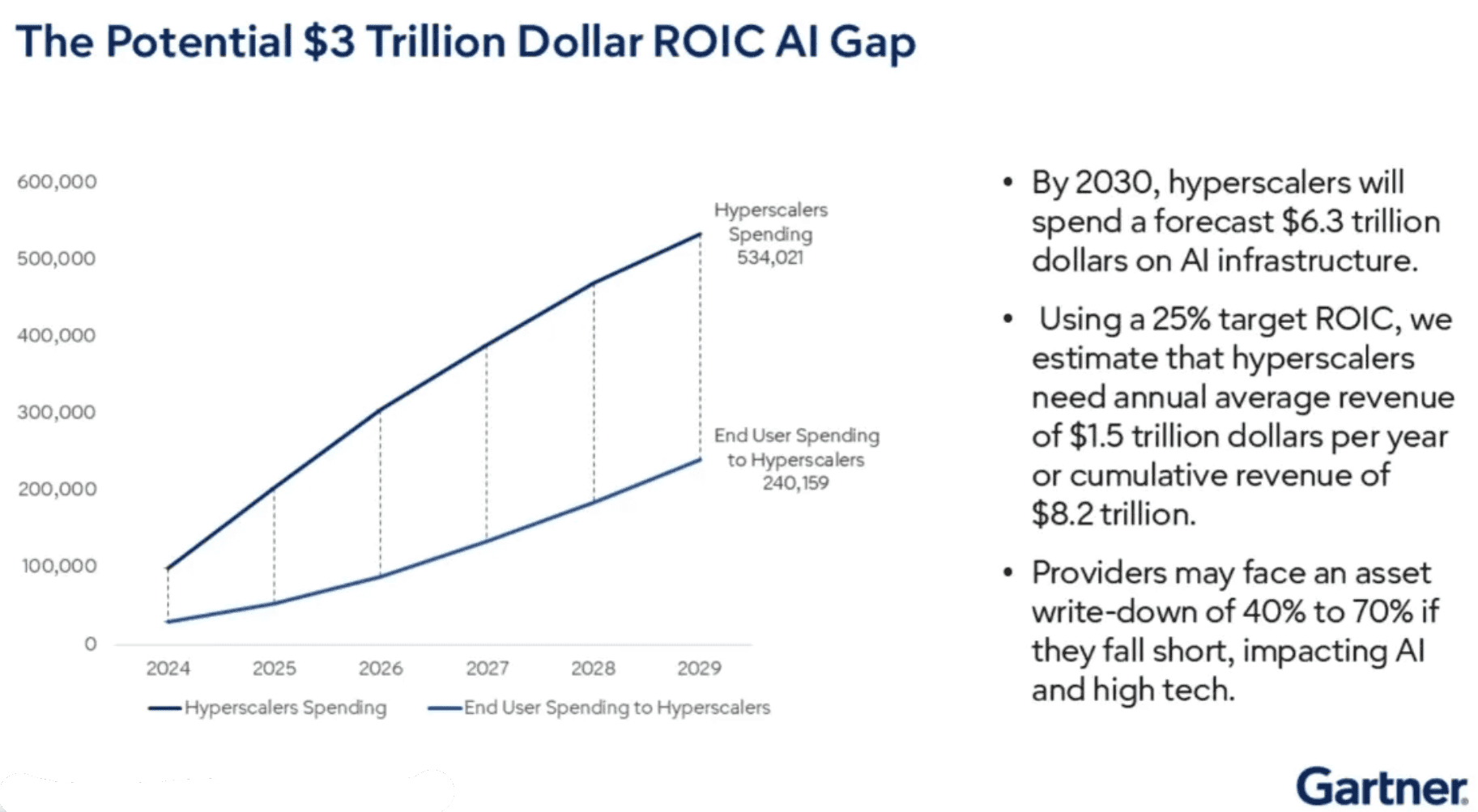
And it’ll get worse. Gartner expects this to be $6.3 Trillion by 2030.
 |
With many new companies (Anthropic, OpenAI) going public they will be under pressure to show positive gross margins (Anthropic is close) so they’ll raise prices. And then all the SaaSapocalypse companies (SAP, Workday, Oracle, Salesforce, Adobe) will also want to show Wall Street they’re making money.
So they’ll all be raising prices (or competing on price!)
I was in NYC with clients this week and three times I heard CIOs or CHROs mention that the high Claude Code costs were already leading them to think about whether they should “outsource” their AI to engineers in India.
The Takeaway (from The Information)
“Eric Johnson, chief information officer at PagerDuty, which helps software engineers respond to tech outages, said he is bracing for volatile costs as his company’s 1,200 employees start using Anthropic’s AI coding and other tools to speed up software development and other tasks.
 |
“I am preparing myself to be surprised” by the bills, the CIO said. “We believe that there’s a lot of value here. Unfortunately, it’s fairly new technology, so there’s some open questions that we’re gonna be working through” around its costs and getting a return on the investment.
Businesses whose employees are heavy users of Anthropic’s Claude products are likely to pay significantly more for them, as the company changed its pricing model to charge enterprise customers based on the amount of AI they use rather than just charge flat fees. Anthropic has said it is using a new version of a technology called a tokenizer for its latest AI models, which could also contribute to the increased costs paid by customers.
Many technology firms and other large Anthropic customers say they plan to eat the soaring costs as they try to boost productivity among software engineers and salespeople by automating certain tasks.
UPDATE: Gemini 3.5 Flash, just announced this week, is supposedly 10-times less expensive than Opus 4.7, so the battle for price-performance now officially begins.
Second, How Much will Prices Go Up?
Ok let’s do a little “back of the envelope” analysis. Let’s add Claude (at $20 per month) to answer.

Read that carefully.
The total “new revenue” that has to be obtained to generate a 15% compound return (assuming a five year depreciation, which is generous) is at or above a $Trillion per year. Most likely more, based on AI margins.
I suppose some of this revenue will come from consumers and ads, and some will come from businesses.
On the consumer side, all internet ad spending today is around $750 billion or so, and that includes all ads on all platforms. So if we double or more the amount of junky ads we see, these companies could come close to paying this off.
On the business side, all enterprise software spending is around $1.2 trillion (Gartner) so we could also double that.
No matter how you look at it, someone (that’s us) is going to pay twice as much for enterprise software or twice as much for ads (unlikely) for this investment to pay off.
Now I’m leaving out other revenue sources: US government spending on the military and many “new markets” for bio-research, energy research, and so forth. So of course AI revenue sources will be broader.
But this “Moore’s Law” idea that computing always gets cheaper just isn’t likely to happen in the near term.
By the way, the original IBM PC (IBM 5150, sold for $1565 with no hard disk) at today’s inflationary price would be around $5700. When you go buy a new Lenovo or Mac PC today it’s often around $3000, but remember you also own an i-Phone. So for computing alone your “cost of computing” has gone from $5700 down to maybe $3500 over the last 45 years. That’s not exactly a huge drop in price.
In other words, all this wonderful AI is quite expensive, and unless it replaces many other things, we’re just going to be paying more. And from an economic perspective, that means we need productivity, health, or other benefits we have not seen yet.
Remember, companies like Nvidia, Oracle, Microsoft, and Workday do not plan on “replacing” revenue with AI, they want growth. Ditto Google, Meta, SpaceX, Amazon, and Apple. And Jensen Huang puts it into simple terms: “AI compute is revenue.” Which means seat-based licensing is going away.
Third, What Are The Implications?
There are lots of things to consider, none too surprising.
- If corporate IT spend goes up (which it clearly is), we need some bigger ROI projects, and willy nilly layoffs aren’t the answer. Our HR 2030 project is all about finding these new ROI architectures, but we’re not there yet. And an agent that makes it easier to file expense accounts and book travel may not be it.
- Ill conceived projects will get trashed. In addition to Uber, who burned up their AI budget in weeks, we now find that Pizza Hut and Starbucks had failed AI projects that resulted in $100M lawsuits. So after burning up all that money on tokens, these projects can fail.
- Will the “job elimination” from AI rationalize itself? I think so. We won’t be buying millions of dollars of Claude or Copilot if the cost is higher than doing it by hand. So we’re all going to get a little more discriminating about where we focus our AI investments. I keep reading about Block eliminating engineers and managers; Meta creating a 50:1 span of control; and then Standard Charter getting rid of “low productivity” human beings. What if these “low productivity” humans are cheaper?
- Will AI replace other things? Absolutely. Over time the money we spend on other core systems, outsourcing, consulting, accounting, legal services, will all go down. This has been discussed endlessly in the press, and it forces services firms to redefine what they do. The services industry is 20-times larger than IT software, so there’s lots of opportunity there.
- Will AI projects become more strategic? Yes, the idea of “giving everyone Claude” may stop, just like “giving everyone a PC” didn’t happen that fast. So the widespread “adoption before value” may slow down, and I already see that happening. Many of us will get embedded agents, maybe not our own. We need to treat AI as an investment, not a random tool for everyone to play with all day.
- Will AI Agents get smarter? They have to. If that onboarding agent costs $50,000 a month to run, it better be far superior to the call center team that cost $25,000 a month. The trend away from “assistants” to “agents” to “Superagents” goes faster. The enterprise architectures are still emerging, but we will see much more dynamic companies as AI becomes integrated into finance, HR, sales, etc. And that’s much more than AI “sales development reps” (which don’t work).
- Will Consumers stop paying? Hard to say, but if the providers decide that $20 a month isn’t enough to charge this becomes more like a cell phone, where most consumers pay $75-150 per month just for service. And you all know how much resistance there is to that kind of new cost. However if you can start your own business with a $200 per month Claude license, you’ll do it.
- Will massive new markets be needed? For sure. I do believe companies will pay a fortune for models that help with drug discovery, energy engineering, construction engineering, and other “high value” AI value products. In exchange for this new spending they’ll launch more great things, and we as consumers will pay. (Those investors want a return@!)
- And finally, will the AI “market” adjust? Most likely it will. The high valuations and unlimited funding for new data centers is highly likely to collapse at some point, and as more people do the kind of analysis I”m doing, more “Warren Buffet” types may opt out of the “buy any stock that’s AI” mindset.
Additional Information (Note that all our research and podcasts are in Galileo)
Could Microsoft Win The War For Enterprise AI?
The AI vs. Labor Economy, Why Benefits Are Being Cut, The Role of Legacy Systems
The Context Layer (Semantic Layer) In Enterprise AI (And Where Business Rules Go)