The Reinvention of Workday: From System of Record to Platform of Agents
Workday, a pioneer in enterprise applications for finance and HR, has struggled to reinvent itself in the age of AI. This week, in a compelling and integrated way, the company unveiled a clear strategy for the future, leveraging its almost $3 billion of acquisitions (HiredScore, Evisort, Paradox, Sana), a new management team, and a repositioning of Workday’s role in the world of Agents.
I’m bullish on these moves, so I want to explain in some detail.
Aneel Bhusri’s Reinvention Strategy
In 2008, when Workday first came to market, the company pioneered an innovative new platform uniquely architected for the cloud. It was a breakthrough.
At that time companies had on-premise client/server systems and the only alternatives were SaaS, hosted solutions run by others. These older systems were often out of date, hard to integrate, and lacked scale and flexibility.
Workday introduced a new architecture: an object-oriented database, an integrated security and business rules engine, and a novel user interface that excited companies in every industry.
The company grew rapidly, focusing on the message “Power of One” – a single system that could handle all HR and Financial needs, with one architecture, designed for the future. Revenue grew and the company captured more than 30% of Fortune Global 2000 and now has more than 11,500 customers and over 75 million end users among its clients.
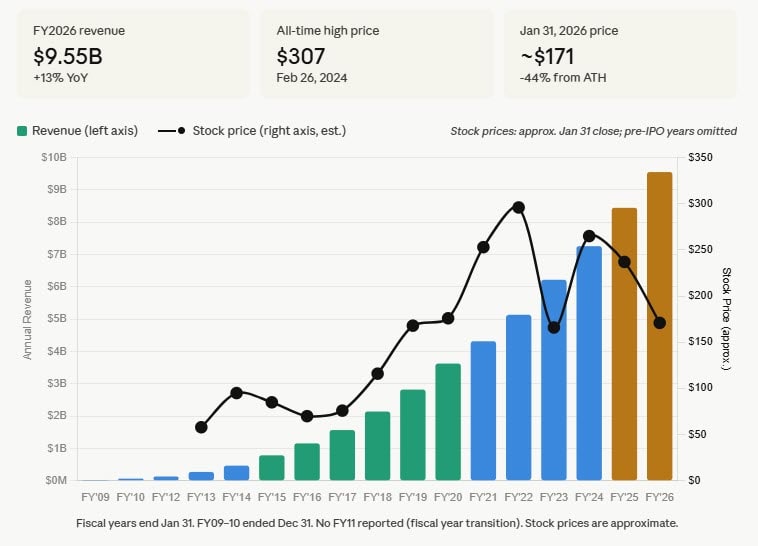 |
During these years of growth, the company maintained its strong employee-first culture, attracting HR leaders, IT teams, and investors. Aneel Bhusri, the co-founder, maintained his role as CEO until 2024 when he turned over the CEO role to Carl Eschenbach.
As Aneel explained to the Summit, over the last two years he felt Workday had lost its startup culture and the AI strategy was not clear. So he came back as CEO and has rebuilt the executive team, leading a reinvention of the company. Let me explain it below.
The New Workday Position
Let’s start with the main problem: what is Workday’s role in a world of newly developed, easy to build AI Agents? What value or role does a “system of record” play in the future?
Here’s their high-level answer, as we see it.
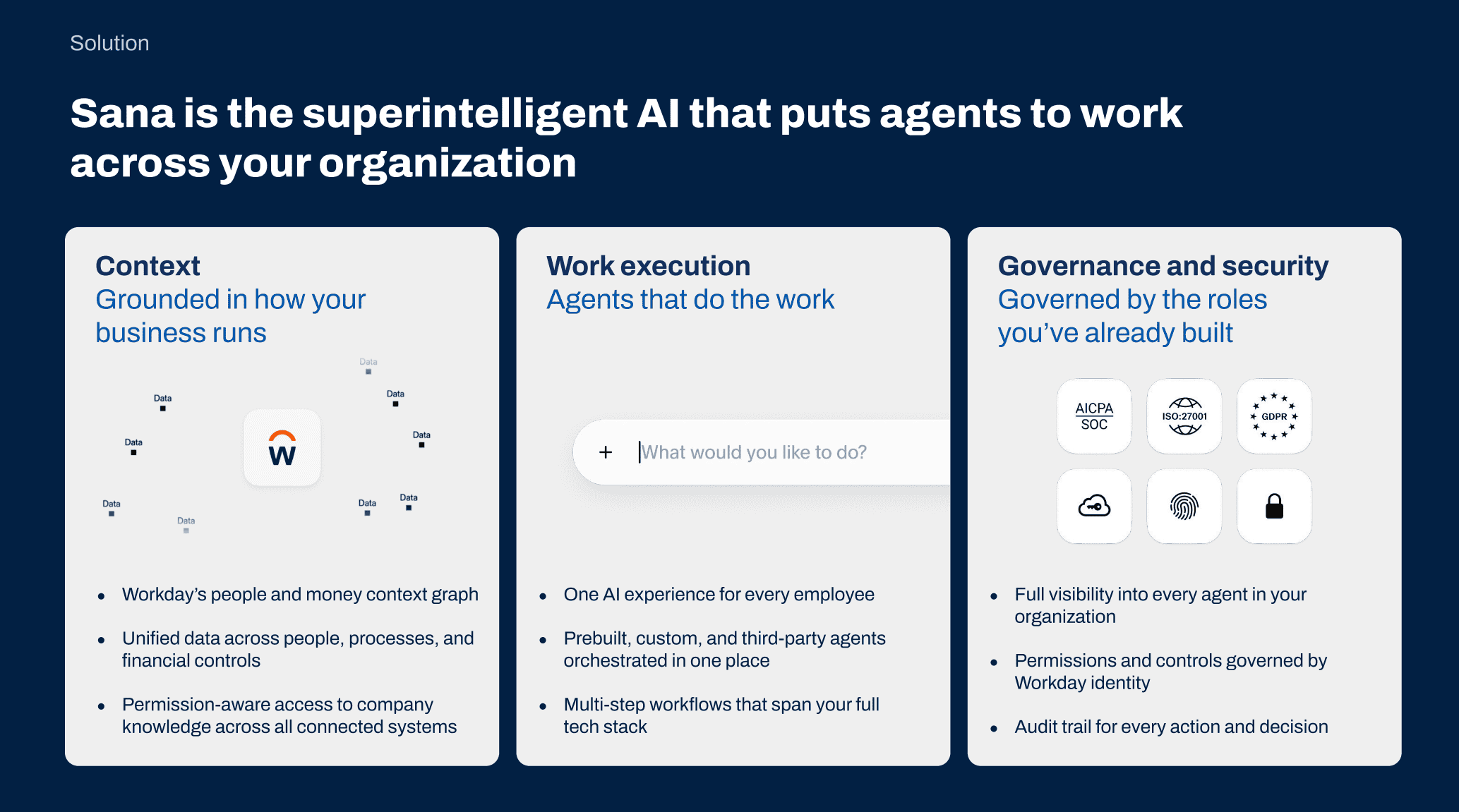
Workday is transforming the system of record into a platform for agents.
If we unlock the data, security, and business rules in a company, agents can be designed and built with scale, security, and speed. Workday, as a trusted system of record, provides the company rules, policies, security model, and compliance that enables agents to run at scale. These “rails” exist in Workday today and recreating them outside of Workday is expensive, slow, and risky.
The Five Pillars of Workday’s Reinvention Argument
Let’s take this apart and look at the five pillars beneath this strategy.
First: AI complements enterprise software. It does not replace it.
As Workday states, reasoning alone cannot run payroll, close the books, onboard a worker, or enforce segregation of duties. Those require deterministic rules, approval chains, and data models built over twenty years. Workday combines probabilistic reasoning with deterministic execution to deliver enterprise AI. Standalone agent platforms sitting on top of extracted enterprise data are structurally incomplete.
(In a similar argument one could argue that autonomous cars cannot thrive without roads, traffic signals, speed limits, and other laws. Similarly, we can’t build data centers without the electric grid. So what Workday is saying is not that they’re protecting their base, rather they’re unleashing innovation through easy-to-use, scalable infrastructure.)
Second: Workday’s “rails” are the core of enterprise AI.
Workday’s configuration and business process framework encode every customer’s unique policies, approvals, compliance rules, and org structure. In some sense, as I describe in my podcast “where do business rules go,” these rules are your company.
An Agent operating outside of Workday does not understand these rules and could produce outputs that look reasonable but violate compliance. Workday routes an agent’s action through the existing configuration, making the agent lawful by default.
(Again, to support Workday’s thesis – if you start building your nest of agents from scratch, you’re quickly going to realize that you need “coordination” and “rules” agents as well. So why not leverage what you already have?)
Third: governance and agent management can be productized by Workday.
Workday believes that their agent management tools are a core part of the infrastructure going forward. Agents, like people, are first-class citizens with unique identities, defined skills, scoped authorization, and audit trails.
The Agent System of Record (over twelve hundred customers registering and observing agents today), a new standards-based access and privilege management system, and a new single front door for internal and external agents are the three productized layers. These apps are positioned as enterprise-grade trust infrastructure that manage the agent sprawl.
(This is a contested and immature space. ServiceNow Agent Control Tower, Microsoft Agent 365, Cursor, and many others will offer these kinds of tools. Workday customers are likely to need Workday’s tools but will likely have other open management tools as well.)
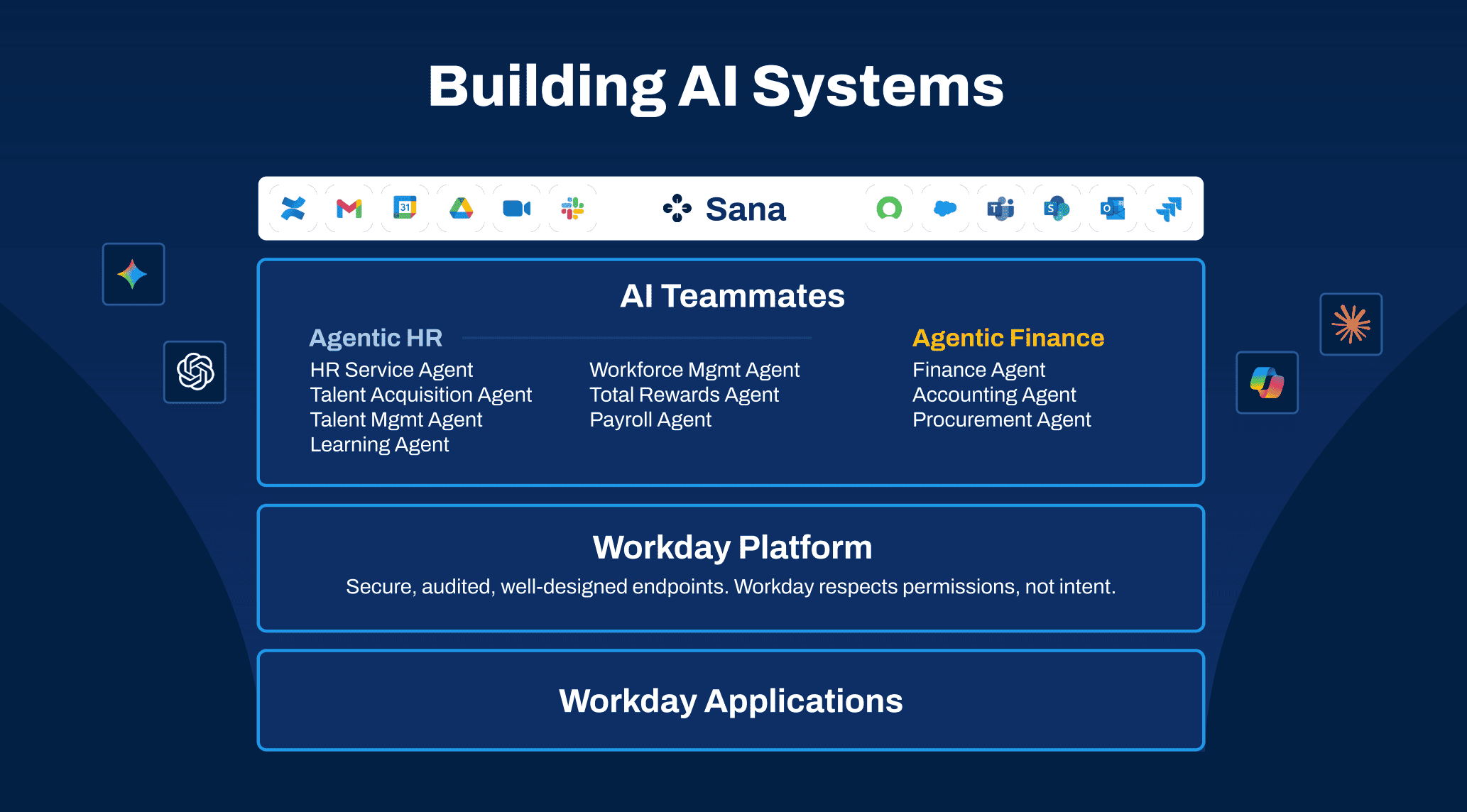
Fourth: the new Workday experience is unified and liberated through Sana.
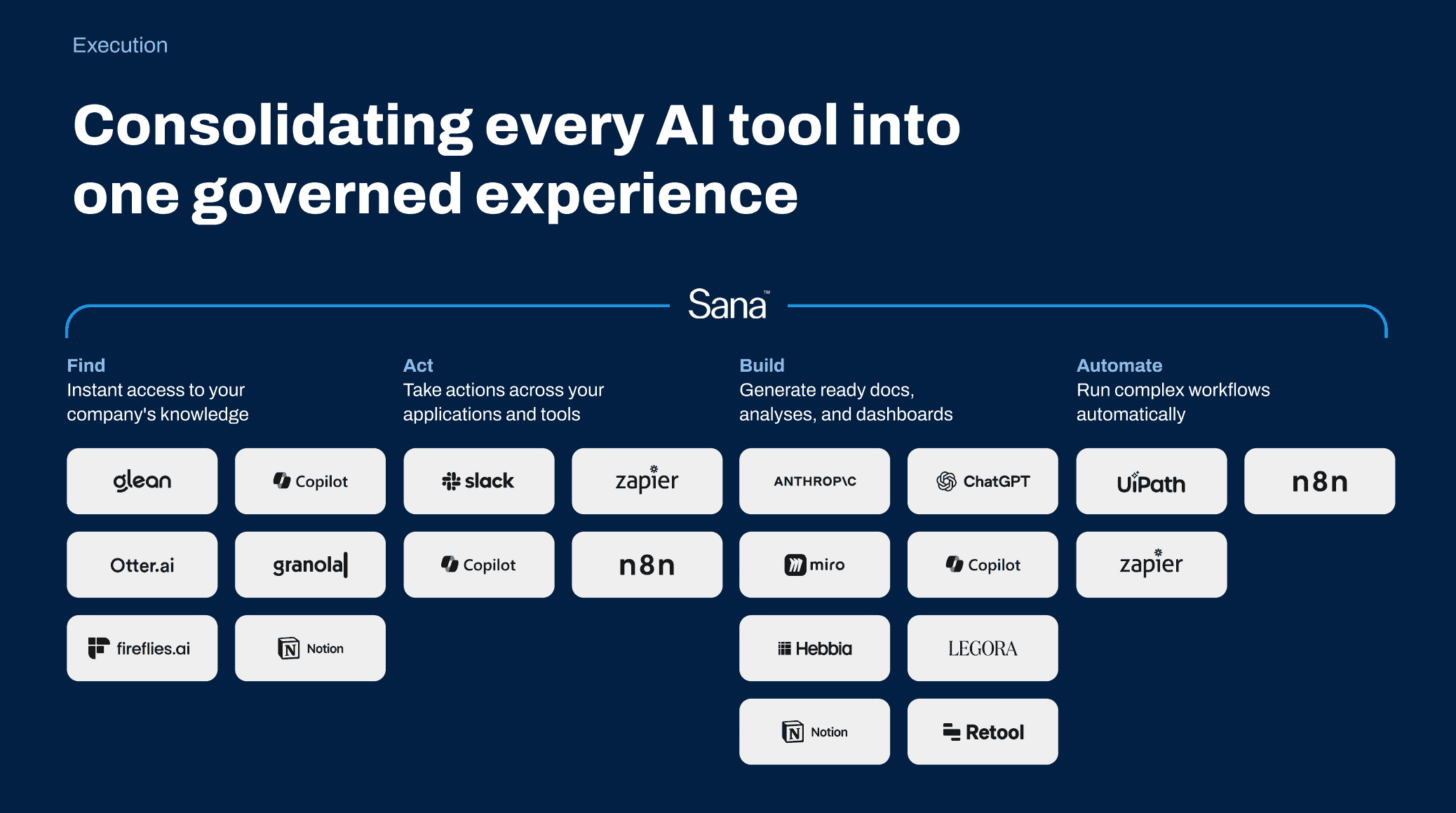
Sana is the new default front door for Workday, bundled for all customers (Sana for Workday) and upgradable to extend beyond Workday to Salesforce, Slack, Teams, and SharePoint (Sana Enterprise). Sana now competes with Microsoft Copilot and other front-door agents.
Workday’s position is that Sana is the last enterprise application employees will ever need to learn (Joel Hellermark calls it the DaVinci of Software). It also functions as the agent development studio and the learning surface.
 |
(I would note that the Sana dynamic learning platform is far more profound than most companies realize. AI-native learning is not training alone: it’s global employee enablement, powering enormous improvements in productivity and employee reskilling. I don’t think Workday fully sees this opportunity yet, but Sana customers do – read our new research or get Galileo to experience Sana directly.)
Fifth: Workday’s new commercial model aligns to outcomes, not seats, and therefore can grow rapidly over time.
In the old-world people licensed Workday by seat, leading to high prices with few active users. Now Workday is shifting to a hybrid of seats plus consumption, using Flex Credits as the consumption unit. This aligns Workday’s revenue with customer outcomes, which should be measured in business growth, productivity, and management tools. APIs that external platforms use will also be metered per-call, capturing revenue which Workday feels is uncollected.
(Here the jury is out a bit, but the idea is catching hold. Rather than pay $100 per employee per year for a system which is rarely used, think about the system as an “Agentic Business Platform” that does work on your behalf, and you pay for its actions, not how many employees you have.)
Workday’s Answer to “Build from Scratch”
Now that we’ve all experienced Claude Code, Codex, Cursor, or another tool it’s easy to imagine “rebuilding” HCM from scratch. I sat with an HR leader in Europe this week who is doing it.
A customer could, in principle, extract their Workday data into a data lake, connect a large language model to it with tools, and try to rebuild the same agent capabilities outside of Workday.
Workday’s answer: this approach produces a shadow ERP that costs millions to build, misses the unified object graph, misses the configuration system, misses the compliance machinery, and remains fragile. The agents that result are lawless by design — they maximize the task without enforcing the rules. This brings risk and eventually demands the security and workflow tools already in place.
 |
(I have some disagreements here, since it will be easy to use Microsoft, Google, or ServiceNow tools to build multi-process agents that may use Workday for authentication but rely on OKTA or Azure identity for authentication also. So some apps will stay within Workday for ease of implementation but others will likely reside elsewhere. If Workday recognizes this and doesn’t overcharge for APIs, all is good.)
Workday’s Answer to A Multi Agent Future
Customers will run multiple AI surfaces: Microsoft Copilot, Anthropic Claude, Gemini Enterprise, Salesforce Agentforce, internal custom agents. Workday’s position is that this is fine.
External agents come in through Agent Gateway, using open standards like MCP and A2A. They can delegate to Workday agents to inherit Workday’s rails, or they can call Workday APIs directly, which are now metered per-call. Either way, when the agent needs to interact with people, money, or regulated workflow, the reasoning hands off to Workday for that portion of the execution.
(Again, if Workday’s new Sana-based Agent Developer is as exciting as the demos, lots of app developers will use it. In the past it has been quite daunting to build Workday Extend apps, so the easier and more approachable this becomes, the better for Workday. Our experience with Sana’s Workflow dev tools, which we use for Galileo, has enabled us to build more than 400 HR workflow apps with ease.)
Can We Make Workday More Dynamic? Dynamic Reconfiguration.
One of the arguments against a cloud system is its slow product release process, forcing customers to wait years for new features. Today Workday updates the system twice per year, and product roadmaps are slow and highly interlinked.
Two major changes address this issue.
First, you can now extend Workday with the new UX and Sana. Register agents in the Agent System of Record, and it’s easy to build new apps – no waiting. And Workday is engaging with hundreds of partners in the Agent Partner Network for industry-specific and advisory agents.
Second, and even more important, Workday introduced the “Deployment Agent,” a dynamic system testing, configuration, and consultative deployment system that lets customers deploy changes more quickly.
This is a massive improvement. Not only can companies configure and deploy Workday in a week or less, but customers no longer need to hire an expensive systems integrator to get it working. And Workday will now roll out new releases more continuously.
This radically reduces cost of implementation and ownership, and unleashes Workday to release product, feature, and system updates much more frequently. This is a major win for customers and a big disruption for Workday SI partners. (Accenture reported that they reorganized 800,000 employees in one week.)
My Analysis Of This Story
We had three of our senior analysts at the Summit and attended demos and in-depth discussions of the entire product strategy. Here is my synopsis of what this all means.
1. The founder returns, a new level of energy
As with Steve Jobs at Apple and Howard Schulz at Starbucks, sometimes a pioneering company loses its way. Aneel, as a leader who deeply understands technology and the Workday market, has the energy and passion to define “the next chapter.”
Not only has Aneel brought in new leaders, he set in place a “General Manager” model around product areas rather than diffuse AI strategy everywhere.
Now Workday has one owner for the Agent Factory, one owner for AI APIs, monthly cross-functional AI task force with the management team. And the company narrowed fifty agent projects down to fifteen in a single afternoon with Gerrit Kazmaier, President, Product and Technology. The “startup culture is back.”
(Note that Microsoft recently centralized its Copilot engineering strategy for almost the same reason.)
2. Workday can lead the charge for agentic HR and Finance
Rather than focus on hundreds of mini-agents within Workday as-is, the company is now betting on big transformation agents for the future.
By acquiring Paradox and Sana, two market leaders in AI (recruiting, agents, and learning), the company has a management team with deep experience in Agentic applications. Workday can demonstrate applications that embrace our agentic future but also leverage our existing infrastructure. This gives the company an opportunity to proactively show companies where the world is going – building and facilitating agents that redefine how companies work.
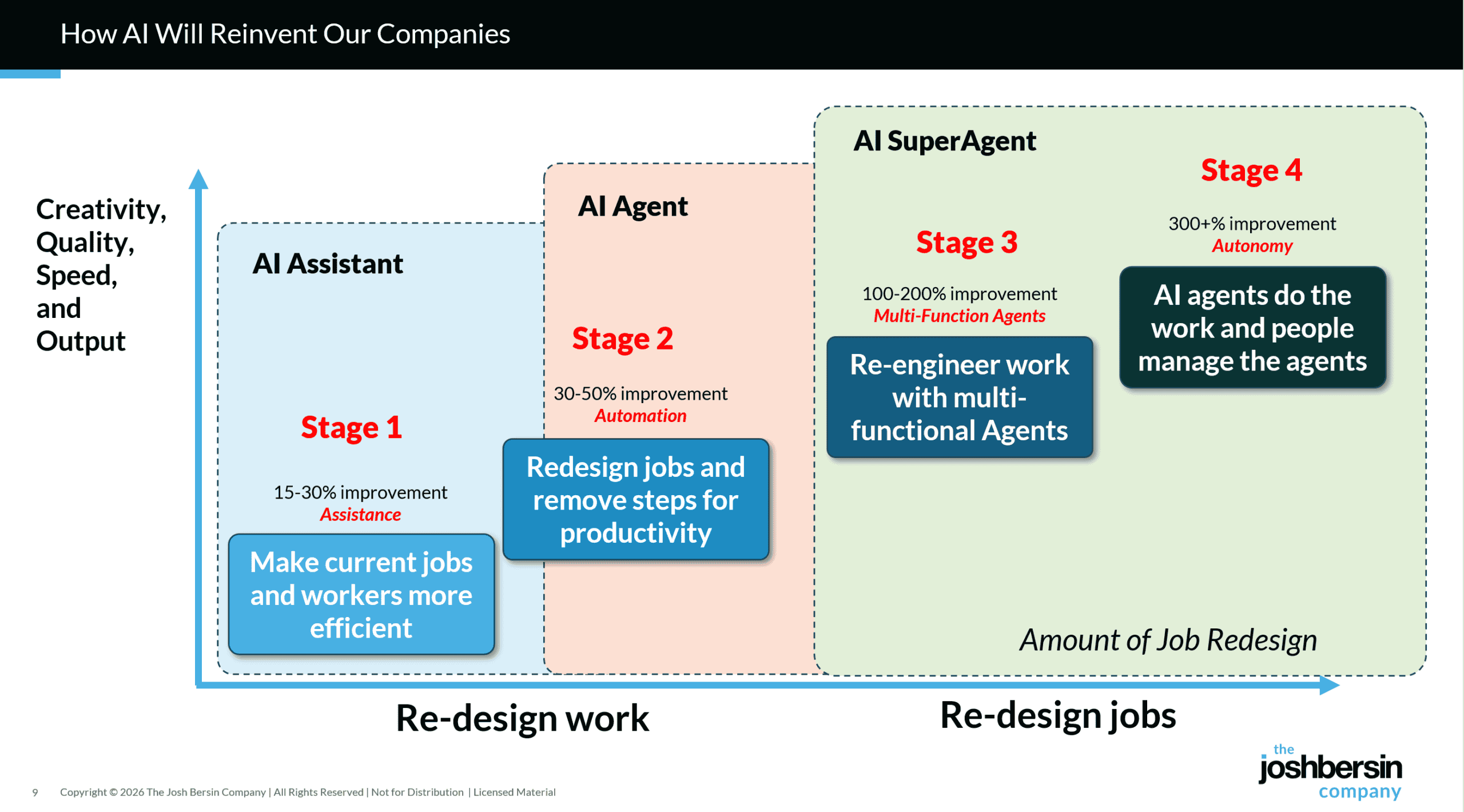
(Our experience shows that “agentifying” a current workflow or job has modest benefits. The big ROI takes place when you build what we call a “stage 3 agent” that automates an entire workflow, eliminating jobs and steps along the way. Sana and Paradox are manifestations of this future.)
 |
3. Sana and Paradox change workday: new leadership
Workday is leveraging new leaders to make this happen.
Reporting to Gerrit Kazmaier, President, Product and Technology, are the new leaders of Workday’s latest AI superstars: Adam Godson and Joel Hellermark.
The CEO of Paradox (Adam Godson) now leads Workday’s entire talent acquisition platform, including the ATS and intelligence system acquired from HiredScore. This is a hot, highly competitive market with more than $200 billion of total spending.
The CEO of Sana (Joel Hellermark) now leads Workday’s entire learning platform (and AI layer), including Workday’s older product Workday Learning, a market with more than $400 billion of total spending.
These entrepreneurial leaders are now General Managers, so they’re not only responsible for product strategy, they also own revenue and customer support. This creates a highly accountable set of product owners, unlike the prior “integrated product group” which delivered very slowly. Product vision, velocity, and competitiveness goes up exponentially.
Remember also that right now talent acquisition and mobility and corporate learning and enablement are the areas where AI is most advanced in HR. So I expect the pioneering innovations in these two companies to directly impact many of the agentic redesigns that will happen in other parts of Workday.
(Note how dynamic these new AI markets are: SAP just acquired SmartRecruiters for $1.8 billion and the knowledge tool vendor Glean is valued at $7.2 billion. Workday competes directly with these solutions so in a sense Paradox + Sana could be worth $10 billion on the outside market.)
4. Workday can try to define Enterprise AI Infrastructure
My fourth observation is that Workday has an opportunity to define how enterprise AI architectures should evolve. This is a messy topic that seems to be baffling every company I meet.
The questions we have to ask are complex: how many agents do we build and what Superagents vs. Subagents do we design. Should some agents be agents of “action” and others agents of “observation and benchmarking?” Should there be masters and slaves so agents have to ask permission of other agents? And how do we segment what information vs. authority different agents possess?
If we think of agents as “superpowered people” (I know that’s a tortured idea) we have the emotional issues of agents stepping on other agents’ toes, and renegade little agents built by someone which may replicate more corporate agents built by IT.
It’s a mess.
Well Workday is thinking about this and they see the problem. In the old world the mainframe governed everything. Then the “system of record” set the rules.
Today we have many layers: the intelligent LLM, the semantic and rules layer, agent code layer (orchestration, tools, workflows), and the runtime/trust layer (security, compliance, guardrails).
Workday can define how this should work. While there are lots of competing vendors here (Microsoft, Anthropic, OpenAI, ServiceNow, Google), in the ERP/HCM world, I challenge Workday to take the lead, and this leads to the question: who is Workday’s “forward deployed engineering team?”
5. Workday understands the context and semantic layer challenge
“Everyone is ignoring the big boring problem of bad context.” — Joel Hellermark
(This is music to my ears.)
There’s an important lesson everyone should learn about AI: context is what creates value, and if we can’t trust the content, we can’t trust the agent.
Gerrit explained that Workday’s biggest accuracy improvements have come from investing in knowledge graphs and context engineering, not from larger models. We have seen the same in our own product Galileo.
So Workday is evolving the Data Cloud to include more than data – the real customer semantics you build as a business. This includes things like skills models, cost centers, career paths, certification workflows, and hundreds of other things not stored in the HCM or financial database.
The fact that Workday’s team understand this shows that Workday is thinking like an AI company, not a transactional vendor that just wants to build agents in the flow of work.
Bottom Line
This event and the series of new leaders at Workday mark a turning point.
The company is ready to reinvent itself, pioneer new solutions, and focus on enabling its customers and partners to participate in the business agent revolution.
With the new product leaders, the new AI infrastructure, and a focus on helping clients test and reorganize their Workday system in near real-time, I think Workday really is on the verge of reinvention.
For financial analysts, I expect products like Sana, Paradox, and the Enterprise AI management tools to show new revenue growth almost immediately. We’ve worked intimately with Paradox and Sana over the last five years and they each have clients and implementations that demonstrate massive value to Workday customers.
I want to congratulate Aneel, Gerrit, and the entire Workday team for this important turning point, and we will keep you informed as more announcements come over time.
New Research and Offerings from Us
Experience Sana for Yourself: Galileo Mars Release
Irresistible 2026: The Global Conference for HR Leaders and their Teams (June 8-10, USC)
HR 2030: The Agentic Future of HR (detailed handbook coming!)