SAP’s Autonomous Enterprise – It Now Calls Itself An AI Company
Last week SAP launched one of the most sweeping announcements in years – a complete enterprise AI architecture that Christian Klein, the CEO, claims makes SAP an AI company at its core. It’s called The Autonomous Enterprise.
“The Autonomous Enterprise includes a unified AI platform for building, contextualizing and governing agents, an autonomous suite that executes core business operations and a new user experience that redefines how people work with enterprise software.” Christian Klein, CEO of SAP SE

While the name has a few issues, I believe they’ve done something big here. After 3+ years of effort with Joule, agents, and various business data layers, the company has made a major pivot. And the pivot is interesting and profound, but maybe not as transformational as we want… yet.
Remember that SAP, unlike Workday, is a true ERP. In other words, the system manages all forms of business resources, including financial, human capital, parts, inventories, manufacturing in-process, and all the procurement, contracts, suppliers, vendors, and outsourced staffing and contingent labor we use.
In SAP, which has more than 25 “industry editions,” you can track a product you sell all the way back in time to who sold it, who is supporting it, what contract was used, where and when was it assembled, what parts were used, what suppliers provided those parts, and what relationships you have with suppliers. And this “end to end” business software (which was assembled through many acquisitions) means that a pharma company, auto company, consumer goods, airline, oil company, health care provider, or even a telco can use SAP to manage this entire complex web of business processes, value chains, revenue, costs, and profit.
So if you go to your SAP system and say “why is our profit margin for product group A (maybe a family of candies you make) declining in South America?,” SAP actually knows that the profit drop is due to a small set of suppliers who raised their prices for a period of time and that whacked out your P&L in that geography.
Without AI that kind of question sets off a lot of analysts looking at data. Now, with SAP’s “autonomous enterprise AI” stack you ask Joule the question, it may ask you to clarify a few things, and it runs an analysis to find the answer. And remember this answer is complex: the sales commission may have gone up or the shipping costs skyrocketed or maybe the raw material commodity cost of milk is to blame. The AI in SAP digs around and figures out that the main contributor to this problem is a supplier.
This is powerful stuff if it works.
In our area of HR and human capital, there are equally interesting and difficult questions to answer. Why is one sales team underperforming its peers? Is it leadership? Training? Tenure of the team? Experience level of management? Or was it the market or a competitor?
These important questions get asked every day, and we often think “skills” is the solution to every problem. Well that’s not necessarily true. Sometimes it’s a weak leader, a misaligned team, or some weird business process that’s holding up our performance. So this optimization problem is all over our human capital operations.
Now what exactly did SAP announce?
The Autonomous Enterprise
The big theme is “autonomous,” which I believe is not quite the best message. SAP seems to believe that your SAP system will “run without your help” at some point, automatically finding sub-optimum things and fixing them on its own. So many of the 224+ agents they announced are focused on these “automations.”
Here are the agents announced in HCM alone.

As you can see they have various naming conventions, but as with our HR 2030 blueprint, they’re fairly specific in nature. There are lots of options on how “big” or “extensive” an agent may be, and you can see that SAP got into some specific processes here.
And that’s the big question we face in Enterprise AI. Are these “automations” designed to simplify something that took a long time to do by hand? Or are they agents that redesign how HR really operates. It’s not clear quite yet.
Our research shows that there are “types” of agents, not just “flavors.” Some are monitoring agents, some are action agents, some are rules agents, and some are data and information agents. Our HR 2030 blueprint details 100+ of them and defines some as that focus on bigger workflows. Right now it appears that SAP is mostly looking at automation. (SAP’s WalkMe is a good automation tool and it’s far easier to implement than a new agent architecture, by the way.)
In the demos for SuccessFactors the company focused on Payroll (a very error-prone and complex process) and employee development. In both cases the system automates many steps, finding glitches, fixing them, and automatically generating alerts, creating development materials, and targeting employees with the right upskilling.
All good stuff.
What I noticed, however, is that a lot of the value is focused on the automation part, not the “process redesign” much at all. So what SAP’s AI layer does is take your SAP system as-is and find ways to “make it operate more autonomously and effectively,” not necessarily “change how things are done.”
It’s a little bit like the Waymo vs. the Zoox.
Waymo is a regular car with driver’s seat and steering wheel that drives itself. A miraculous invention that drives enormous value, but not really a revolution in the passenger experience. The Zoox redesigns the “entity” of an automobile to optimize the “passenger experience,” doing away with the uncomfortable back seat, steering wheel, etc.
SAP is a Waymo, not a Zoox.
Step 1: From Driver Assist to Autonomous Driving
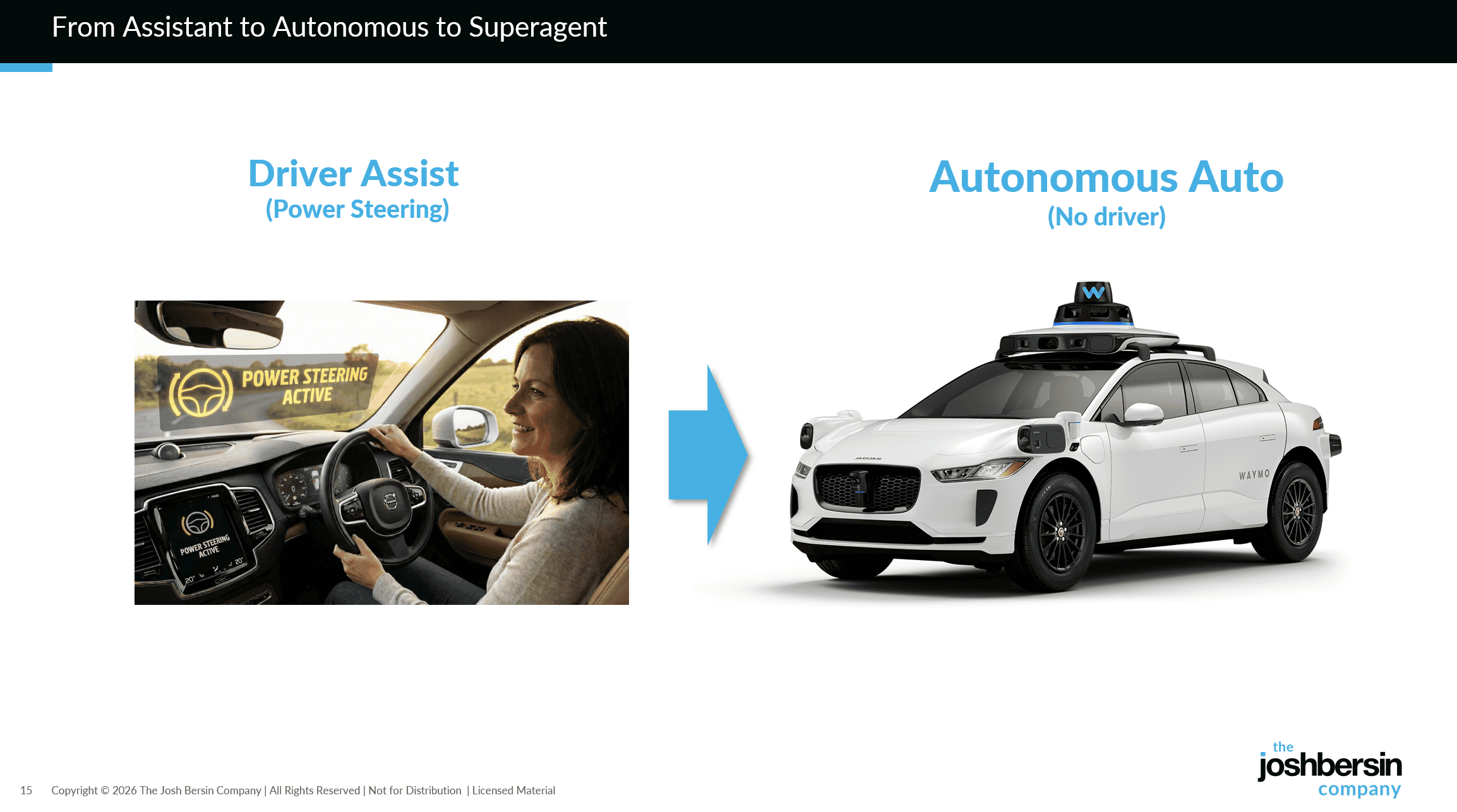 |
Step 2: From Autonomous (Old Process Automated) to Superagent (Redesigned)
 |
This is fine, by the way, because most SAP systems are so complex that these automation workflows add massive value. But ultimately the potential for AI is much greater as we redesign, which SAP may have to do over time.
Remember, autonomy is really powerful: once you get an automation running you can see where it fails or underperforms and the AI could tune it to get smarter every day.
Here’s our four stage model for AI agent use cases, and you can see that Stage 3 and Stage 4 are 5-10 times higher ROI than automation alone (Stage 2).

To date SAP has shipped 224 agents with various levels of autonomy and 51 assistants across four major business areas.
Under the Covers
Let’s now get into the fun stuff: what’s under the covers. Without belaboring the architecture, let me say that I think there are some groundbreaking new things here.
Here is the main picture.

As you can see, there’s a big blue AI layer that includes a data fabric and many models, including a large context window that lets SAP put lots of business data into the blue AI model.
One of the exciting new parts of this is a new tabular data model (called SAP-RPT-1.5).
This is an SAP-proprietary AI model that analyzes, evaluates, and models tabular data. Tabular data is the root of all business software, so this new AI really amazes me. Unlike an LLM that kind of chokes on spreadsheets and tables sometimes, this AI is optimized for massive tables that lets you find, analyze, model, and ask “what if” questions of your complex, real-time business data. It’s amazing to see so for you SQL gurus or data geeks, you have to check it out. (Here’s the playground, it’s fun.)
In the middle is this tiny bubble called SAP Knowledge Graph. This is a big thing. As with Workday’s Sana layer and ServiceNow’s Context Engine, this is the “brains” of the system that maps all the thousands of business entities, structures, and rules you have in SAP into a semantic layer you can talk to.
When you ask a question like “what’s family leave for my new baby” or the more complex one I mentioned earlier, it translate this English query into all the function-specific context queries to understand the question and find the data, information, or policy.
(Galileo, by the way, is an intelligence layer that sits on top here to turn the Knowledge Graph and Joule into an intelligent HR, human capital, and leadership advisor Galileo is integrated into SAP and available now.)
So the SAP knowledge graph is a big deal, and SAP customers are going to be playing with it a lot.
On the top, in purple is Joule, the copilot interface for users and also the development tool for agents. We now we see that Joule is more advanced and important that we thought. Let me talk about this a bit.
Joule was originally launched as a chatbot to find and automate transactions across the SAP suite. Now it’s much more.
The new Joule Studio, shown below, looks like an enterprise class development tool (not a vibe coding system) that lets you design, build, test, integrate, and manage any complex or simple agent you want.

So what SAP has done is not “oversimplify” the tools (which I’m afraid many LLMs are doing, listen to this podcast for more) but rather give IT teams and SAP developers a very robust system to build all types of agents.
Given the richness of all that SAP does, this is a big move.
If people gravitate to Joule to build agents, they may just “redesign SAP” from Joule. In other words, if you keep all the arcane, database driven, integrated applications from SAP in place and you decide you want to build a massively more personalized onboarding system that reflects hundreds of employee options, role pathways, and even first year development plans – you can build it yourself. The SAP “onboarding” agent may be a good start, or else you can just start from scratch.
And as with ServiceNow and Workday, you can access other systems through SAP’s data layer and interoperate with non-SAP agents through their agent management system.
While ServiceNow is selling the “agent platform that lives beyond SAP” and Workday is selling the “platform for agents,” SAP is doing both – and Joule Studio brings to a developer all the SAP unique data objects and modules throughout the suite.
I would expect that Workday’s new Sana Studio will be similar, but so far Joule is the most advanced I’ve seen.
For employees and other end-users. Joule is a platform like Sana (Workday) or Otto (from ServiceNow) that you can “talk to” and “ask question” to do work. So as you build agents in SAP, Joule is always there as your front end for users, managers, or administrators.
Big Memory and A Company Model
Another casual mention discussed building massive context windows to store an entire “company memory.” This is a big idea. Imagine the AI model(s) could store an entire data set of operational knowledge (customers, products, processes, rules, and even documents and emails) and use that “company corpus” to analyze, model, and continuously improve. Kind of a big big idea.
Well Klein talked about this, and it’s a topic we detail in HR 2030. If you capture this information into a big LLM or tabular model (or hybrid), you’d have a “company model” and you could look at any performance gap and see, perhaps, the directly contributing factors.
We’ve been experimenting with this in Galileo – where we loaded an entire fictitious company into the model and asked to do a reorg or flattening, then reallocate people based on their prior jobs and skills. It works amazingly well.
Imagine if you had all this tribal knowledge in the model – we’d see things like “some sales teams engage senior execs for support and others do not” – discovering operational best practices that may not be well known. Think of the thousands of business activities we could improve. We’ll see where this goes but this is one of the benefits of AI coupled with ERP.
(I actually think Workday/Sana could do this extremely well, btw, so I expect to see this from Workday in time.)
AI Governance
SAP, like Workday and ServiceNow, understands the important topic of creating rules, data policies, security, and operating limits on all these agents. Remember that an AI agent, unlike a human, may just run amok and delete data, send data, or release confidential information.
SAP now offers AI Agent Hub, a management system similar to tools available from Workday and ServiceNow. Their tool also supports non-SAP agents (built by vendors and clients) and it includes tools to throttle an agent’s consumption activity, verify the agent, connect it to data, and coordinate agents.
It occurs to me (and this is in our research) that the biggest challenge we have is coordinating agent to agent communication. In HR if you have an agent that delivers training in a personalized way, it should check with development planning agents, performance management agents, and other agents that monitor an employee’s work. We’ve built a dependency diagram for this in HR and you can imagine the spider web it becomes.
Is SAP Now an AI Company?
Right now investors and enterprise software CEOs are worried that their entire stack of value is going to get uprooted by startups using Claude Code. Well I can’t speak for Salesforce (ServiceNow is taking them on), but in HCM, Financials, and ERP it’s going to take years to rebuild these systems.
In other words, the SaaS Apocalypse is baloney.
SAP CEO Christian Klein, in a parallel fashion to Aneel Bhusri of Workday, simply says this is not going to happen any time soon.
SAP, like Workday and Oracle, is going to re-engineer its decades of R&D and “turn their ERP or HCM system into an AI application.” And that’s what they’re out to prove.
Remember the goal here is not to start over but rather leverage AI to bring cross-domain process innovation, customer and employee experiences, and smarter systems into our companies. If we can do this by building Superagents in Joule or Sana, then life is good and we don’t have to throw away huge systems that work.
Finance gets assistants for close, controlling, and related workflows. Spend gets sourcing and buying assistants. Supply chain gets need-to-deliver assistants. HR gets recruiting and career development assistants. Customer-facing functions get assistants across sales, service, offers, and marketing.
This is why Christian Klein believes SAP is an AI company, and it’s starting to make sense.
SAP is not abandoning software: it’s making software less visible by embedding execution into agents that work across the suite. If that model works, customers will interact less with static workflows and role-based systems that decide, recommend, escalate, and act.
And best of all, SAP’s financial model will shift to consumption and outcomes, not just seat licenses.
I think this strategy will work. While I’m sure there are smart competitors trying to start from scratch, the decades of industry and business knowledge (and customer investment) in SAP remains vital and essential, and this new AI strategy is likely to reinvent and reinvigorate SAP’s growth.
We’ll keep you up to date as all this continues.
Additional Information
(Note that all our research and podcasts are at your fingertips in Galileo)
The Reinvention of Workday: From System of Record to Platform of Agents
Could Microsoft Win The War For Enterprise AI?
The AI vs. Labor Economy, Why Benefits Are Being Cut, The Role of Legacy Systems
The Context Layer (Semantic Layer) In Enterprise AI (And Where Business Rules Go)