Microsoft’s Voluntary Exit Is Not a Layoff. It’s a New Model of Management
When Microsoft announced its Voluntary Exit Offer last week, the headlines were immediate. “Microsoft Lays Off 60,000.” “Tech Giant Cuts Workforce.” “AI Takes Another Victim.” Quickly Instagram and TikTok were filled with angry videos: “another big company eliminates workers with AI.”
Well I hate to tell you, this is not what happened.
I spoke with Microsoft’s HR leadership team this week, and the story is much more positive than it seems.
What Microsoft has done is not a layoff, rather a thoughtful workforce innovation, one which many companies will want to copy.
What Microsoft Really Did
Let’s start with the facts. Microsoft introduced a voluntary exit offer available to 60,000 eligible employees across four markets: U.S., Canada, India, and the UK. Eligibility is determined by organizational unit, not performance. Employees from vice president level and below are eligible, with no tenure requirement, so you could have been at Microsoft for a week or for twenty-five years.
The goal of the program is not to force people out, rather to encourage people to move on with their careers. In other words, Microsoft is saying “if you aren’t 100% on board with our new strategy, we want to help you move on with your career.”
Microsoft CFO Amy Hood stated that they expect few employees to take the offer. Based on industry precedent for voluntary programs of this breadth, the HR team expects an uptake rate of 3-1%. The means only 1,800 to 3,000 people out of 60,000.
The offer itself is a standard severance package. It is not sweetened to encourage departure. It includes pay based on tenure, stock vesting, healthcare, and career transition services. There is no quota, no forced selection, and no predetermined headcount target.
Microsoft has been clear: they are not announcing layoffs. And critically, Microsoft just delivered a very strong financial quarter, so this is not the behavior of a company in distress: it’s the behavior of a company thinking ahead.
A New Model of Workforce Dynamism
So what is this, if not a layoff?
Well earlier this year, Microsoft introduced a Voluntary Retirement Program for tenured employees approaching the end of their careers: age and tenure at Microsoft had to add up to 70 or more. And what happened is that many non-eligible people said “I wish I had a deal like this!”
Amy Coleman, the CHRO, hear this message so they decided to broaden the program. She realized realized that others were ready to leave.
The result is a program focused a simple idea: not everyone who works at a company wants to be there. So let’s make it easy for disengaged people to move on.
If someone has been mentally preparing for their next chapter, starting a business, joining a startup, or simply changing industries, this new program gives them a supported path to do so.
I’ve thought about this in my own career. Years ago I worked for Sybase and was there during its decline. My job was important but I wasn’t very busy. I would show up, work 5-6 hours a day, and then often leave early to coach my kids’ soccer teams. Eventually I left for a new opportunity but if they had offered me a voluntary exit I would have taken it and we both would have been better off.
That is exactly what Microsoft is building: a release valve for mutual misalignment, rather than a forced program to reduce headcount.
This is all about quality of hire and talent density.
Amazon and Netflix famously offer new hires a financial incentive to leave within the first 90 days if the fit is not right. The philosophy is the same: a smaller, more committed team outperforms a larger, partially disengaged one every time.
The Talent Density Imperative
The concept at the heart of what Microsoft is doing has a name: we call it talent density.
It’s a simple idea: scale does not come from “more people,” it comes from “better capabilties, automation, redesign, and internal redeployment.” Every manager who asks for headcount should hear “let’s talk about how we can redesign what you’re doing to deliver more.”
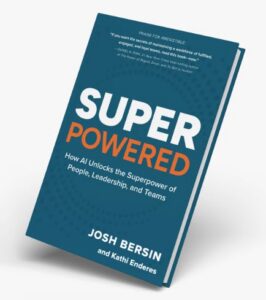 The traditional talent management model, developed before skills shortages, was a supply chain: hire when growing, contract when slowing. That model no longer works because almost every role is being reinvented for AI. (Our new book Superpowered explains this in detail, with more than 100 case studies.)
This means new jobs, internal redeployment, and lots of learning and development. Our Dynamic Organization research details how companies who redeploy people well are 31 times more likely to lead their markets.
Google’s 2025 AI turnaround is a good example: rather than hiring hundreds of new engineers to compete in the AI race they redeployed talent from scattered product teams into Gemini, producing a game-changing product and a new business for the company.
Microsoft is playing the same game, just at a more sophisticated level. By creating space for self-selection out of the organization, they make room to redeploy talent into AI-critical roles, continuing to hire selectively in high-growth areas, and maintain the engagement of those who stay.
The Engagement Crisis We Face: How To Create More Energy
There’s another angle to consider: if misaligned people leave, the remaining teams are even more excited.
Gallup’s new engagement data shows that U.S. employee engagement has dropped below 30% for the first time in a decade, its lowest point in fifteen years. Only 21% of workers are fully engaged, down 10% from the prior year, and 66% of employees report “suffering.”
Two forces are driving this problem: constant messaging about AI job cuts and a slowdown in hiring driven by massive investments in tech. (Gartner estimates that AI and IT spending is up 15% to $7.35 Trillion next year.)
I see the fear in clients eyes each day. How do we energize people as they learn to reinvent their jobs and work around AI?
Well Microsoft’s answer is simple. Rather than keep a large, fearful workforce in place, Microsoft invests in the engagement and commitment of those who choose to remain.
CHRO Amy Coleman states publicly that Microsoft wants energized, ambitious, aligned employees. If you don’t feel excited, Microsoft makes it easy for you to leave.
That is not a process of “demanding engagemnt.” It’s a sober recognition that having the right people doing the right jobs in the right seats is a competitive advantage an AI-powered economy.
Transforming Into AI Without Forcing People Out
AI is not really a tool for reducing headcount: rather it’s a tool to drive growth, scale, efficiency, and customer intimacy.
Leaders (like Microsoft) understand the rise of the Superworker and embrace a growth mindset. Engaged employees will reinvent their jobs around AI.
I believe the companies that lead the next decade are not those who shrink: it’s companies that leverage AI for growth, efficiency, and scale. Microsoft is setting this example.
That is the real story. I hope the headlines catch up.
Josh Bersin is a global industry analyst, author of Superpowered*, and founder of The Josh Bersin Company.*