AI Makes The HCM Market Hot Again: Workday, SAP, Oracle, and More.
I just finished a month of meetings with Workday, SAP, and many vendors at the Unleash conference so I want to give you an update on the HCM market. This is a long article but worth the read.
The Big Story: HCM is Hot, Foundational Platform for AI
After four years getting slammed by Wall Street, the HCM core vendors are in the strongest position I’ve seen in years.
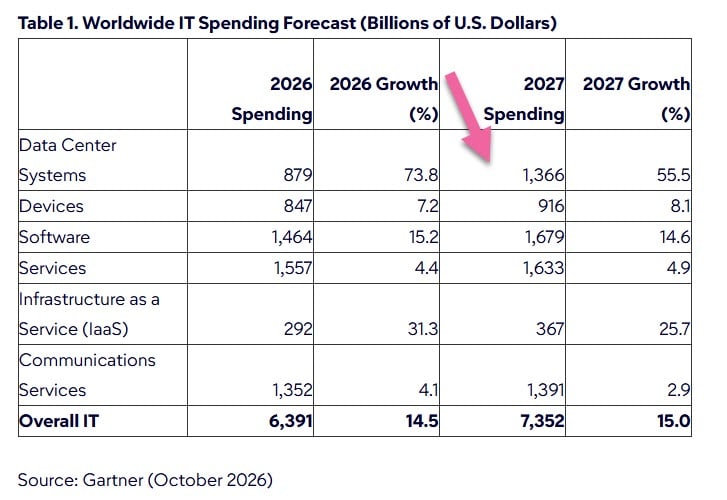
Why? First, the economy is growing and companies are restructuring, so companies need these platforms more than ever. Gartner believes IT spending will rise by 15% this year, and HCM may grow at twice the rate.
Second, the HCM are becoming strategic platforms for AI.
Rather than think of them as HR systems of record, they are now AI platforms for business growth. They refine and speed hiring plans, improve company skills, and soon will manage a hybrid workload of people and agents. And they hold all the strategic information you need for major decisions like M&A, restructuring, or productivity analys.ss.
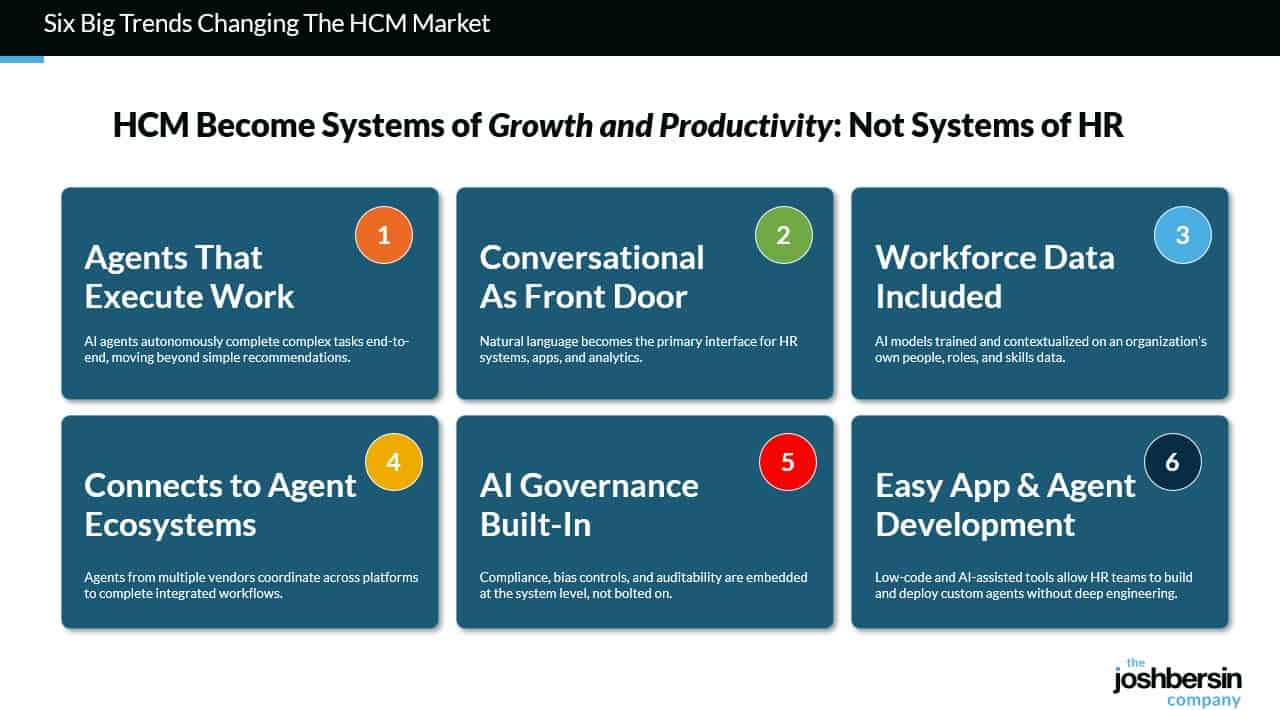
Look at the six big trends in this market. In the new world of AI, HCM provides a solid and trusted data set, agent management tools, an easy to use experience, and tools to build apps. And by 2030 our companies will have as many agents as people: HCM helps us manage these new “workers.”
 |
Third, the “standalone agent” market is dysfunctional.
I saw 40+ vendors selling “recruiting agents” or “coaching agents” at Unleash, and it’s hard to tell what any of them do. As we describe in our HR 2030® research, companies want an architected “system of agents,” not a bunch of standalone tools. Does your agent do sourcing? Candidate communications? Interviewing? Screening? Pre-hire assessment? We need a system to manage this stuff.
When you buy lots of sub-agents from startups you’re acquiring “pieces” of an application from different vendors. We need to stitch these tools together into a holistic system, and the HCM platform can do this.. in an open and interoperable way.
Fourth, HCM platforms are now fully open.
APIs and data clouds are easy to access, so there’s no reason to build islands of data any more. This is a huge shift in the market, facilitated by AI and the ability of HCM vendors to monetize access.
And by the way, Gartner also sees the AI token market growing to $1.37 Trillion next year. HCM vendors will get a good piece of this.
 |
And fifth, these platforms are finally easy to use!
Nobody every claimed that Workday or SAP or Oracle was easy for employees to use before: the new interfaces like Workday Sana, Joule Work, and HiBob feel like productivity tools. Companies can build useful productivity apps in the HCM, which was never possible before.
Let’s now look at the big vendors.
Workday Announcements: An Exciting Fourth Act
The Workday team is new, energized, and AI-ready. Aneel Bhusri, co-founder, calls this the “fourth act” for the company, and I think he’s pulling it off. Gerritt Kazmaier, new president of product and technology, is one of the most savvy tech leaders I’ve met and through the acquisition of Paradox and Sana the company is now filled with engineering, marketing, and product leaders that “get” AI. I know many of them fairly well and this is the most tech-savvy and market-focused leadership team I’ve seen since the early days (Joel Hellemark, Adam Godson, Gabe Monroy, Max Wessel, and others).
On the platform side, Workday, through the acquisition of Sana, is now delivering seventeen what I would call “Superagents” to drive productivity, transformation, and growth. Using the Steve Jobs model of “less is better,” Workday’s 17 Superagents each have sub-agents within them to deliver business outcomes in talent acquisition, work intelligence, system deployment, organization design, financial audit, system adoption, decision intelligence, employee self-service, coaching, payroll, and more. Each of these agents is sophisticated and drives a variety of outcomes.
The Workday Deployment Agent, for example, is designed for a new customer to configure and deploy its entire Workday system in one sitting.
The Decision Intelligence Agent lets you do workforce, hiring, and talent analysis with financial analysis built in. It also applies Work Intelligence to decompose work and jobs into tasks, and then do hybrid work capacity planning and agent-human org chart for redesign.
The Org Development Agent lets you audit, fix, benchmark, and optimize your job architecture which includes AI agents on the org chart. The Payroll agent finds and repairs anomolies that take hours or days to uncover by hand.
Workday also introduced the Workday Data Cloud, which is a new, integrated system to access all Workday data through API or SQL, something I know customers will love.
And to a round of applause, Workday launched it’s “Candidate Profile” which lets job seekers can apply once to a Workday employer and never have to fill out a profile again!
And Workday also launched their partnership with us around the HR 2030 operating model, with new research and education on agentic HR for growth.
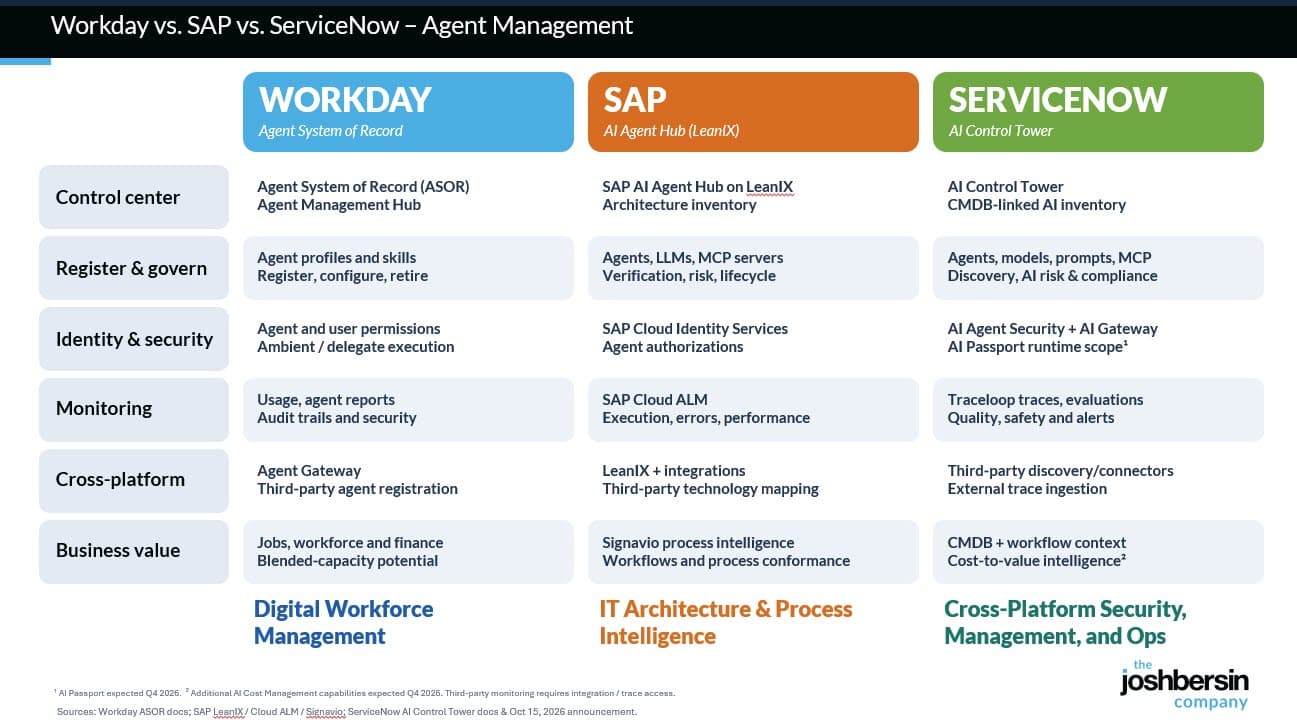
Workday is also very commited to agent management tools. These include the Agent System of Record, Agent Gateway (to manage third party agents), and a new Agent Identity system acquired from c1.ai. It’s an ambitious suite, competitive with tools from SAP, ServiceNow, and others.
 |
I talked with dozens of Workday customers at the Rising conference and they’re excited about opportunities to deploy real-world agents that work. And many of these are mature and proven: Paradox (recruiting) and Sana (learning) are in-the-market AI-native products. So I expect Workday’s AI revenue to grow rapidly as customers understand these opportunities.
SAP and SuccessFactors: The Autonomous Enterprise
SAP, through its “Autonomous Enterprise” strategy, is moving in a similar direction, but with a slightly different focus.
While Workday focuses on productivity and growth, SAP is focused on enterprise automation. The investments are similar but the focus is different.
Here’s the picture.
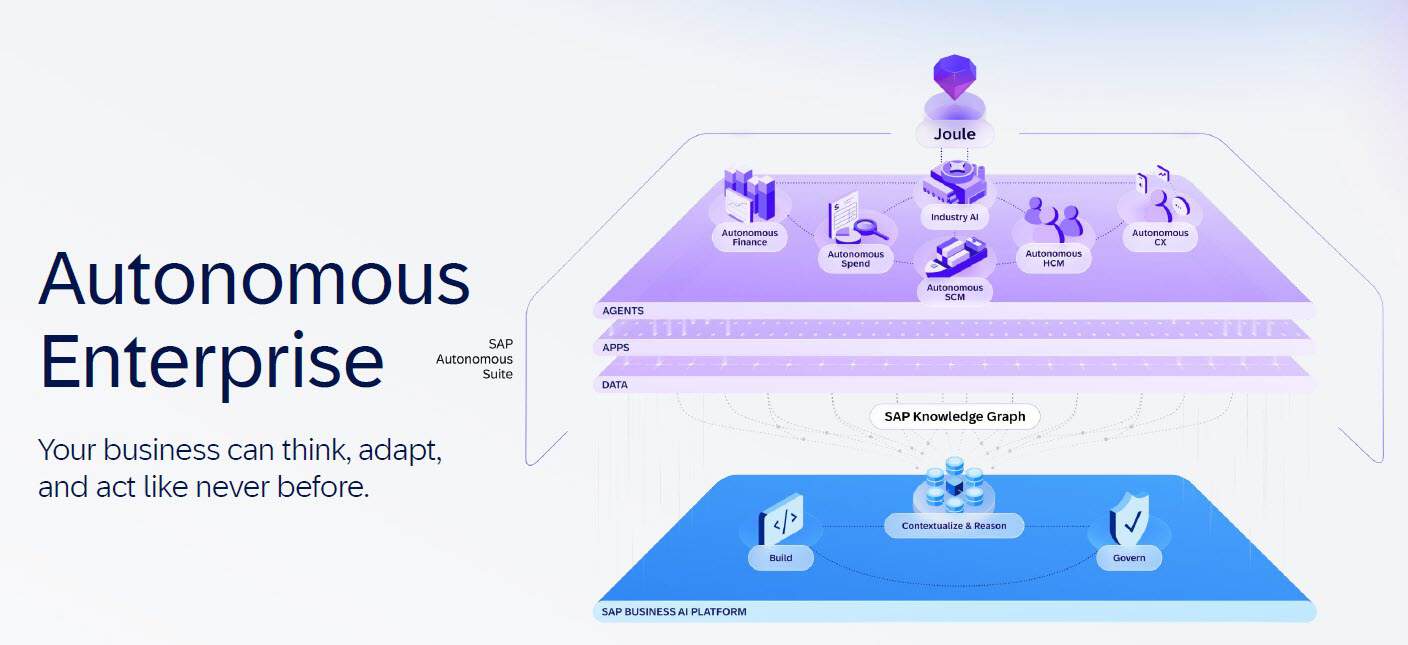 |
SAP’s ERP has five pillars: Finance, Spend, Supply Chain, HCM, and Customer. Under each element there are many agents, each interacting with the data fabric and SAP Knowledge Graph to access thousands of data elements and APIs. So as with Workday, agents can access any part of the system.
Unlike Workday, SAP believes in lots of smaller automations. There are more than 40 agents available in HCM alone, and these are grouped into “AI Assistants.” The plan by year-end is to offer at least 22 more, covering areas like pay equity analysis and other functions also discussed in HR 2030®. So SAP’s model is more built around AI automation specialists, which are then grouped into “Assistants” to help employees do higher level work. We call this a “Superagent” in HR 2030.
In another innovation, SAP plans to offer a “Workforce Planning” Superagent later this year, leveraging the task-intelligence engine they plan to acquire through Techwolf. (Read more on task intelligence here.)
For SuccessFactors, a key change is the promotion of Siva Sunderasan as GM and Chief Product Officer, and the promotion of Rebecca Carr as President of HCM Products.
Rebecca comes from running SmartRecruiters, which is now SAP’s strategic talent acquisition platform and Siva has deep experience at both Oracle and Peoplesoft. Together these leaders bring experience, depth, and innovative thinking. And for the first time in my visits to SAP, CEO Christian Klein talked about HCM as a strategic part of the ERP.
SAP understands that the AI transformation ahead is all about people and work, not just software.
SmartRecruiters, which is the new strategic platform for recruiting, becomes a technology base for more. It has its own agent “Winston” which can talk with job candidates, and is considered a more modern platform than SuccessFactors recruiting. So Rebecca and her team have free reign to innovate.
The big user story at SAP is the agent Joule Work. Unlike Sana, which is an entire AI lab located in Sweden, Joule is a product born and built by SAP. Originally built as an “do everything agent” to help users find and transact with the thousands of SAP interfaces, it’s now an orchestration and AI platform itself. It’s central to SAP’s long term strategy, so it compares very closely to Workday’s Sana, yet each are quite different.
HiBob, Oracle, UKG, Dayforce, Gloat, Darwinbox
Now these two large companies have enormous resources to pull this off. Is this story unique to them? Well no.
Other HCM vendors are experiencing a similar “rebirth.”
Oracle, the company that acquired Peoplesoft years ago, has built more than 1,000 agents into its ERP suite, and while it’s not the most adored platform the company is growing well. Oracle’s cloud revenue grew by 14% last year (similar to Workday) and the company is now focused on verticalizing its apps. In a move similar to SAP, Oracle is building out unique HCM solutions in healthcare, energy, utilities, retail, and defense. These are global industries where Oracle already leads.
UKG, the PE-backed company that combined Ultimate Software with Kronos Group, has done a spectacular job building agents to optimize workforce management. They now position their HCM as a “Workforce Operating Platform” to reinforce its new value. They are also growing at double digit rates, focused like a laser on the market for frontline work. Frontline work makes up 72% of the US workforce, so this is a hot market ripe for operational improvement. (Details here.)
Then there’s HiBob, the fast-growing “Instagram of HR,” which now has 5,500+ customers and is growing at 30% or more. HiBob is a new architecture HCM designed for “people management,” not HR, and has recently announced 7 Superagents and the high powered “Bob Assistant” powered by Galileo. They have moved beyond HR and now sell an operational management platform for companies as large as 5,000 employees. HiBob just received a $166 million investment from Salesforce Ventures.
Dayforce, once known as Ceridian, is also growing and recently went private to fund its expansion. They, like UKG, are well established in workforce management and have launched a series of agents as well. And new offerings like Gloat AI-Native HCM and Darwinbox Cortex are also bringing AI-native HCM to their customers.
What does all this mean? It means smaller startups are going to have a hard time. Yes, this is a huge market with room for innovation, but now that HCM vendors are central and strategic again, more and more customers will select their agents first.
The New Front Door to Work: A Massive Paradigm Shift
Let’s talk about the biggest change of all: making these systems useful for daily work.
Since HCM is now an “agent development and management” platform, we want more employees and managers to use it. And this is a massive change in the market.
If you look at Workday’s 80+ million users and SAP’s 120 million+, you find that most employees barely use the system at all. An employee may use it to check their vacation balance or review their 401k, but that amounts to a few times per year. And the learning and performance tools have been fairly hard to use, so companies buy LXPs and other tools to sit on top.
Those days may be over.
In the new HCM world, where “AI is the new UI,” these platforms become a center of employee application development (often called “employee experience”). Why? Because all the data, context, and important information an employee needs to manage their career, grow, schedule their time, file an expense account, or find information is right there! Fully protected, security-authorized, and managed.
I don’t think Workday or SAP fully grasp this change yet, but it’s clearly coming. This means the active users of these systems could go up by 10-100 times, to say nothing of the new agent activity we expect.
We have already catalogued more than 240 business use cases in HR 2030 for employee needs, and I’m sure companies will build more.
What about building employee apps in ChatGPT, Microsoft Copilot, or Claude? Of course that will happen, but these apps need authentication and data from the back end. If HCM vendors stay focused, many of those employee agents get built directly into Sana, Joule, HiBob, itself. And most of the vendors now have managed interfaces to Claude as well.
In the corporate market the big competitor may be ServiceNow, who recently released an amazing new manager and employee agent platform (Employee Works). But even they have to connect to the HCM system of record, so if Workday and SAP are shrewd, more and more “manager and employee workflows” will go into their platforms, not necessarily into ServiceNow.
Here’s more detail.
Workday’s Sana
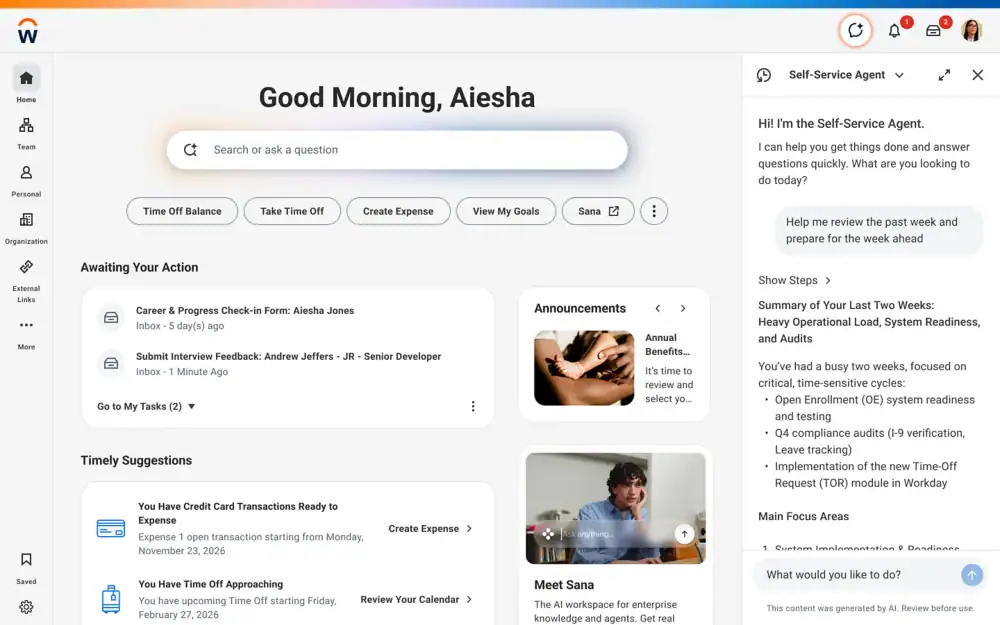
Workday replaced its entire user experience with Sana, which is an elegant “what do you want to do today” interface anyone would love. They’re also using Jev (by Typesafe.ai), a lightning-fast technology for instant answers which bypasses the need for an LLM. This means it’s milliseconds fast, fun and interactive, and almost free from a token standpoint.
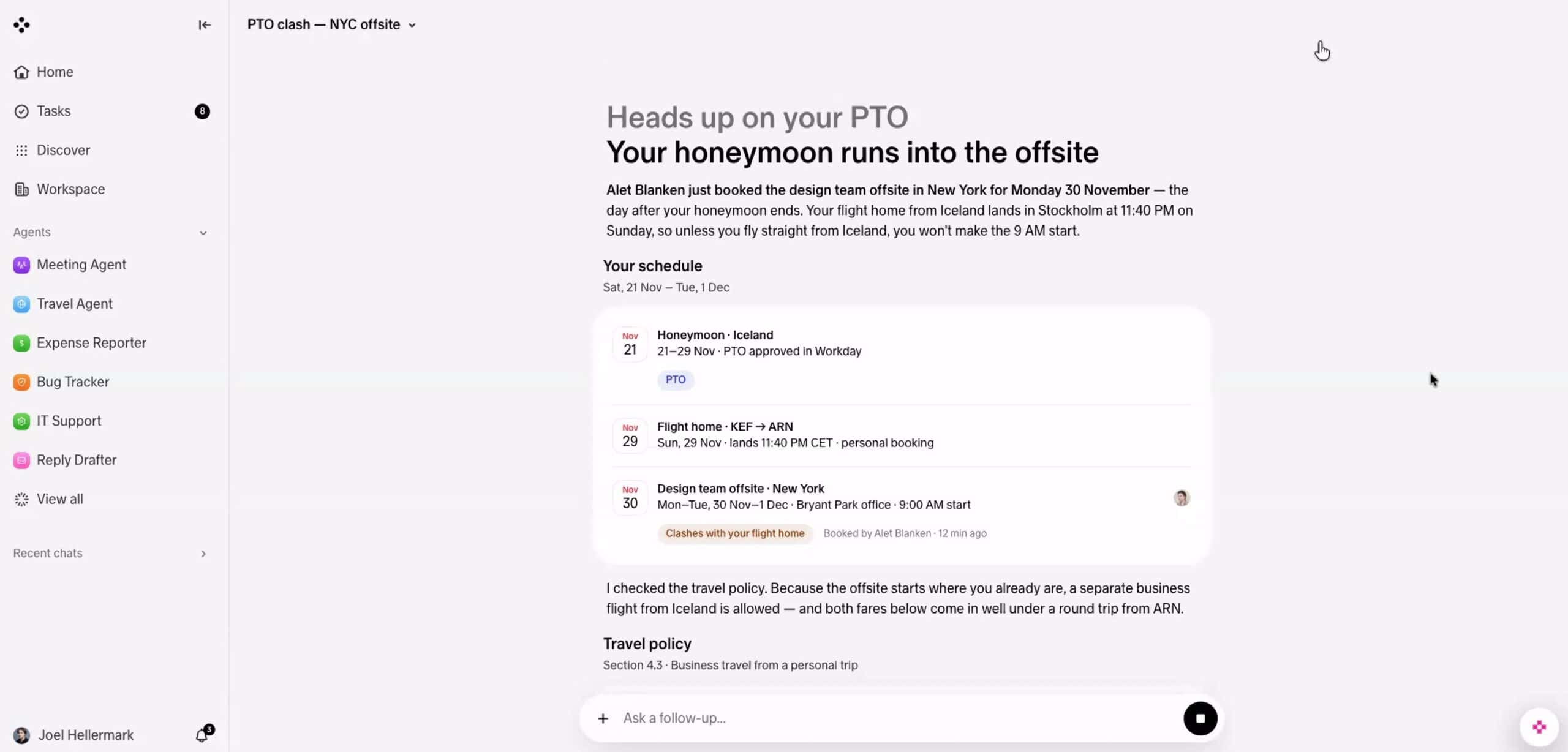
Workday also introduced Sana Concierge and Sana Coach, which give any employee an interactive, fast toolset for answering questions, booking time off, filing expense reports, as well as managing employee check-ins, doing performance reviews, and building development plans. Our product Galileo will also be embedded into this experience, starting in late this year.
The UI experience is beautiful. Here’s an example of Workday Concierge.
 |
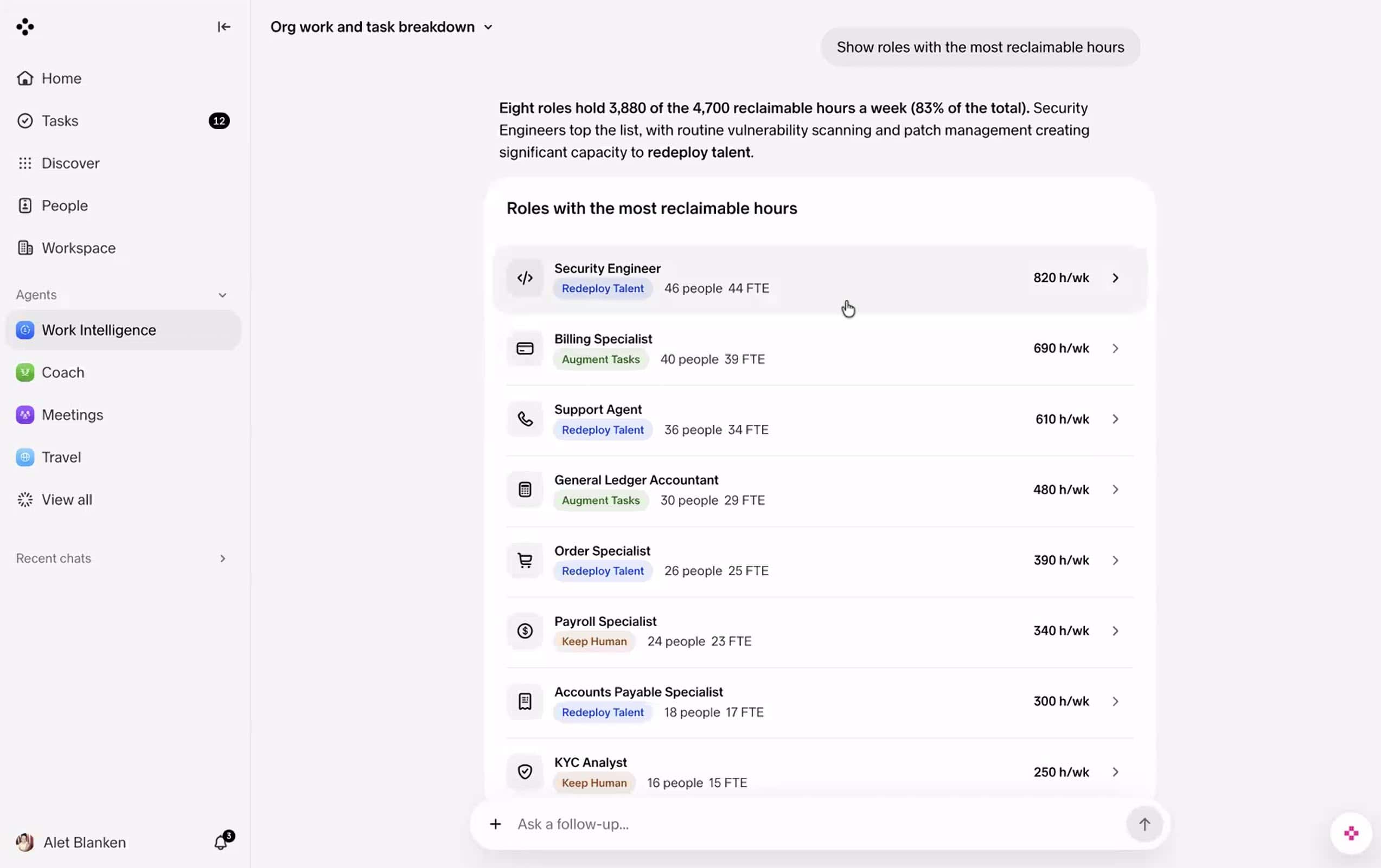
Here is the “Work Intelligence” module within the Workday Decision Intelligence Agent.
 |
Workday also introduced a comprehensive Developer Agent, which is a tool that seems as easy to use as Microsoft Copilot, with in-depth functionality for professional developers.
Any Sana agent you build is “lawful” through the use of Workday’s Agent System of Record, Agent Gateway, and the new Agent Identity platform from C1.ai. And a new feature for “Autopilots” means that any agent you build can be “ambient” and always-on. (In HR 2030 we call that a “monitoring agent.”)
 |
Workday now comes with Sana Core built-in, and you can upgrade to Sana Enterprise to get interfaces to dozens of third party systems like Microsoft, Salesforce, Dropbox, Slack, Google Docs, and others. So again, IT teams may think of Workday as “the primary employee agent” for work.
Workday also launched a tight integration with Claude, so you can use Claude as the front-end agent in a lawful way, and I expect the same with Microsoft Copilot will also come.
And while it wasn’t promoted, Sana Learning continues to be the leading AI-native learning platform in the market. Workday is merging Sana Learn into Workday Learning, which may or may not play out well – but nevertheless you can “generate learning experiences” dynamically from any content using Sana. (We bundle Sana Learning with Sana Agent in Galileo Suite.)
SAP Joule Work: A Different AI as UI
SAP customers have the same challenges as Workday. There are thousands of commands and interfaces in SAP, and many come from acquired applications.
In an ambitious effort SAP launched Joule Work, an impressive “front door” in its own right. While it’s not a complete harness like Sana, you can see that’s where it’s headed. Right now Joule Work is an extensible, trainable AI agent and orchestration platform that leverages the SAP Knowledge Graph (a fabric layer that brings all the SAP applications and data elements into one place) to let a user ask any question, transact, and get answers.
The interface includes conversational work and user workspaces called Spaces, and it also has a growing ability to access third party applications through MCP or A2A. The system can execute workflows, so it is an application platform in its own right.
Joule Studio is an impressive development environment that lets end-users or professional developers build simple or very complex applications. In many ways Joule Studio is the dream tool set that ABAP or Cobol programmers have wanted for decades.
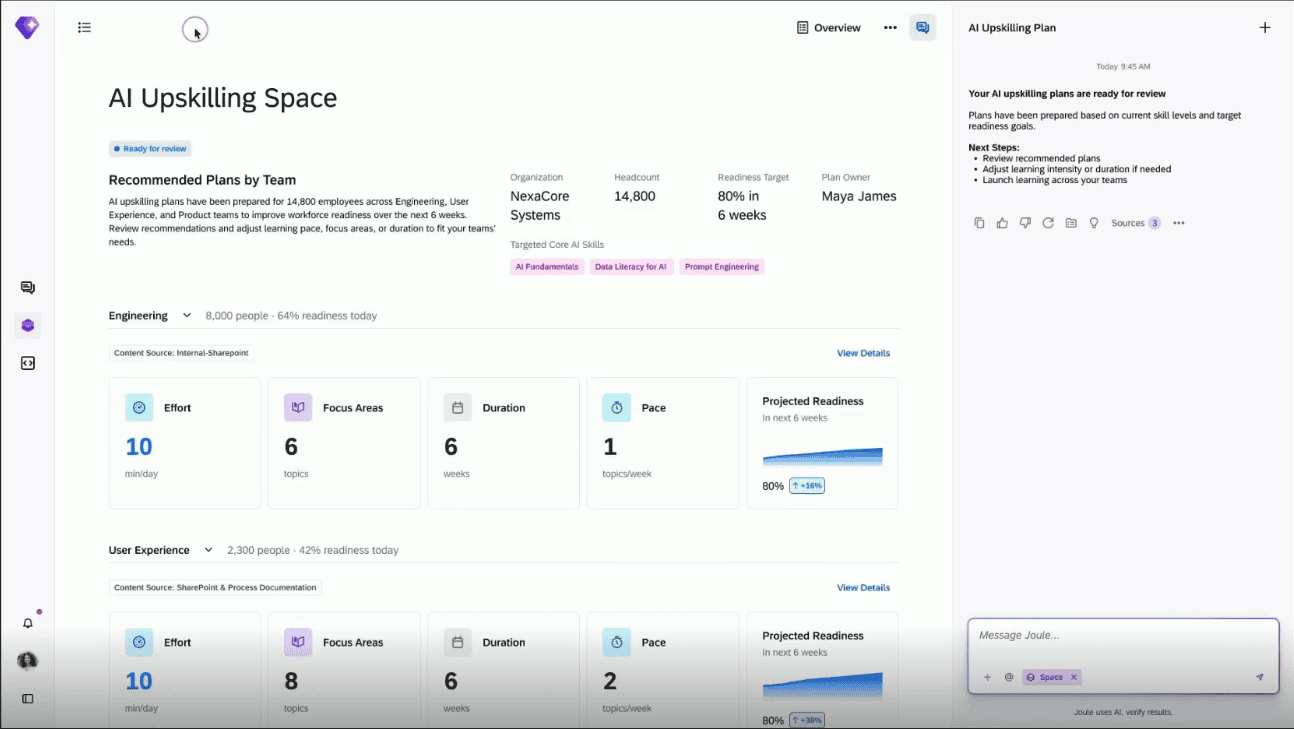 |
I wrote about Joule Studio a few months ago and it’s mind-blowing what it can do. This includes “intent-based development,” which means “talk about what you want the new agent to do and Joule will prompt you to build it.” The demos are impressive, and every developer has access to the library of 1,000+ data elements and objects in the SAP application suite.
SAP is also prototyping a tool similar to Workday Work Intelligence Agent, using the newly acquired technology from Techwolf. This type of “task analysis” is becoming more popular, and while I don’t think it applies to all problems, it’s a new way of thinking about workforce planning. As I discuss in the podcast, every agent and every token is a “unit of work” so if we do break work down into tasks, we could more easily find ways to apply AI for scale. (Here is more detail.)
Agent Management, Safety, Monitoring, and Identity Tools
As mentioned above, Workday and SAP are each developing enterprise platforms to manage, govern, and monitor AI agents. They recognize that as companies deploy thousands of agents, companies need to know which agents exist, who owns them, what they are authorized to do, how they behave, what they cost, and whether they produce measurable business results.
I believe the two companies are approaching the problem from slightly different directions.
Workday sees agent management as an extension of workforce management, considering an agent as an “intelligent actor” at work. SAP, through its process roots, sees agent management as part of enterprise architecture and business process management.
Workday’s central product is the Agent System of Record (ASOR), supported by its Agent Management Hub and Agent Gateway, complimented by Agent Identity management by C1.ai. SAP’s central product is the SAP AI Agent Hub, built on LeanIX and connected to SAP Cloud ALM, Signavio (process mining), and Cloud Identity Services.
Both companies want to manage agents developed by other vendors, not simply their own. Both want to become a system of record for the enterprise’s agent population.
Workday, conceptually, is managing agents like a digital workforce. In other words every worker should have an identity, an organizational purpose, a set of responsibilities, appropriate access rights, and a managed lifecycle. Workday is extending this model to AI agents. (Read our HR 2030 technical paper on multi-agent architectures for more.)
Within the Agent System of Record a company can register an agent, define its capabilities, configure its access, activate it, monitor its activity, and deactivate it when no longer needed. An agent has a profile, a set of skills, and security permissions. And Workday’s architecture supports both its own agents and externally developed agents, as long as they integrate with the Agent Gateway.
The Agent Management Hub serves as the administrator’s control center to view available agents, their configuration, security, usage, and lifecycle status. Workday’s security model distinguishes between an agent acting independently, called ambient mode, and an agent acting on behalf of an employee, called delegate mode. In delegate mode, the agent operates within the employee’s permitted access; in ambient mode, the agent uses its own assigned permissions.
For example, consider a recruiting agent that handles candidate screening, schedules interviews, and prepares interview summaries. Workday could evaluate the agent alongside recruiting workloads, recruiter capacity, organizational roles, and the cost of hiring. This creates the foundation for managing a blended workforce of employees and AI agents.
SAP starts with a different problem.
A large multinational company may have hundreds of enterprise applications, thousands of business processes, and agents built on SAP, Microsoft, ServiceNow, Google, AWS, or internal platforms. SAP’s position is that these agents cannot be managed effectively without understanding the business systems and processes in which they operate. This is why SAP built its AI Agent Hub on LeanIX, the enterprise architecture management platform it acquired in 2023.
Rather than looking at agents as digital workers, SAP treats them as enterprise technology and business-process assets. Each agent can be associated with an owner, an application, a business capability, a process, a risk category, and a governance status. So SAP inventories not only AI agents but also large language models and MCP servers. These are important because an agent’s behavior may depend on the model it uses and the tools or data sources it can access.
Imagine an agent that automatically resolves procurement exceptions. SAP would allow an enterprise to identify the agent’s technology dependencies through LeanIX, examine its execution behavior in Cloud ALM, assess how it changes the procurement process through Signavio, and evaluate its business impact.
|
Agent Monitoring and Safety
Given our worries about rogue agents, we also need monitoring tools. Here’s how these vendors respond.
There are three types of agent monitoring.
First, technical monitoring: Is the agent running? How often is it invoked? How long does it take? Does it fail? Are its actions authorized?
Workday uses ASOR, its audit capabilities, and Agent Gateway. SAP uses its AI Agent Hub architecture and Cloud ALM.
Second, process monitoring: Is the agent performing the right business activities? Does its behavior follow approved procedures? Is it creating extra steps, bottlenecks, or exceptions?
For example, an agent might complete a purchasing transaction successfully but bypass a preferred approval sequence or generate an unnecessary exception. Technical monitoring alone would not necessarily tell management that the process was suboptimal.
Third, workforce and business-performance monitoring: Is the agent improving employee productivity, organizational capacity, financial results, or customer outcomes?
This is where Workday has a particularly interesting position. Workday owns extensive information about employees, jobs, compensation, reporting relationships, workforce plans, and financial performance. It could use this information to analyze agents as productive resources alongside people. (SAP could presumably do the same.)
For example, if a team of 20 recruiters now handles twice as many requisitions because of AI agents, management needs to understand the change in productive capacity—not simply count the agent’s completed tasks. Workday is naturally positioned to connect these data sets. SAP’s approach, meanwhile, could connect agent performance to business process improvements and use SuccessFactors to incorporate organizational context.
Neither vendor has yet deliveed a system optimizes the productivity of a blended human-and-agent workforce across an enterprise yet, but I guarantee this is coming!
Why I Believe “HCM is Hot Again”
Let’s get to the bottom line.
AI-fueled agents mean that HCM is moving from a “system of record” to a “system for business re-engineering and growth.” As we detail in HR 2030, these new agent-ready, easy-to-use, easy-to-build platforms are going to change the market.
Imagine a scenario where your HCM system spots a low performing operation, assesses the skills of that team against others, designs a set of development or organizational changes, and literally “creates an agent” to inform the manager and upskill the employees. That same agent would also be able to advise on hiring plans and eventually support long term workforce planning, or even spot process bottlenecks that could be eliminated.
Yes, you’ll pay a token cost for this new service, but the upside is a major uplift in revenue generation and growth. And all the core data for this kind of example is already resident in the HCM.
There’s a $10 billion or more new business opportunity here, listen to the podcast for more.
Additional Information
Galileo® goes Enterprise: The Jupiter Release
HR 2030®: The New Architecture for Human and Agents
Our New Book: Superpowered: How AI Unlocks the Superpower of People, Leadership, and Teams