Affordability Is Not Just Inflation: It’s Time For A Historic Shift In Wages.
Fuel, transportation, housing, and food costs go up, but wage growth is far behind. Is this episodic or is there something bigger going on?
A NYT article explains that in San Francisco a combined salary of $370,000 is not enough to find a nice apartment. And this issue is national. For 2026 YTD gas prices are up by 24%, energy by 27%, airline fares by 26%, and fruits and vegetables by 5%. At the same time average private sector wages are up by 3.5%.
This impacts workers, families, and retirees.
“Unretirement” is a new trend. AARP found that 7% of retirees are unretiring, and 12% of seniors have returned to work in 2026.
Why are retirees going back to work? They cannot afford the costs of healthcare, food, and energy.
Given that we advise companies on leadership and HR, I decided to dig in. So as a micro-economist (we talk with large employers all day), I wanted to share my thoughts on what we, as business leaders, can do.

Yes, the cycle feels like an replay of the early 2000s when internet millionaires appeared and housing costs skyrocketed. Today we can include the cost of computers, phones, transportation, and fuel.
Why are wages so far behind? It’s not just an episodic issue.
The “high cost of living” has been almost 50 years in coming, and employers can help with the solution.
Here’s the data.
1. US Purchasing Power Has Been Dropping For Years
First, if you look at wages vs. inflation over the last 20-30 years you can see that real (after inflation) purchasing power in the US is dropping fast. Wages, measured after inflation, have only gone up by a few percent in the last ten years, while inflation has more or less soared.

Just to check, I looked at St Louis Fed, which looks pretty similar. This is a chart of “Purchasing Power” and you can see how it went down almost 40% over a similar period.

2. US Productivity Has Gone Up (as has GDP) For Years
Well I understand this issue, since I work in tech: over the last 30 years there has been a ton of technology invented, so maybe the problem is simply productivity is going up and CEOs and shareholders are “hoarding” the benefits and not passing them on to employees.

THis chart shows dramatically that productivity went up by 14% (this is a lot) while wages went up by 2%. So 12% or so of US economic productivity did NOT go to wages, it went elsewhere.
GDP Has been going up too, as the following chart shows.

3. Productivity Benefits Have Not Gone To Employees, They Went To Stocks
So where did the 12% of “non-wage” economic growth go? That number, by the way, is over $100 Trillion over 20 years, and it had to go somewhere.
It went to shareholders (ie. owners) of course. Thus the stock market grew and so did dividends and other corporate owners.
I asked Gemini to confirm and it did a great job. Here’s its answer:

So we as business people, in our quest to make investors and CEOs happy, have “minimized” labor as much as we can. And the stock market has done quite well.

(Paul Krugman, in his most recent podcast, blames the rise of the MBA and Harvard Business School for this.)
In other words, CEOs and CFOs, driven by investors (not employees or customers), have spent their profits on capital and automation, not increases in wages and employee benefits.
4. CEOs And Investors Have Been Rewarded
If you agree with this story so far, the next issue is CEO rewards. When stock prices go up, CEO pay goes up. So sure enough, the stock market (investors) are happy so we let executive pay more than double.

And now that we have AI we see more and more CEOs saying things like “if I just got rid of all these low-productivity workers our company would be so much better.”

So again, without thinking a lot about workers and wages, CEOs (and investors) are happy. (I’m a CEO and I have experienced this effect.)
In fact a new study by Equilar shows that the average CHRO pay is now $3.7 million, so average CEO pay is likely 2-3 times higher.
5. Federal Minimum Wage Has Not Been Increased
What else has happened? Well Federal minimum wages have barely budged. They’re more or less stuck around $7.50 per hour, which almost means nothing.

This is a somewhat new phenomena. Before 1980 the minimum wage was going up steadily. Ronald Reagan put a stop to this (“the government is the problem”), enabling wages to slow. (He was attempting to fight the inflation of the late 70s, also caused by oil prices.)

6. Labor Union Participation Has Plummeted
While we stopped increasing minimum wage (fear of causing job loss, which is proven not to be true), we also demonized labor unions. So Reagan and following administrations (until Biden) continued to fund programs like 401K and other “self-managing” ways to build wealth, and union participation plummeted.

Again I’m not trying to judge these decisions, just clearly pointing out what happened. A lot of the anti-union push was also to reduce inflation and also a push to increase corporate profits, which clearly happened.
7. Inflation Expectations Are Now Baked In
The final issue is inflation itself. There are many causes of inflation (supply shocks, US tariffs, oil prices, war spending, regulation, shortages in supply chain) but we’ve entered a period today where we’re well above 2% since 2021 and the pandemic.

So for about five years we’re all getting used to “continuous increases in price for food, gas, housing, electricity, and most other items.” So here we are now, after all this “disinflationary” business-first policy where most of us are no longer surprised when a single bag of groceries costs $30-50 or more.
The “inflationary expectation” has now been fueled by AI capital spending, shortages of chips and memory (Apple prices up 20%), and many other areas of the economy getting pricier. This is why employee satisfaction with pay is the lowest it has been since 2014 (Fed Reserve Bank of NY).

Net: A High Cost of Living Has Become Systemic
So here we are, with inflation over 4% again, and families and young people simply do not see a way to keep up. I think the growth in gambling (prediction markets), stock market (Reddit /wallstreetbets) and ever more speculation on bitcoin, gold, and whatever else comes along is simply people desperately saying “I need something, anything, that might help me keep up!”
Of course US Tariff policy, War in Iran, and highly uncertain federal government isn’t helping. So CEOs are just not comfortable raising wages (much) and we’re stuck in this rut where prices go up, people gamble, and purchasing power wanes.
What Can We Do?
I’m not a policy maker but I do know a lot about business. So I advise the following.
1/ If you’re a manager or leader, think more seriously about paying people well.
Is labor simply an “expense” to be minimized? Absolutely not.
If there’s one thing I’d change in the business world is the fact that we don’t capitalize wages and labor. In reality labor cost is an investment. In fact of all the investments we make, people are the only true “appreciating asset.” The more we train and engage people, the more they can do for customers and the business.
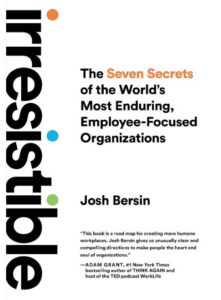 I won’t get on my soapbox but the research I did for Irresistible (my book) shows precisely how taking care of employees (including paying them well) leads to outperformance in growth.
2/ Stop or slow hiring and focus on improving the capabilities of the people you have.
Even with AI, you’ll need and want to keep your existing workers.
All our studies of AI (hundreds of case studies) show that the real benefit is not headcount reduction, it’s increase in speed and scale.
Most code-generation projects don’t immediately eliminate engineers, they let you build software faster. Once you pay for the tokens and other AI costs, you then need engineers to design, test, and scale the systems you have. AI productivity is not “headcount cutting” its “superworker creation” (as our new book will explain).
This means you can use the productivity to increase pay, not cut cost.
The buzzword here is “Talent Density.” Rather than think of a person as an incremental set of hands to do work, we must now think of each individual as a highly skilled, improving, learning asset. Rather than replacing people when a business unit slows, we train and redesign roles to constantly improve productivity.
Our 4R model (recruit, retain, reskill, redesign) model explains this. By slowing the churn of hire, fire we move to a model of “enablement for growth,” and wages for everyone can go up.

3/ Consider pay an investment, not an expense. Higher wages pay off handsomely.
I know wages are an expense, but if you pay people well a bunch of amazing things happen.
First, you attract the best, brightest, and most ambitious. So your talent pipeline gets healthy.
Second, your retention and redeployment goes up. When you pay fair or above average pay your people hang around. And when you ask them to move and do something new, they lean in and reskill themselves.
The cost of replacing an employee is often 2-3 times their annual salary (when you factor in loss of knowledge, loss of customer relationships, culture damage, and cost of search, hiring, and onboarding a new person). Keeping the people you have, with appropriate incentives and goals, lets you raise wages and improve productivity.
4/ Invest in internal mobility, it builds company dynamism and gives you funds to invest in people.
It’s expensive to hire people (and then lay many of them off later). As we’ve learned, if you’re not in a high turnover industry (ie. retail, food service), the cost of leaving a position open, recruiting, and hiring can be 50% or more of a worker’s salary and you’re losing the opportunity cost of getting work done. One solution is to build a culture of internal mobility.
Enduring companies redeploy talent as often as possible, which improves engagement and gives you human capital dollars to invest in wages. PwC’s 2026 CEO study found that companies who redeploy talent at the rate of 20% or more of their workforce each year are 27% more profitable over a long period of time.
So this is a very powerful practice among well run companies.(Don’t use younger tech companies as an example here, they tend to be more “churn and burn” cultures.)
Bottom Line: We employers have a responsibility for affordability.
It’s easy to blame the minimum wage, union bashing, or tax policy for the wage-price disparity. We as employers also play a role.
Companies that pay a fair, above-average wage (ie. Costco) outperform their peers. And they’re more profitable for the reasons I stated above.
And if you don’t believe me, this week the WSJ described how Costco’s “above average” pay has let those amazingly friendly cashiers become millionaires.

As far as the US economy over the last 40 years, a new policy-making era may be coming.
I go back to the old Henry Ford idea that if he paid a fair wage he could create a massive market for his low cost autos.
If you think income inequality and affordability is a problem, vote with your investments and maybe you can help move the needle. Otherwise we may have to wait a long time for US economic policy to change.
The Definitive Guide to Pay and Benefits: The Road to Systemic Rewards
The Myth Of The Bell Curve: Look For The Hyper-Performers
We Wasted Ten Years Talking About Performance Ratings. Seven Things We’ve Learned.
Benchmark your Pay Practices With Galileo: The AI Agent for Everything HR