Why AI Is A Massive Job-Creation Technology, Despite What You Think
I am getting tired of reading stories about AI eliminating jobs. While AI does eliminate tasks and many routine activities, the real story is quite the opposite: AI makes jobs more interesting, more valuable, and ultimately more rewarding (financially and otherwise).
I don’t say this because I’m an HR and HR technology analyst, but because I see this happening every day. (My new book coming out this Fall will describe Superwork and Superjobs in detail.)
Why AI Is A Massive Job Creation Technology. (podcast)

Let me explain with examples.
First, let’s talk about software engineers.
This is a hot space and my research shows that almost 4-6% or more of the workforce is involved in design, coding, testing, maintenance, and integration of software. So this is tens of millions of people driving trillions of dollars of salary expense, tools, and important corporate projects.
If you read Anthropic’s “AI Exposure” research, which I’m not a huge fan of, they believe that almost 100% of their “work” could be done by an LLM, and that’s why Anthropic is essentially a code-writing engine.
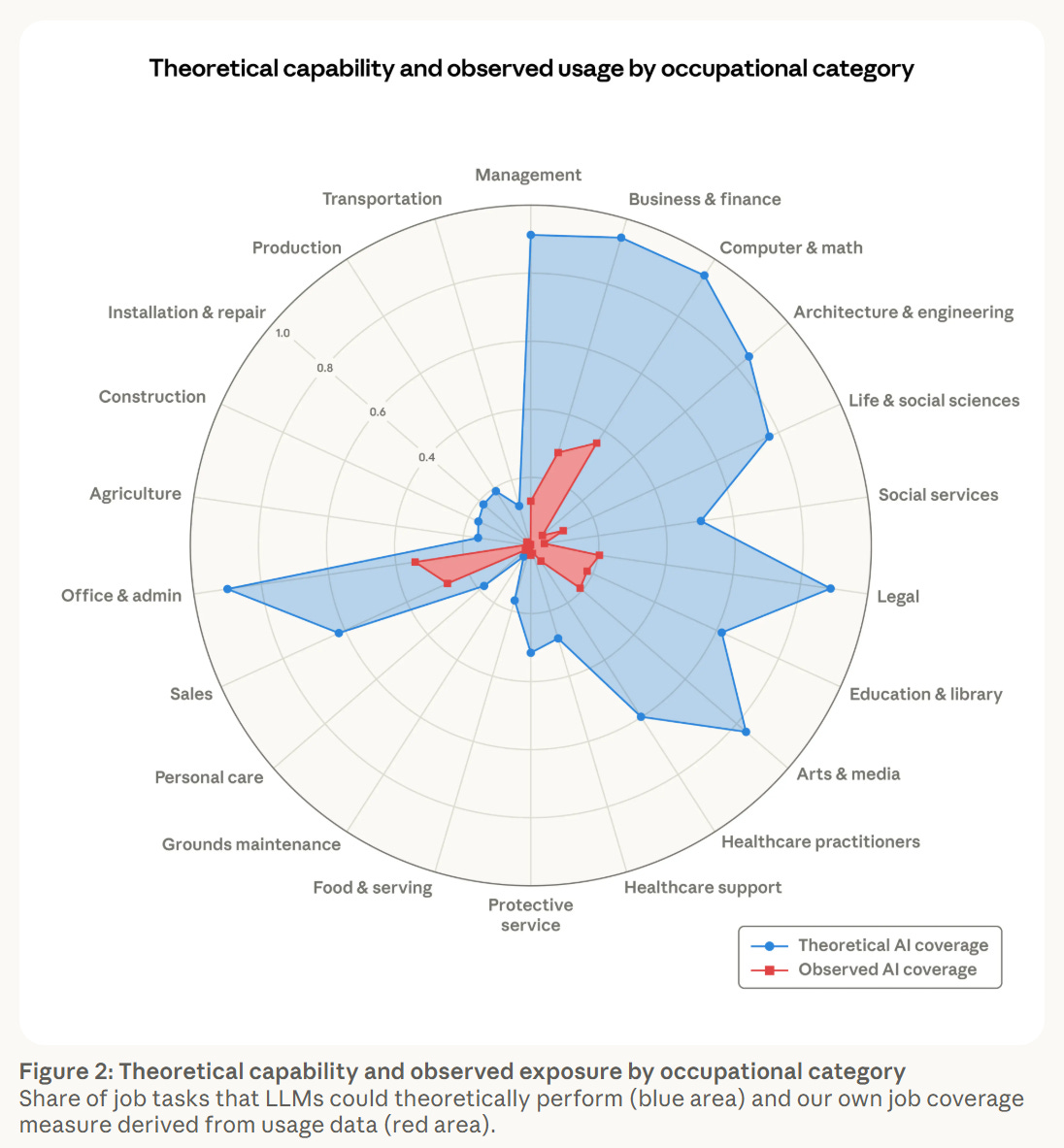
However, the reality is very different. While AI can spit out thousands of lines of code per minute, that isn’t really what engineers do! They scope and understand business processes, they design technology architectures, they refine use-cases, they create test beds, and yes, along the way, they write a lot of code.
Here’s the real data so far. Despite dire predictions on software jobs, the number of software job openings keeps going up! Data from Draup, a large labor market analytics company, shows that “software engineering” jobs have more or less remained the same, despite changes in periodic demand.
Here are global software engineering, design, and testing job postings from Lightcast.

The scale exaggerates the changes but you can see that “global jobs open” has not really changed much at all. In fact right now there are 650 “software engineering” or related jobs open at OpenAI alone, to say nothing of the hiring going on in every IT department as they shift to AI.
What IS happening is a change in the nature of the jobs.
If we look at the “trending vs. declining” skills in these jobs, here’s what we find. (Draup carefully analyzes skills in each job posting through an advanced AI model.)

As you can see, entry level “coding” and “testing” is slowly declining. This, to me, is similar to the end of the “steno pool” (typists) in the 1970s and the end of the “secretary who answers the phone” in the 2000s when we all got answering systems and mobile phones.
How do these new Superjobs manifest themselves? Let’s take a look.
New Superjobs include “full stack AI engineer” or “GenAI engineer” and AI/ML product engineer. Job titles which are being replaced are more general coding, testing, and QA.

How about salaries? They’ve gone UP!
As you can see, over the last three years software salaries as a whole have more than doubled in 15 years and gone up by over 15% in the last year. So thanks to AI, software engineering pay is accelerating.


How About Healthcare Workers?
Let’s take another example, one that has been studied for decades: X-Ray techs.
Ten years ago, as digital imaging became popular, many economists predicted that X-Ray technicians and diagnosticians would become obsolete.

It made sense.
With the same approach Anthropic took, analysts said “reading the scan” will be done by machine and the system will learn how to find cancer, damage, and other problems through AI-powered medical image analysis.
I can’t argue with the paper, but again it misses the point. We already know, going back to the invention of fire, that new technology changes jobs. But it does not change the human motivation to “add value.” So again let’s look at what happened.
The number of job posts keeps rising. In fact Lightcast data shows that year over year job postings for imaging and medical diagnostics are up 35%.

Let’s look at salaries. They’ve steadily climbed also (not as fast as software engineers, but you can see they’re significant).

What about skills?
Well again we see the same thing. Now that the AI does initial diagnostics there are many new roles in data management, patient care, and others. Again, let’s look at Draup data.

In this case the job has also become more “full-stack” and more focused on human communication, time management, and patient care.
But there’s more! AI has created scale and reduced cost.
The cost of imaging has decreased (when compared to the soaring cost of other health services) and the volume has skyrocketed. Here are the studies.


So to simplify the story, AI has created scale and cost-efficiency. And this doubling in demand has NOT resulted in the elimination (or even reduction) of human labor.
An anecdote: I recently went to the doctor for a nagging cough and asked her to listen for pneumonia. After hearing nothing she said “let’s get you in for an X-ray to check.” (I told her I had suffered from pneumonia before.)
She zipped a message into her terminal and told me “they’re waiting for you now.” I walked around the corner and a very pleasant nurse helped me through the simple procedure and said “you’ll get a call with the diagnosis.”
Believe it or not I got a call in the car driving home telling me all was fine, not to worry.
No waiting in line, no complicated machines, and no patient waiting for results.
I’d say my doctor and my imaging specialist are both Superworkers now.
What Is A Superworker and Why Does This Happen?
Almost every tech CEO (except Jensen Huang, I might add) thinks AI is going to destroy the job market. As I’ve learned through 25 years of research (and my own 40+ year career), technology does not “eliminate” jobs. It changes them.
We’ve seen this for centuries. The US unemployment rate has hovered around 4.5% for many years, demonstrating how well we humans adapt to change. And your job as a leader is to facilitate, support, and drive this change.
Now I’m not saying job disruption is easy. Many people are happy doing what they know so when a young whippersnapper comes along they don’t react well. But this is a failing we can all overcome. And here’s why.
We, as human genetically powered creatures, are enormously more powerful than AI. We may not calculate as fast, but we’re wired with hundreds of millions of years of genetic learning ability. We adapt unlike any creature ever created (except maybe those darn cockroaches). And this time is no different.
And not only are we learning animals (watch a baby learn to walk, talk, and read and you’ll experience this magic), we are also “value creators.” In other words we are instinctively able to “make things better” over time.
Yes we have our flaws (many would challenge if the US is making the world better at the moment), but we always try. And that’s why businesses exist. We, as leaders, are wired to fix problems, find solutions, grow our value, and change when times are tough.
Look at how we adapted to the pandemic. Watch someone with a disability or chronic disease find ways to adapt, thrive, and change. I meet professionals and peers all week who are constantly searching for ways to make their companies better. It’s our nature and our role.
Technology, and AI is no exception, is just one more way to innovate. Whether it’s OpenClaw, the self-driving car, biologics that repair our flaws, or just better ways to run our companies. There’s no limit to what we can do.
So that’s my thesis and I’m happy to debate. AI is NOT going to create unemployment. It’s going to reduce many “drudgery” tasks we took for granted and liberate us to do more. Think bigger. Scale higher. And grow – grow our companies, our careers, our god-given strengths, and our lives.
How to Learn More
Our podcast (2-3 episodes a week now) is filled with stories, vendors, and tech discussions on this stuff.
Come to our amazing conference (Irresistible 2026) on June 8-10 at the beautiful USC campus to meet other leaders and discuss these issues.
Read our research and debate. We put ALL our research, case studies, and models in there – and we update it every day. It’s like the Bloomberg Terminal, Encyclopedia Brittanica, and HR Expert with new research, vendors, and case studies every day. . Get Galileo for yourself. Our entire 2026 AI Imperatives research is all in Galileo.
Dive into our Superworker studies.

Read my 2012 article “The End A Job As We Know It” for further background.