New Research: How AI Transforms $400 Billion Of Corporate Learning
Everywhere I go people talk about reskilling, upskilling, and accelerating the adoption of AI. This week I met with more than 200 CHRO’s in India and Singapore and the #1 topic was AI readiness: how can we accelerate AI fluency and capability in all areas of the company?
Well we’ve been studying corporate training for years and I have a surprise for you. Our entire approach, philosophies, tech stack, and operating models for learning are out of date.
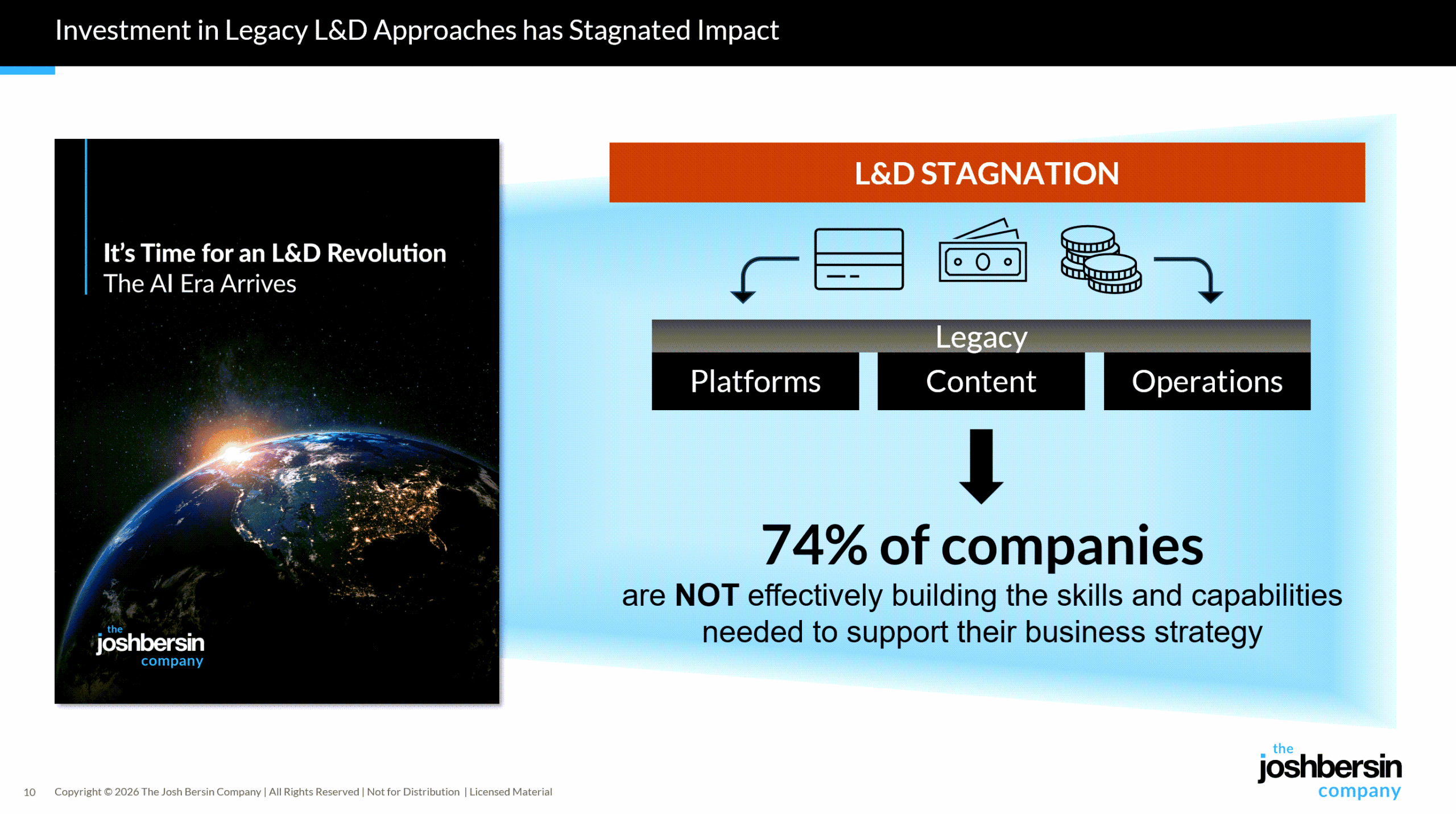
 This week we launch our fifth major study of corporate L&D and the results are staggering: 74% of companies tell us they are not keeping up with their company’s demand for new skills.
This is a shocking statistic. Businesses spend $400 billion on training, content libraries, L&D technology, trainers, and learning consultants. If three-quarters of them are not keeping up it says we have billions of dollars of wasted effort.
Well there is an answer, and it’s all about redefining the problem.
Our skills challenge at work is not one of “learning” or “training.” Rather it’s a problem of dynamically sharing information, enabling people to explore, question, and apply new ideas. The traditional pedagogical paradigm of “training” is holding us back.
 |
The Research We’re Introducing
As with all our major studies, we surveyed and interviewed hundreds of companies, vendors, and senior leaders. Our hypothesis, as we describe in The Revolution of Corporate Learning, is that AI is poised to totally reinvent how organizations learn.
Now, as we launch the final study, I can attest that this is true.
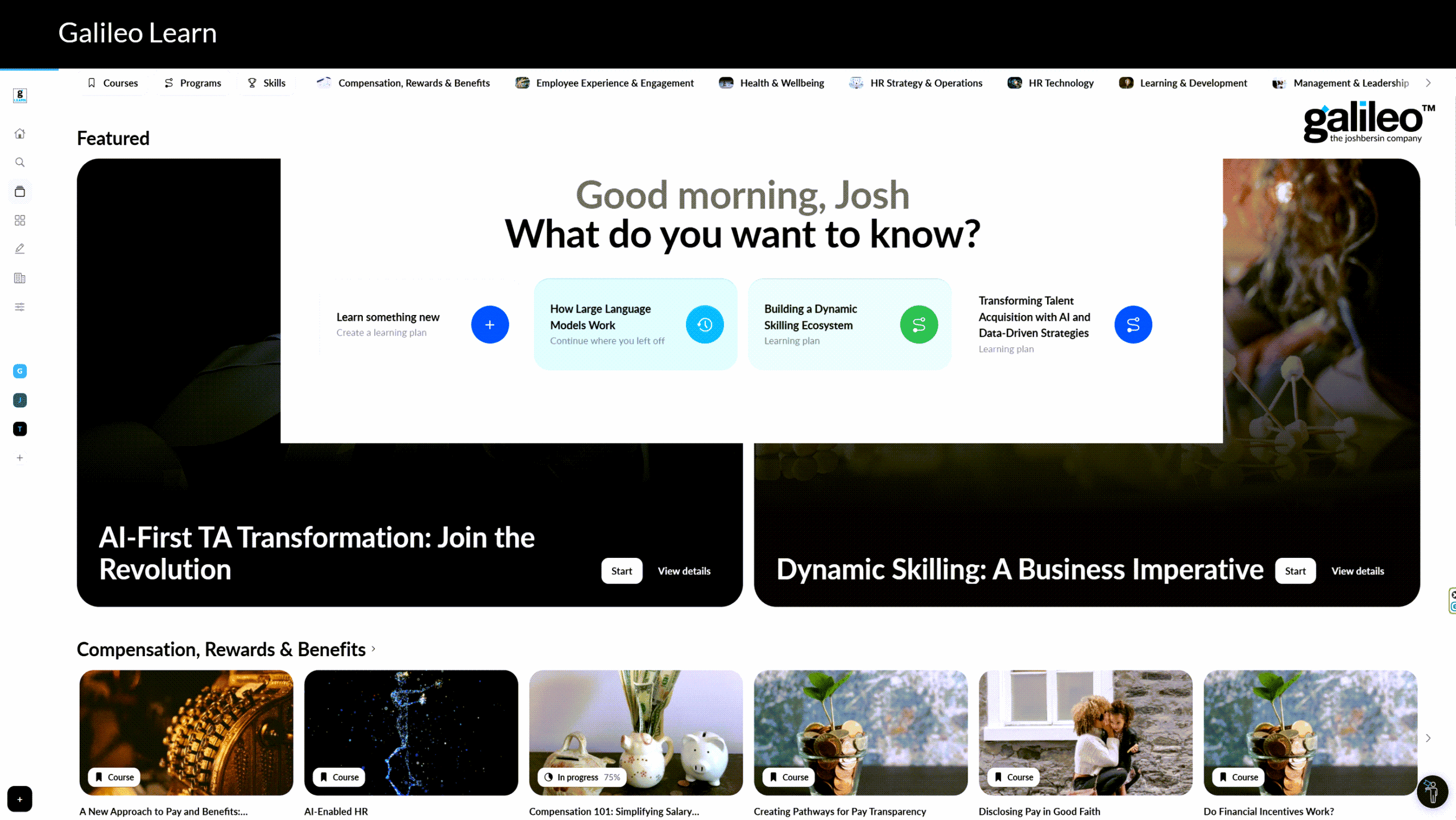
AI-native systems, which share and generate content dynamically (and systemically), are able to reinvent the way we train, upskill, support, and “enable” people. And this new world, which we’re delivering to clients today with Galileo, is poised to redefine L&D, HR, and all aspects of organizational change.
 |
What is AI-Native Learning?
Generative AI, by nature of its dynamic content generation, is the perfect technology for learning. Rather than manually design, build, and publish courseware (which is static and must be updated, translated, and regularly improved), the AI platform builds content dynamically, making it available in any form you desire.
Using Galileo (built on Sana), for example, we can build new courses in days instead of months, and each time we introduce a new topic the entire system can use the new content. This means employees can:
- Take a course (if they choose)
- Ask a series of questions or queries for examples (using the Supertutor)
- Ask the system for a podcast or video or infographic
- Simply chat with the Supertutor to ask questions, get examples, or dive into details.
The system automatically categorizes all content into “skills” (we specified the skills taxonomy) and as employees use the system it automatically infers their skill level from their activity.
And best of all, every object in the system is connected – so you don’t have to find a course to answer a question. Each time new content is added the entire library is updated, so it functions like one “intelligence system” about your company.
Consider this: among the 900 million people who use ChatGPT each week, roughly 60% are learning something. That level of activity (ie. success) has never been reached by all the course catalogs ever built. The paradigm really works.
And there’s more. We’re working with clients who regularly interview experts and simply publish recordings into Galileo. This makes the system smarter and current with new information, tips, and findings.
It’s a miraculous application of AI, and I believe it’s likely to result in a trillion dollars of business improvement.
But how do companies get there from here?
Four Levels of Maturity
Let me share our newest Learning Maturity Model, which we built over the last year of research.
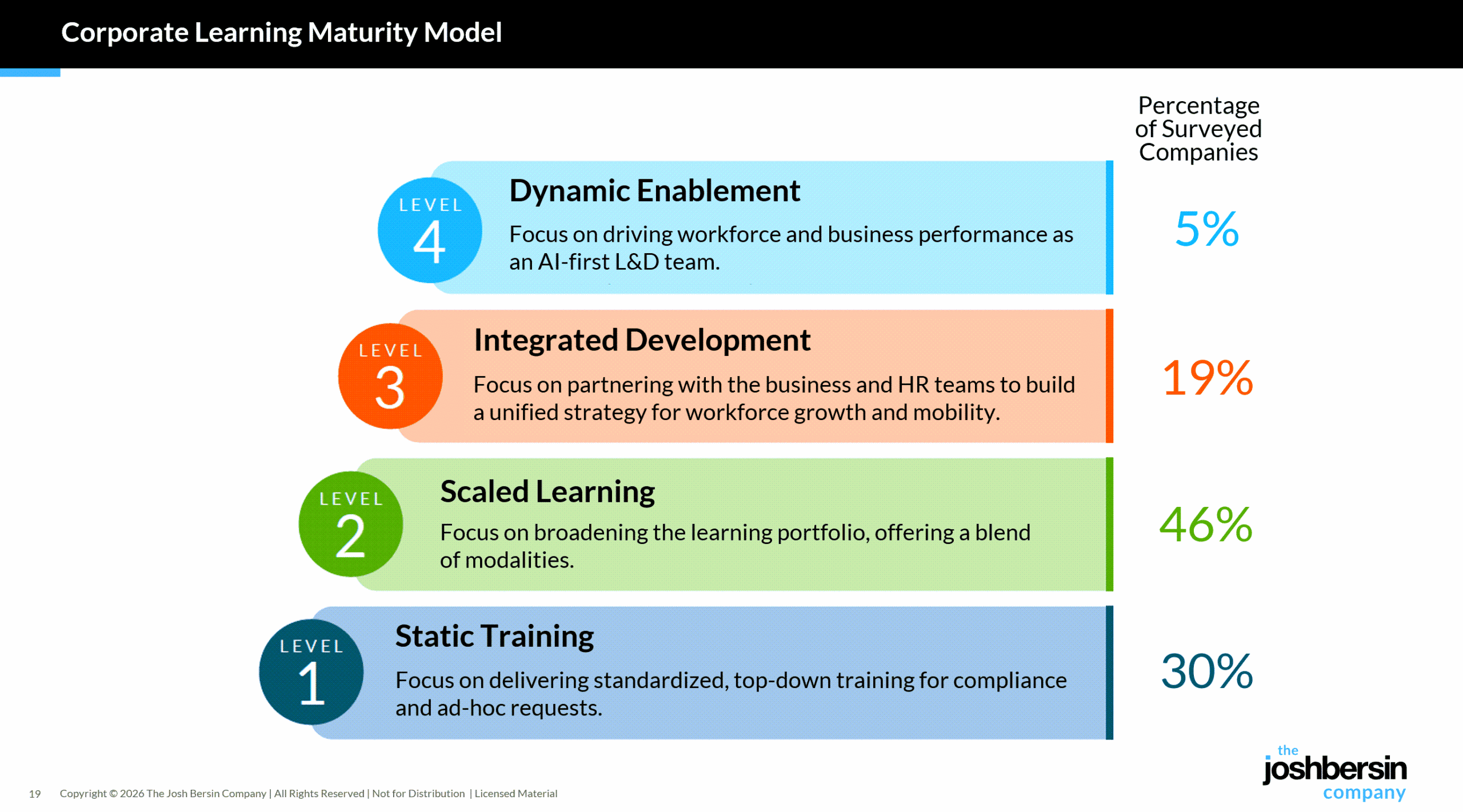 |
Most companies start with Static Training programs (Level 1). The company builds or buys “trainings” (in the form of courses) to enable compliance-based or top-down mandatory completion. This makes up almost a third of the market, and these companies often focus on compliance, new product launch, or something else episodic in nature. At level 1 there is very little skills-based learning but the programs are cheap to buy or build and they help people stay current on things that are new.
As soon as this begins, however, another 46% of companies add other formats to build Scaled Learning (Level 2). They build videos, audios, job aids, and a myriad of other “learning tools.” These broaden the portfolio to give people more options, and they often rely on the media and interactivities built by content vendors.
Most of the offerings from LinkedIn, Coursera, Skillsoft, Pluralsight, and others fall into this category. The training is more extensive but it’s up to the learner to figure out what to consume and when. And that then leads to Level 3: Integrated Development.
At Level 3 companies tailor learning programs around job roles, skills, and career paths. Here the company builds “development programs” not just training, and complexity starts to set in. At stage 3 you wind up with a multi-dimensional mess of technical skills, professional skills, job roles, and job levels to deal with.
Level 3 looks good on paper, but career paths and topics are changing all the time, (LinkedIn states that 70% of all job-related skills go out of date each year), so it’s very hard to maintain. Nevertheless for channel training, technical education (ie. certification), and people new to a role, this approach makes sense. Few if people go through all these pathways, but they’re there for those who have the time.
When companies reach level 3 the size and cost of L&D goes up. Now you’re building, maintaining, and refreshing dozens of programs, curricula, skills models, and content objects. Companies that reach this point (Cisco or Ericsson, for example), wind up with a huge mess of activity. It’s easy to get out of hand. And that leads to the issue of Operating Model. Who maintains what?
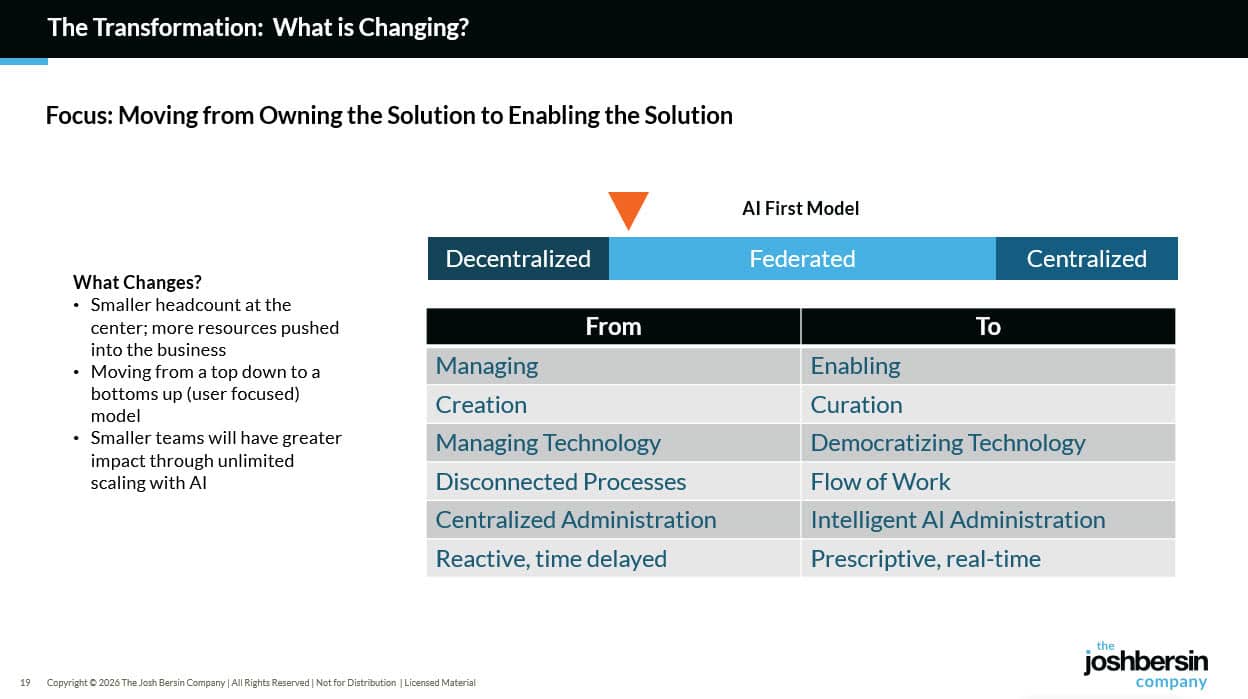
Corporate Learning (L&D), unlike most of HR, is a totally decentralized domain.
While corporate trainers hold the keys to strategic corporate programs, at least 70% of training is localized into sales, manufacturing, customer service, and other specialized domains. This is why we built our HR Academy: each functional domain is unique, specialized, and needs locally updated content. So the effort, content licensing, and infrastructure at the core takes money away from training needs at the frontline.
This forces many level 3 companies to shrink the size of corporate L&D to fix this, essentially delegating line of business training to others. This creates a more complex but far more scalable
“federated” model of training.
Well now we can move to Level 4, where AI transforms everything.
Imagine a platform that houses all the “knowledge” in your company – some in the form of courses but others in the form of documents, policies, and even audio or video interviews with experts. Do you call this a “learning platform” or is it much more?
That’s what AI-Native learning is all about, and we see it cross into a new domain: one we titled “Dynamic Enablement.” L&D can publish information in days instead of months, and each employee can learn in any way they want.
Most companies maintain their LMS for older compliance programs, and the new AI platform replaces the LXP, learning portals, and most of the content development tools. Our early clients are already experiencing up to 40-50% reduction in L&D internal spend.
 |
Bottom Line: Enormous Savings, Impact, and Alignment with the Business
The bottom line is simple: enormous savings in time and money to deliver learning solutions and an exceptional new experience for employees. And as our new Systemic HR AI Blueprint points out, now learning can be embedded into every corporate chatbot or agent in the company.
You’re filling in your forms for benefits? Ask a question about how the benefits compare. You’re entering a new opportunity into Salesforce? Ask the system to coach you on selling into this industry. You’re logging into your station as a nurse of manufacturing worker? Ask the chatbot “what processes have changed and what’s new in our department.”
One of our clients, a large travel reservations company, is using call recordings from top customer agents to put right into the learning system so others can learn best practices or hear difficult situations. Imagine the opportunity to train people in customer service, engineering, sales, and all areas of support.
In our company we publish all new materials into Galileo, including client interviews they agree to share. This means anyone in our company can learn about a client, understand an industry, or ask questions to better understand a new client’s need.
We call this new domain “Dynamic Enablement” because we’ve crossed the Rubicon from “learning” to “enablement.” And that’s what business really needs.
We don’t learn at work to learn, we learn to “enable ourselves” to grow and perform at a higher level. That’s what this is all about.
Proven Returns Already
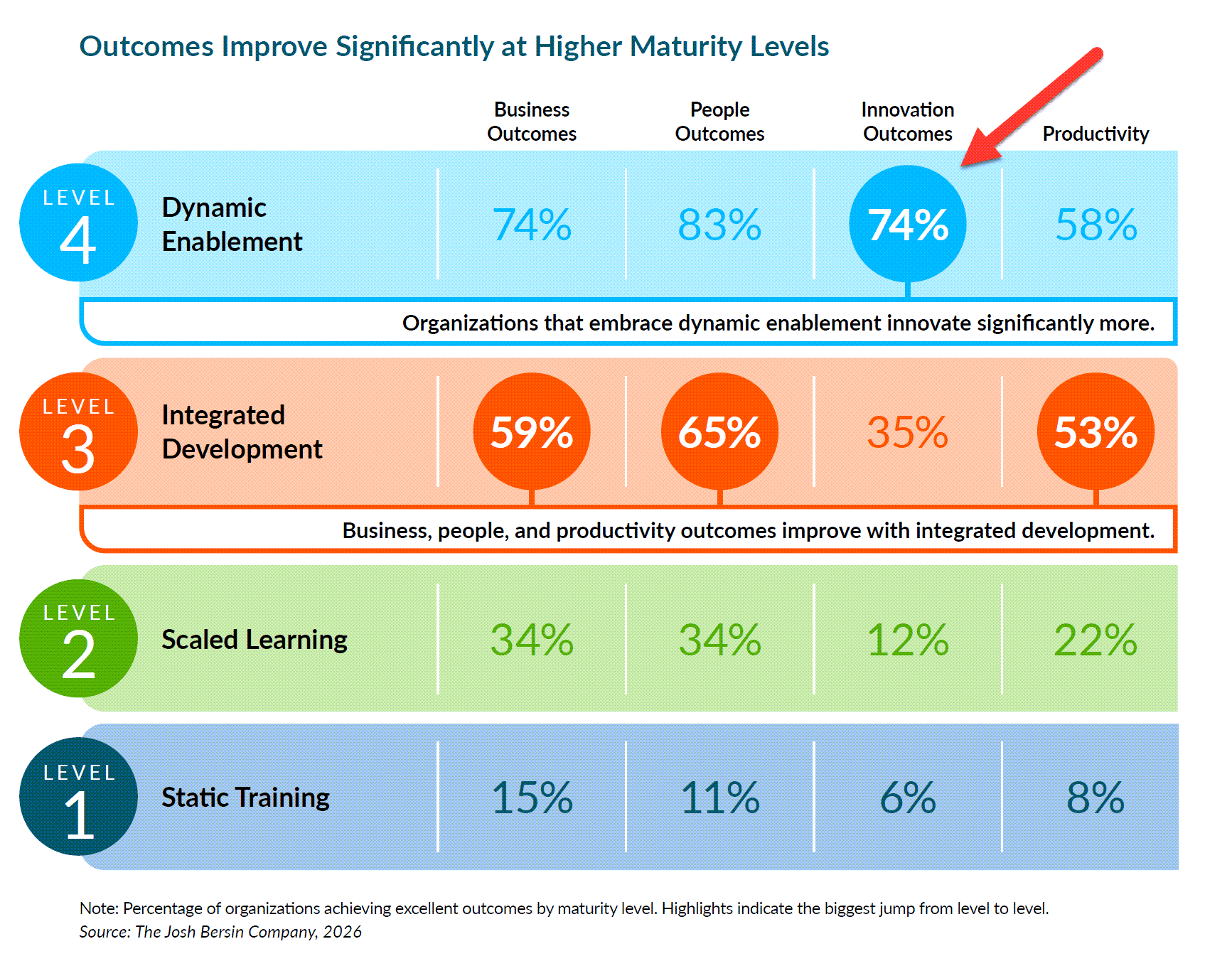
In all our studies we analyze the financial, business, and human capital returns of practices. In this study the benefits of Level 4 are clear. As we move from formal training to dynamic enablement, speed and innovation go up. And as these dynamic AI-driven learning platforms mature, the benefits will continue to get bigger.
 |
What Should Companies Do?
Let me note that Dynamic Enablement or “AI-Native Learning” is not “using AI to build courses faster.” It requires a replacement of the traditional SCORM-based LMS with a dynamic content system (some of these include Sana, Arist, Disperz, Uplimit, Colossyan, and others will come).
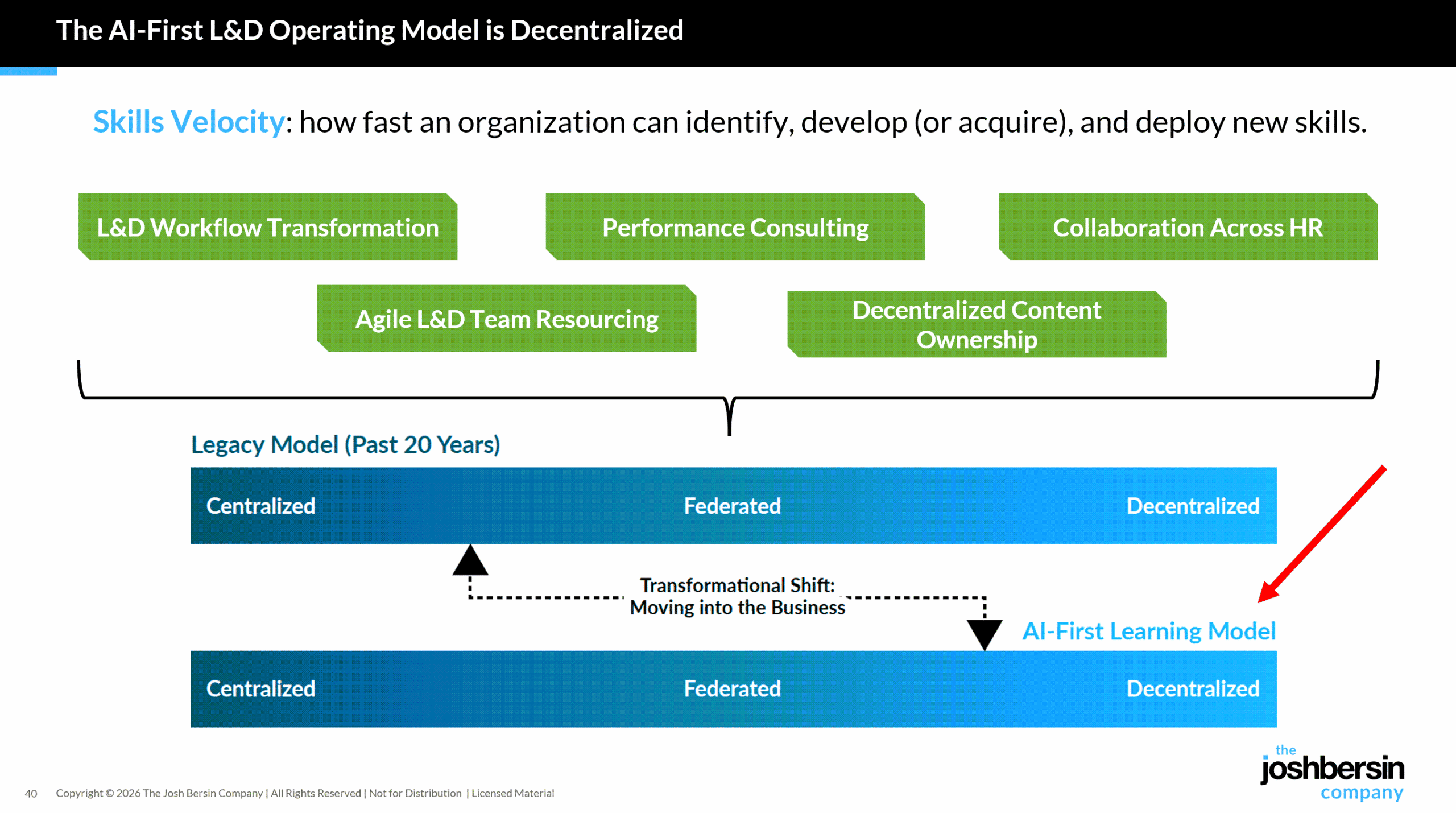
The roadmap to Enablement is clear. Companies need to rationalize their content, decide which content to keep (SCORM courses can be “transformed” into AI-native with Galileo), and put together a new governance model for L&D. Our early clients (major insurance, healthcare, pharma, and airlines) have already discovered that they can now delegate line of business training to local staff, once the system is set up.
This hybrid or distributed operating model creates agility. Now corporate HR can focus on global topics like leadership, compliance, culture, and business strategy – individual business areas can build “Enablement Academies” for sales, manufacturing, and other domains.
 |
The Bottom Line: AI-Native Learning Will Change Your Business
This research confirms our own experience: companies at Level 4 are 10-times more likely to be innovation leaders, 6-times more likely to exceed financial targets, and 16-times more likely to adapt well to change. Dynamic Enablement is the learning, change driver, and strategy execution we all need to keep up.
How to Learn More
All the research, case studies, benchmark data, and maturity model diagnostics are in Galileo. And we have built a series of Agentic Workflows which help you diagnose your own level of maturity, dig into case studies, and study vendors.
We have also launched a new Galileo Learning program “The Journey to Dynamic Enablement,” also available to Galileo Suite users. And as a Galileo user you can author courses, upload content, and experience AI-Native learning yourself!
Join us in this journey!