UKG Stakes Out Leadership Position In $6.5 Trillion Market For Frontline Work
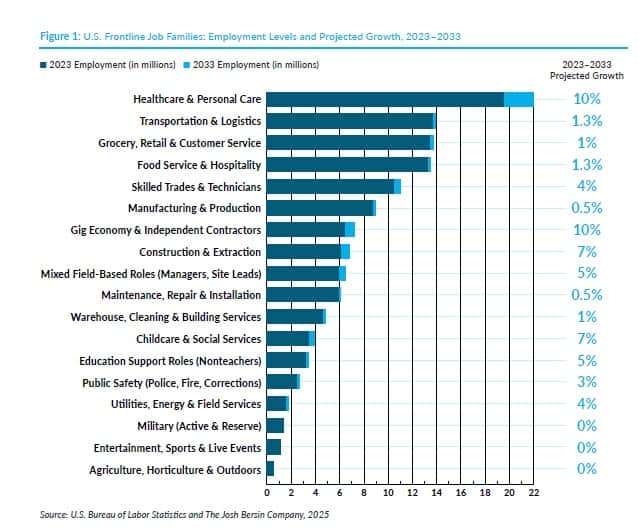
Let’s talk about frontline workers, the most in-demand workforce in the world. These are the nurses, drivers, hotel workers, restaurant staff, airline employees, cleaners, technicians, and manufacturing workers we rely on every day. Our research shows that almost 80% of all workers (by number) take on these jobs, and their total wages are $6.5 Trillion in the US alone.
As our research confirms, this workforce segment is growing much faster than white collar employees, largely because AI cannot automate away their work. To CEOs and CFOs this population is highly strategic: they deliver the core of a company’s value through direct connection to customers, patients, and delivery of products and services. And they represent the largest and often most controllable cost in the organization.
 |
Lack of Investment in the Frontline
Despite the value of these roles, companies don’t invest much in these employees.
Spending on training, management development, and career growth for this segment is less than one-third ($400 per worker) of that invested in white collar workers (over $1500 per year), often justified by the higher turnover. “If we’re going to lose these people in a year or two, why spend money on long term development?”
Obviously there is a flaw to this logic: when employers invest more heavily in these roles their tenure and productivity can skyrocket. Costco, for example, pays their retail employees an average of $26 per hour vs. industry benchmarks of $17. The company also offers healthcare and promotional paths into management. The result? Costco’s turnover is less than 8% per year vs industry averages over 60%.
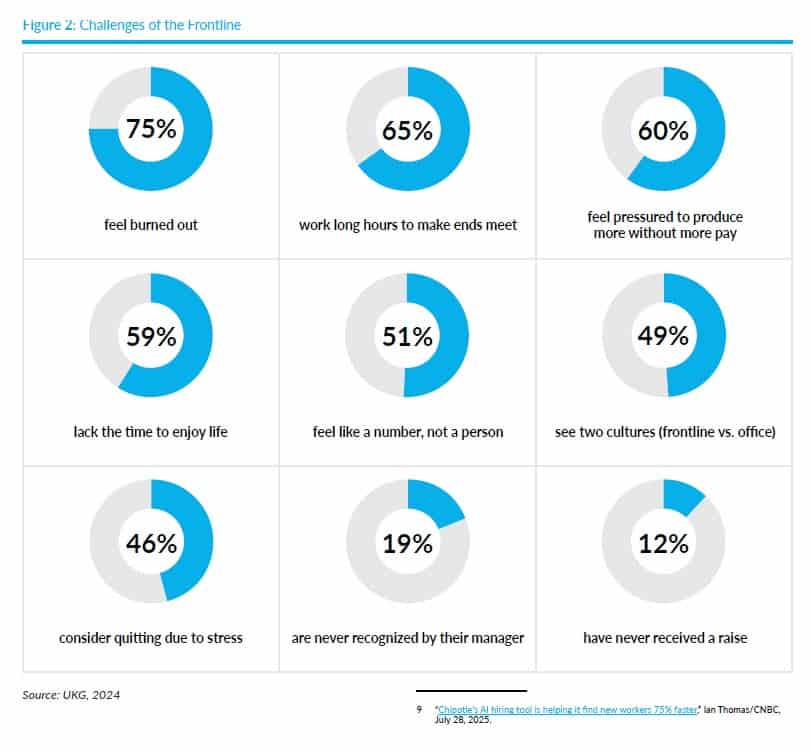
But it’s more complex than pay and benefits: frontline-first companies invest in communications, schedule flexibility, management support, and time. Consider the issues below (from our research “How Frontline-First Companies Thrive“).
 |
Why Are Frontline Investments Problematic?
Quite simply frontline workforce issues are extremely complex.
Imagine a highly trained nurse who needs to change her shift for childcare or a driver who works all weekend and goes home with a sore back. Frontline employees perform physical labor are often paid hourly, so they’re often changing shifts, looking for overtime opportunities, and upgrading their skills to find higher paying positions.
They want schedule flexibility, real-time visibility into their pay, and realistic opportunities for growth. They face physical risk, stress, long hours, and a lack of connection to the company. When these needs go unmet the company suffers low productivity and turnover, increasing operational and financial challenges.
From a business standpoint, optimizing capacity in the frontline pays off.
Imagine a rapid change in demand: supervisors and operations teams must reschedule shifts, speed hiring, or quickly upskill individuals to fill gaps, with revenue and reputation at stake.
When employees don’t receive full shifts or face unpredictable schedules they may quit or underperform. And as labor forecasting changes it’s difficult to see expenses until timesheets are finalized, creating a high risk of spending over budget.
A network of gyms or hair-care salons which is understaffed loses direct revenue and brand value. Chipotle applauded its workforce automation as a key competitive advantage in their recent sales results with financial analysts on CNBC.
And skills management in frontline work is mission-critical. Frontline workers need specialized technical which impact safety and operational risk. Companies have to track certifications, safety training, and skills to pay workers higher wages for more advanced capabilities.
Many of these jobs are physically strenuous, so employers train workers in lifting, bending, and physical fitness (a poultry manufacturer I just interviewed told me they give fitness training to workers who lift heavy food objects).
HR is Not Always Deeply Involved
Surprisingly, HR is often not involved in these issues: supervisors and ops managers deal with these matters and they may be under-trained as well. It’s not uncommon for line staff to be promoted into management with little or no formal training, creating a cascade of risk.
When HR gets involved it can make a huge difference. During the pandemic, when almost every Marriott hotel was closed, the CHRO and CEO decided to build a completely new management training program to get the business back on track. It was spectacularly successful but required a total revamping of leadership development worldwide. This created a new operating model, coordinating HR with operating teams to empower workers in a new way.
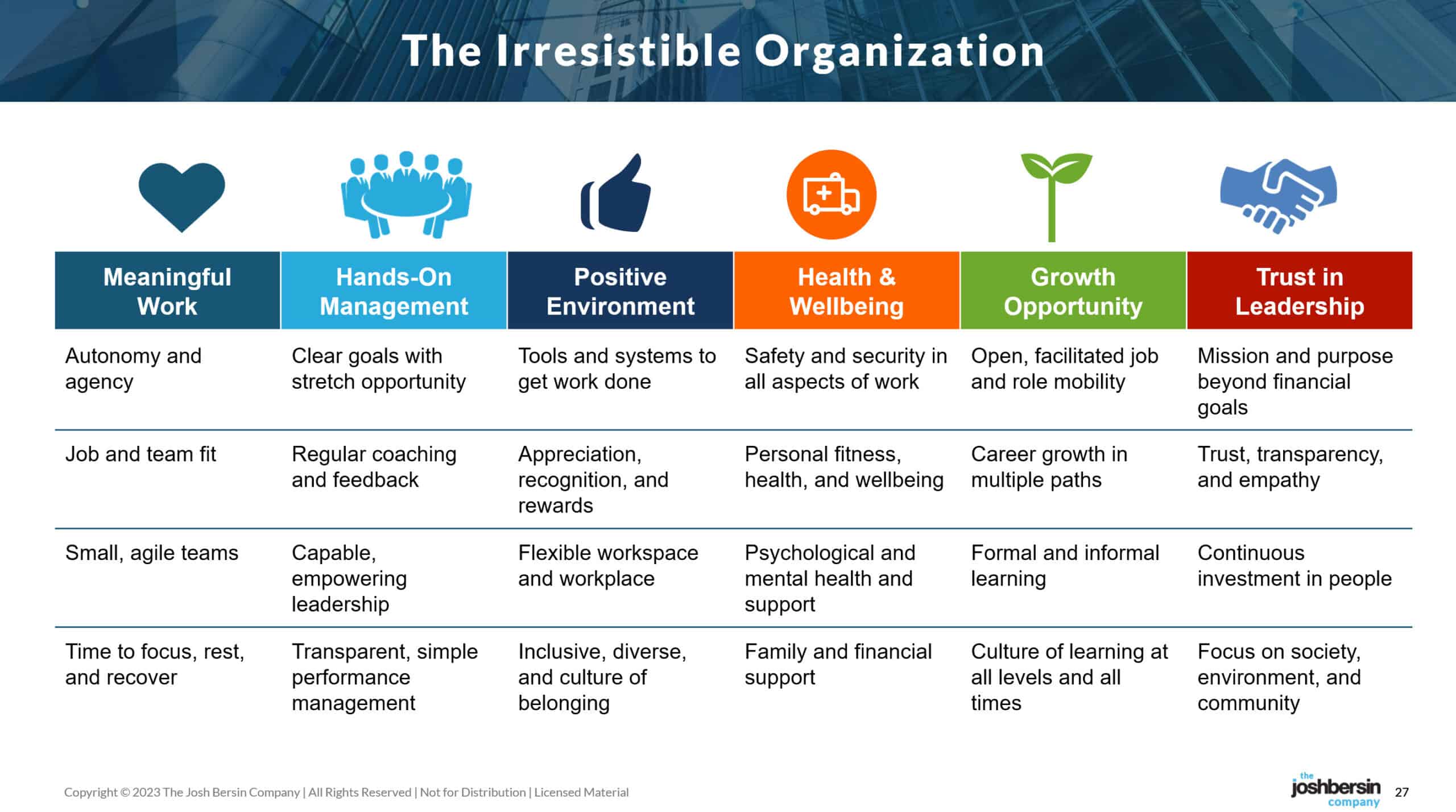
We track 24 different areas of employee experience in our Irresistible model, and each is complex in its own way. Many frontline staff have no computer or email access and they can’t look at their phones all day. Some need payday loans or real-time pay to make ends meet, so they need financial education and support. And most feel disconnected so they need communication and team-building programs.
 |
The HR Technology Market Has Tried To Help
Every payroll and HR vendor tries to address this market, but most do it in pieces. They often buy or build a workforce scheduling tool, and it is lightly connected to HRMS and payroll. This creates problems: skills in multiple places, shift and work data disconnected from pay and taxes, and difficulty computing the total cost of labor.
Imagine an employee who swaps shifts with a higher wage worker, and changes cities or locations in the process. Will the HRMS and payroll system understand the tax jurisdiction issues and the possible misalignment in position? And how does the worker see an integrated pay statement if all the data between these systems are not combined?
HR vendors have made many efforts to address this market. Workday acquired VNDLY and Paradox and recently decided to focus on frontline. SAP, a leader in energy, manufacturing, telecommunications, and many frontline-first industries, launched its new Total Workforce Management platform in September. ADP, a major player in mid-market frontline industries, revamped its workforce platform last month.
With so much value opportunity in this space, is there a market leader?
Enter UKG: The Pioneer In This Space
Enter UKG, the company that pioneered time clocks, dynamic scheduling, and a frontline-first employee focus from the beginning.
UKG (Kronos) invented workforce management three decades ago and now supports thousands of organizations. The company has become a $5 Billion powerhouse, offering HCM, global payroll, pay optimization, dynamic labor optimization, high-volume hiring, employee communication, voice-driven employee apps, integrated surveys, recognition and wellbeing, and a new array of AI agents to make it all easier.
The company calls its solution the Workforce Operating Platform, and it’s an integrated suite designed for the needs of C-suite decisionmakers, operations leaders, managers, and frontline workers.
As CEO Jen Morgan stated last month, “UKG understands the needs of frontline industries, workers, and what’s important to them.”
So what makes UKG different?
UKG’s Unique History and Strategy
UKG has a unique history and origin story.
UKG was formed through the 2020 merger of Ultimate Software and Kronos, leaders in mid-market HCM, pay, and workforce management. Kronos pioneered the worker time clock and started the industry for dynamic, optimized shift scheduling. Ultimate was an easy-to-use, scalable HRMS and payroll system, built in the early days of the cloud.
Together, under new leadership, UKG built an integrated platform (the Workforce Operating Platform) that brings pay, scheduling, shift management, skills, and HR processes into a single operationally integrated system.
This platform approach makes a difference. Every shift change, pay adjustment, jurisdictional tax change, overtime calculation, and employee record change flows seamlessly across payroll, HCM, and scheduling.
Core HR functions like onboarding, compliance management, training, and performance management operate in the same environment as day-to-day workforce operations. The result is a “single interface” that simplifies employees’ lives while giving managers and leaders AI-fueled tools for scheduling, employee engagement, operations management, and cost containment.
And UKG understands the role of culture and leadership in the frontline. In 2021 UKG acquired “Great Place To Work™” (GPTW), a company that built a validated culture assessment. This data is used by Fortune Magazine to rank and rate companies on the top 100 Best Companies to work for each year. UKG customers can use this survey to get industry-specific benchmarks and learn how to build trust and improve management.
Today UKG supports more than 80,000 companies, generates around $5B in revenue, and added 1,500 new clients this year.
UKG’s Frontline-First Focus
The company has always been all-in on the frontline worker market. At the company’s recent user conference UKG announced a flurry of new capabilities, each focused on the urgent needs of frontline-first companies.
Let me summarize what’s new.
Workforce Intelligence Hub:
The real issue with labor management is not just scheduling, pay, and benefits. It’s real-time planning and adjustment. Well UKG’s Workforce Intelligence Hub (note the word “hub” not “analytics”) brings workforce planning and operational insights together and gives managers tools for action. This goes back to the Kronos legacy and I’m not sure another vendor has pulled this off.
For example:
- A restaurant leader compares labor costs to competitors and then adjusts pay to meet local standards.
- A retail leader spots pay or turnover gaps that impact store performance (using UKG benchmarks) and then launches a pay adjustment to improve retention and sales.
- A manufacturer sees which plants are understaffed, so they trigger hiring or shift incentives.
- A healthcare leader monitors and predict burnout rates, then launches a GPTW pulse survey to improve employee sentiment and patient care
Here’s are some AI use cases.
- An AI agent notices a pattern of understaffed weekends and produce three scheduling options. The manager chooses an option, and then the agent rebalances shift schedules automatically to protect sales and service.
- An AI agent proactively catches a payroll compliance risk. It notifies the manager who can then accept the recommendation. The agent will fix the error before payroll closes and documents the change for audit.
- A hospital administrator sees patient loads spiking, and before there’s a problem, a network of AI agents across HR systems and scheduling recommends which credential staff to pull in, and what incentives to offer them.
You can see how AI is enabled through this integrated data platform: we call these “Superagent” use-cases which would not be possible without this integrated approach. UKG is one of the only vendors to move from a system of insight to a system of action for operations leaders.
Dynamic Labor Management Coupled to Rapid Hire:
Another pioneering innovation is the announcement of a system called “Dynamic Labor Management,” coupling the real-time labor insights and benchmarking with a hiring solution to scale capacity.
In November UKG acquired Chattr, a rapid-hiring solution that lets job seekers quickly apply for and accept jobs without the time and expense of creating a profile and slowly plodding through application and interview. This company. which was founded in 2018, built a “one click hire” solution that’s perfect for dynamic labor management.
Imagine a restaurant manager who sees a storm blow in and suddenly needs more staff to handle a wave of customers, and also needs to plan for the holiday rush. With Dynamic Labor Management coupled to Rapid Hire (UKG rebrand of Chattr) the manager can open positions and fill them in hours.
A potential worker, who sees the job ad on their phone, can scan a QR code and apply for the job immediately with UKG’s digital hiring assistant. Again an opportunity for a “Superagent” to help the business grow.
Voice Enabled Frontline Worker Support:
Here’s another innovation that’s easy to understand. Imagine a voice activated AI agent that connects your schedule and personal calendar (on your phone) to the entire UKG system of shift scheduling, pay, skills, and rewards. This is project Alto, and it’s more profound than you realize.
Imagine a restaurant or transportation worker who asks Siri for her November earnings and decides she needs an additional $500 for Christmas shopping. Project Alto literally listens to the employee’s request and uses UKG’s integrated platform to recommend additional shifts and even the option to apply for a supervisory role. She responds with interest for the promotion and the system recommends training to ready her for the possible position.
This integrated experience, which couples with Siri and other voice assistants, brings the power of UKG’s integrated platform right into the hands of a frontline worker who’s busy, mobile, or only has a few minutes. This feature will be valuable for us white-collar workers too!
UKG Frontline Worker Network:
Again focusing on frontline empowerment, UKG also announced a partner network that gives all UKG-powered workers access to third party services focused on health, wealth, and wellbeing. The initial suite of capabilities focus on financial wellness and support. For frontline workers who often live paycheck to paycheck, this includes offerings like Chime, OnePay, TurboTax, with more to come.
UKG Beacon:
In late November UKG also acquired Mo, a UK-based employee recognition solution designed for easy to deliver recognition solutions. Employee recognition can be as simple as a “thank you” or “shout out” to more complex solutions like gift cards and rewards delivered by peers or managers. We studied this market a decade ago and found that “high-recognition companies” have 70% lower voluntary turnover than their peers.
In a frontline-first company, where everyone is helping customers or patients, small recognitions make a real difference. Beacon (the new system) appears as an in-suite experience embedded alongside HR, payroll, and recruiting, with a feed of “moments,” boosts, and rewards that managers can send to employees. These can be anniversaries, career moments, or streaks of great work.
To close the circle, UKG tracks these recognition events so managers and execs can see stores or facilities with high or low recognition trends. Imagine an AI agent that nudges a manager to remind them to recognize high performance if they fall below company benchmarks.
Where Will This Market Go?
We believe this is one of the fastest growing segments in HR technology. What UKG is doing, with strong leadership from Jennifer Morgan, is shining a light on this market. And as you can see from this article, there are hundreds of innovations to consider.
Many HR providers see “frontline” as an incremental opportunity: UKG sees this as a market in itself, one with many opportunities for innovation. In fact many of the integrated features in UKG’s new platform apply to all workers in a company, giving UKG a lever into banks, insurance companies, and other industries with frontline staff.
The opportunity is now in the execution: closing long-standing gaps in experience, opportunity, and mobility for the 2.7 billion people who “make the world run” every day. Will UKG lead in this new world of AI-powered frontline support? Under Jennifer Morgan’s leadership and this new executive team, the future looks bright.
Additional Information
Powering the Frontline Workforce: How Frontline-First Companies Thrive
An Exploration into the Frontline Workforce with Josh Bersin (YouTube Video with Josh Secrest of Paradox)
The Age of The Superworker: Four Stages of AI Explainer Video