The Collapse And Rebirth Of Online Learning And Professional Development
The global market for professional development (training, certification, and upskilling) is over $400 billion, and almost a third of this is focused on topics and technologies that aren’t company specific. During the last three decades, much of this demand has been fulfilled by training providers: online course libraries, video libraries, simulations, expert assessments, and many forms of professional certification, testing, and accreditation.
It’s largely a recession-proof market, since ongoing professional development is always needed, and many companies pride themselves on being a place to develop your career, build new skills, and stay ahead in your career.
That all said, the “business” of online learning is changing at light speed. Companies like Udacity (sold to Accenture), Coursera, Udemy (just sold to Coursera), LinkedIn Learning, SkillSoft, Pluralsight, and even companies like Masterclass, TEDx, and BigThink are not the darlings they once were.
Recently, as Coursera “merged” with Udemy, I noted the plunging stock prices of the public traded companies. And this is not because management is not smart: it’s because the technology and consumption market totally changed.
 |
From “Selling Courses” to “Delivering Learning And Professional Growth”
Here’s how this will shake out.
This enormous market for corporate and professional skills development will continue. Every working person has career aspirations, so regardless of job family (IT, sales, marketing, finance, support, HR) there is always demand for skills. That demand tends to fall into five levels, and we use this model in our capability programs.
Level 1: I’m New To This
The first is entry level training. If you’re new to a profession, role, or career you often want to get “certified” on the basics. In my field (HR), there are some very fundamental certificates people pay for. These companies (SHRM, HCI, others) have to keep their “certs” up to date, so employers may or may not really care if you achieve them. My experience in HR shows that SHRM certs, for example, have plummeted in value.
Here people need to learn the basics, the language, the fundamental ideas, and an overview of the tools.
Level 2: I Have Experience But I’m Not An Expert
Let’s say you’ve done this job for 2-3 years. You know the basics but there are lots of things you don’t understand yet. Here people need case studies, advanced use-cases, and training and exercises to stretch their thinking. If you’re a recruiter and want to become a senior recruiter you now need to learn about sourcing, skills assessment, candidate marketing, and AI use-cases, for example.
Level 3: I Have Expertise But It’s Narrow
At this level the professional has depth but not breadth. Perhaps you’re an expert recruiter in tech hiring but you’ve never recruited a senior executive or a sales team. Or maybe you want to learn how to hire and assess internal and external candidates to build a product organization. At this level the professional needs global and multi-industry or multi-technology experience.
Here is where people often leave companies because they’ve been “niched” and they want to branch out. Training here may include new case studies, projects, and exposure to more senior or multi-disciplinary experts. And this may be the person who moves from “Senior Recruiter” to “Head of Recruiting,” which takes the individual into leadership. Leadership development is training for a “new career,” and of course leads to many other types of learning.
Level 4: I’m World Class And I Want To Go Further
At level 4 we find individuals who have decades of experience but they want to keep up, identify advanced technologies and approaches, and often globalize or broaden their industry experience. Many senior HR leaders, for example, are limited by the industry they know. Changing industries gives people massive exposure to new approaches and improves wisdom, perspective, confidence, and value-creation.
People at this level may also become senior executives, they may move from “large company” to “startup” or they may want to branch into vast new technology or scientific areas. I’ve learned in my career that depth in one domain always leads you to want depth in adjacent domains, so here people want access to deep skills, experts, research, and training in parallel (“T-Shaped”) topics.
Level 5: I Can Write The Book
At level 5 we find the smaller number of senior, tenured experts (the 10X engineers, or C-level gurus) who have proven their expertise and impact but they want to go further. They may want to teach others, mentor, coach, or write. They don’t build blogs to be famous: they’re already deeply respected and they want to meet others and collaborate. They want professional communities, deep research, and global peers and case studies to learn from.
The Training and Professional Development Market Tries To Address These Needs With Packaged Solutions
Training and professional education companies address these needs in many ways, but many “sell stuff” without consideration for this rubric. An “advanced” course may cover topics you’re not familiar with, but what if you’re level 3 or 4? It’s difficult to map packaged training to the real needs of advancing professionals.
Well AI addresses this problem. All this information and skill-building can be custom-assembled for your goals.
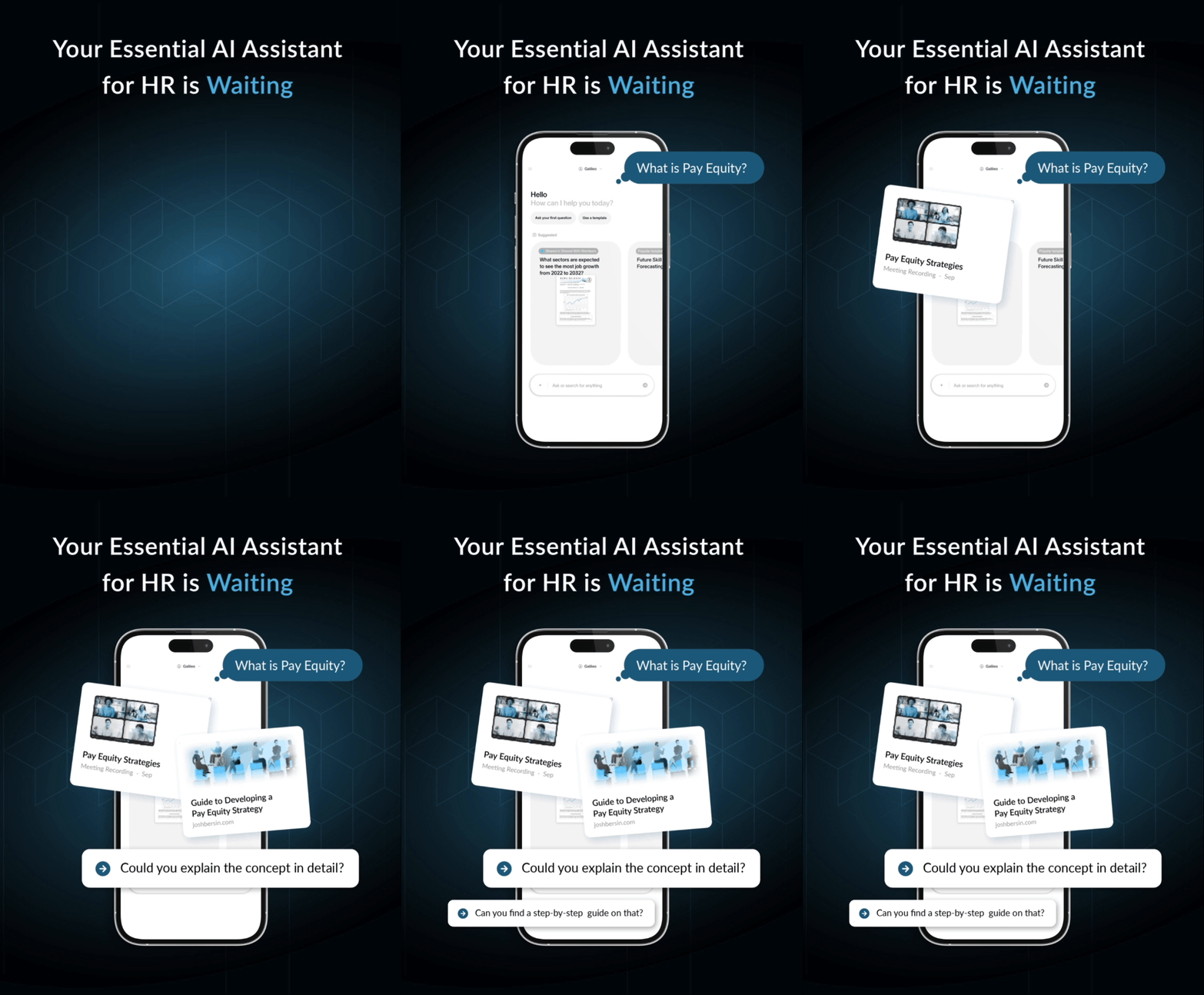
 As we describe in the “Revolution in Corporate Learning” research, AI is tailor made to address these needs, and Galileo does this for HR professionals and leaders. If you don’t believe me, consider this:
Today 900 million people use ChatGPT every week. OpenAI and other analysts find that 40% or more of these interactions involve people trying to learn something (find information, develop a skill, or solve a problem). That means that in about three years OpenAI has attracted more “learners” than any L&D platform in history.
Why? Two simple reasons.
First it’s so easy to ask a question, learn, and unleash your curiosity to grow. This “questioning” approach to learning is what we developed as children, so it’s natural to dig in, learn, and explore through an agent.
Second, OpenAI’s underlying AI content model (the same we use in Galileo) interconnects information (through AI embeddings) in a holistic, systemic way. You are not forced to learn in a linear path (unless you want to), so you can ask “why” or ask for “explanations” or “more details” or “skip this” at any time. This has a massive impact on speed and quality of learning.
Galileo, for example, offers examples, scenarios, challenges, and simulations at any time. You can “take a course” or you can simply ask the Supertutor to answer questions, and it will magically offer new information and experiences based on your role, prior interactions, and other information. Quite simply it’s breathtaking to experience.
 |
How The Market is Disrupted
This radical shift, from “publishing courses” to “dynamically delivering content” changes the entire professional development market.
The market today has five parts: learning platforms (LMS, LXP, etc), learning content (course libraries, programs, exec education), content development tools (there are hundreds), certifications (testing, accreditation), and learning consultants (like NIIT who build content and run platforms).
Among these segments, each must adapt to AI-native infrastructure. And this is not a small incremental change: it’s a discontinuous shift and it’s moving very fast.
As I discuss in my podcast, the “old model” was a publishing paradigm. We identify topics of need, collect subject matter experts, and design courses, interactivities, simulations, and assessments. We then “publish” them into an LMS (or custom platform), and we “launch them” (or sell them) to users.
The web publishing model was groundbreaking in 1999 and 2000, and it disrupted hundreds of classroom training companies. Hundreds of bootcamp companies (CodeAcademy) and executive education programs (Wharton, Harvard, Stanford, Berkeley) still live with this model. And for high-touch experiences, where people will pay thousands of dollars per day, these businesses will continue But the vast majority of professional development is shifting.
This new model, which we call AI-First or AI-Native, uses AI to collect, generate, translate, and deliver content. An AI-native platform like Galileo, for example, delivers a custom learning experience that leverages our 25+ years of research and case studies, merged with a company’s internal content. Users can take formal courses, ask for simulations, perform role plays, or just ask the Supertutor in Galileo to “teach” them. As in a classroom, when a student has a question, they simply ask and the system answers.
This radically different experience creates a massive disruption to the courseware business model.
Not only is the user experience far more personalized (AI remembers what you’ve done so it tunes itself to your needs) but complex high-cost infrastructure like instructional design, translation, and video generation all become highly automated. Our system is almost autonomous: since the corpus is so deep with knowledge the system can generate new experiences every day as we add new content. And as you add your own company’s content the system mixes “expert” content from us with your own company’s process, technical, and cultural practices.
Costly features like career pathways, learning paths, skills taxonomies, and even assessments are now machine generated. So all of a sudden the professional development vendor is selling “pure content” as well as a platform-optimized, personalized, easy-to-use, valuable user experience.
I took our new research on the frontline workforce and used Sora to build a fairly impressive 5 minute course on the economics of the frontline workforce. While I wouldn’t “sell it,” we can expect YouTube and most of the LLMs to offer this kind of feature. Have you noticed how YouTube creates chapters in videos? This takes any speech or professional talk and turns it into “chapters” of education and they haven’t even integrated Gemini yet!
And AI is going to push deeper. I know from our experience that the AI-native platforms can identify your reading level, learning preferences, and get to know your technical interests. I use Gemini, ChatGPT, and Claude through Galileo and my system knows almost everything about who I am and what I do. We load all our meetings into Galileo also, so as a learning platform it knows my language, what i’m working on, and how I think and communicate.
There’s Lots of Room For Innovation Now
In many ways the online learning industry was stagnating: I became almost bored with the lack of innovation in our space. Suddenly with AI, there are hundreds of innovations possible. So as this market reinvents itself, let me highlight a few:
- Arist, a company we partner with closely, uses AI to generate micro-learning that competes with courseware for learners on the go. They also now sell an integrated performance consulting, needs analysis, and learning delivery system that blows away traditional development processes.
- Sana, the company we partner with on Galileo (now owned by Workday), delivers enterprise-class AI-native learning and offers both agent and learning direct interfaces, with advanced features you can experience in Galileo.
- Uplimit, a fast-growing AI vendor (founded by Coursera alums) delivers the most scalable AI-native deep skills, technical, and professional development solution I’ve seen. Experts can teach hands-on courses to thousands at once, and Databricks uses them for the programs I discuss in this week’s podcast.
- Workera, an AI-driven skills assessment vendor, uses simulations and AI-driven assessment to identify your skills in any domain (their AI readiness assessment is now widely used). This type of assessment engine, fully AI-powered, has thousands of applications in corporate compliance, training, professional development, management, leadership assessment. The company already has a skills engine with 10,000+ skills for assessment and is offering AI-based coaching and development around these skills.
- CodeSignal, also an AI-driven skills assessment company, goes further to include simulations for testing and development, AI-powered interviewing, and task-specific, job-relevant exams and simulations. Again this AI solution leads directly into professional development for personal or corporate use.
- Attensi has built AI-driven simulations and games for training, a use-case that is popular in softskills, sales, and customer service but used to cost hundreds of thousands of dollars to build. AI-driven simulations also break open new dimensions of professional development in many industries (ie. healthcare, retail, and other frontline roles) where traditional training falls short.
- Docebo, one of the only publicly traded LMS companies, has introduced AI for content generation, LMS administration, learner analysis, and template-based scalable content development. Docebo is widely used for customer, partner, and revenue generating training as well as global internal L&D.
- Cornerstone, the largest global LMS company, is redefining how L&D and people operations work with its Galaxy AI platform.
- LinkedIn Learning, Coursera, Guild, and other traditional course developers are now using AI to offer scenario-builders, personalized learning paths, and AI recommendations and career pathways. As large players with major corporate clients, they are also in a position to add many of these AI-native capabilities.
- OpenAI itself plans to offer learning (and formal courseware) embedded in its own platform, initially focused on AI.
What This Means for Professionals, HR, and L&D Buyers
Every training, certification, and professional education provider has to deal with this change. Companies won’t replace their course libraries or subscriptions overnight, but as personalized, AI-centric providers emerge, legacy vendors may be acquired.
Remember the change in context. Going forward most employees will have AI agents on their phones and on their PCs, either through Microsoft, Apple, or the agent you select. This means that “reaching employees” will be easier than ever, as long as you have a back-end set of offerings that feed the agent well.
It feels like what happened when Google Search revolutionized our need to build portals. Websites and e-commerce systems didn’t disappear, but if they weren’t “search-enabled” they became unpleasant to use. In the same vein, once employees start using your internal agents to get help with benefits, tax statements, and other employee questions they’re going to ask questions like “what is my path to get promoted?”
That transition gives you an opportunity to totally rethink how you deploy learning at work. Imagine an hourly worker who wants to work extra shifts to make more money: why wouldn’t the agent tell her “if you upgrade your skills you can take a shift in another position for $5 more per hour.” Similar use-cases are now possible with AI.
I know many of you are looking at leadership coaching agents, AI-powered assessments (vendors above plus Skillable), AI-powered content tools (Sora itself is cool but there are many more), and other agents to build videos, audio, tests, and courses. My suggestion for the year ahead is to take some time to build a “re-engineered view” of your L&D strategy. And here’s why:
Our work this year with many companies shows that the L&D of the past is filled with work, jobs, and projects that completely go away. Costs you incur in translation, skills architecture, LMS publishing and metadata management, and many projects for role-based learning, career pathing, and job aids can be fully automated. We’ve helped several large companies re-engineer their manager training, HR support, and other L&D programs and the result has included a 40% reduction in L&D spending coupled with a far more personalized employee experience.
For vendors and consultants, I’m sure you already see what’s going on. My advice is to be bold, look at the new players in the market, and don’t be afraid to partner, build, or buy the AI platforms you need. This is an exciting opportunity to redesign how we develop and support people, and the demand for solutions will be greater than ever.
Watch for our major 2026 Imperatives research coming out in January, and our major new L&D maturity model and in-depth case studies in early February. And if you want to get started now, get Galileo and you can explore and experience your own AI-fueled professional development immediately.
Additional Information
The Online Learning Market Is Collapsing, And It’s Good
The Rise of the Supermanager: Rethinking Leadership In The World of AI
100+ Proven Use-Cases for Galileo (AI in HR)