Workday and Sana Unveil A Bold New Strategy For AI
This week Workday announced a bold and ambitious AI strategy around its new technology platform Sana. We have been partners and users of Sana for three years, so much of this discussion is also based on our own experience building our HR Superagent Galileo, which runs on Sana.
Who Is Sana?
First, it’s important to understand that Sana Labs is an AI company first, product company second. The company was founded in 2016 by Joel Hellemark. His initial vision was to use machine learning and AI to improve how people learn, access knowledge, and collaborate at work.
In its early days Sana worked with OpenAI and other technologies (prior to launch of ChatGPT) to build a system for AI-driven learning. As the company grew and took on investment, Joel and his team decided to build two products: Sana Learning, a next-generation AI-native content and learning system, and Sana Agents, an elegantly designed agent platform that brings together multiple LLMs into an easy-to-use productivity experience.
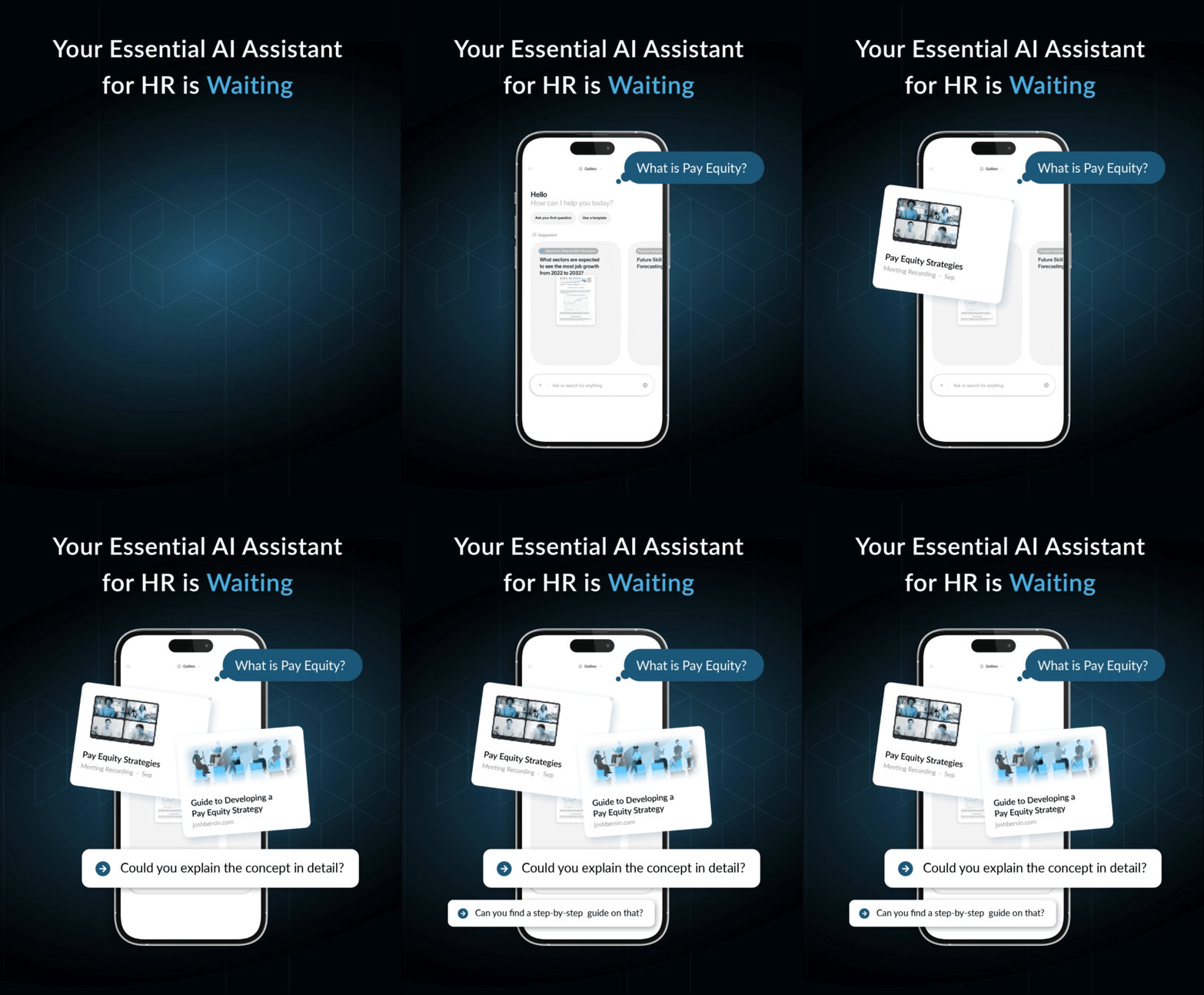
Today Sana Agent, which is the platform under Galileo™, lets users query any LLM, add and manage data and documents, create images and Powerpoints, record and analyze meetings, and create prompts, workflows, and subagents. I think of it like an “agent platform” that sits on top of any AI model, making it easy to use, store history, and build productivity agents of your own.
Sana Learning, which we name Galileo Learn™, is an elegant learning platform that has set the lead (in many ways) to build training, coaching, assessments, and much more. I won’t talk a lot about Sana Learning in this article, but I believe it forms the basis for a large and highly profitable Workday business in what we call “Dynamic Enablement.”
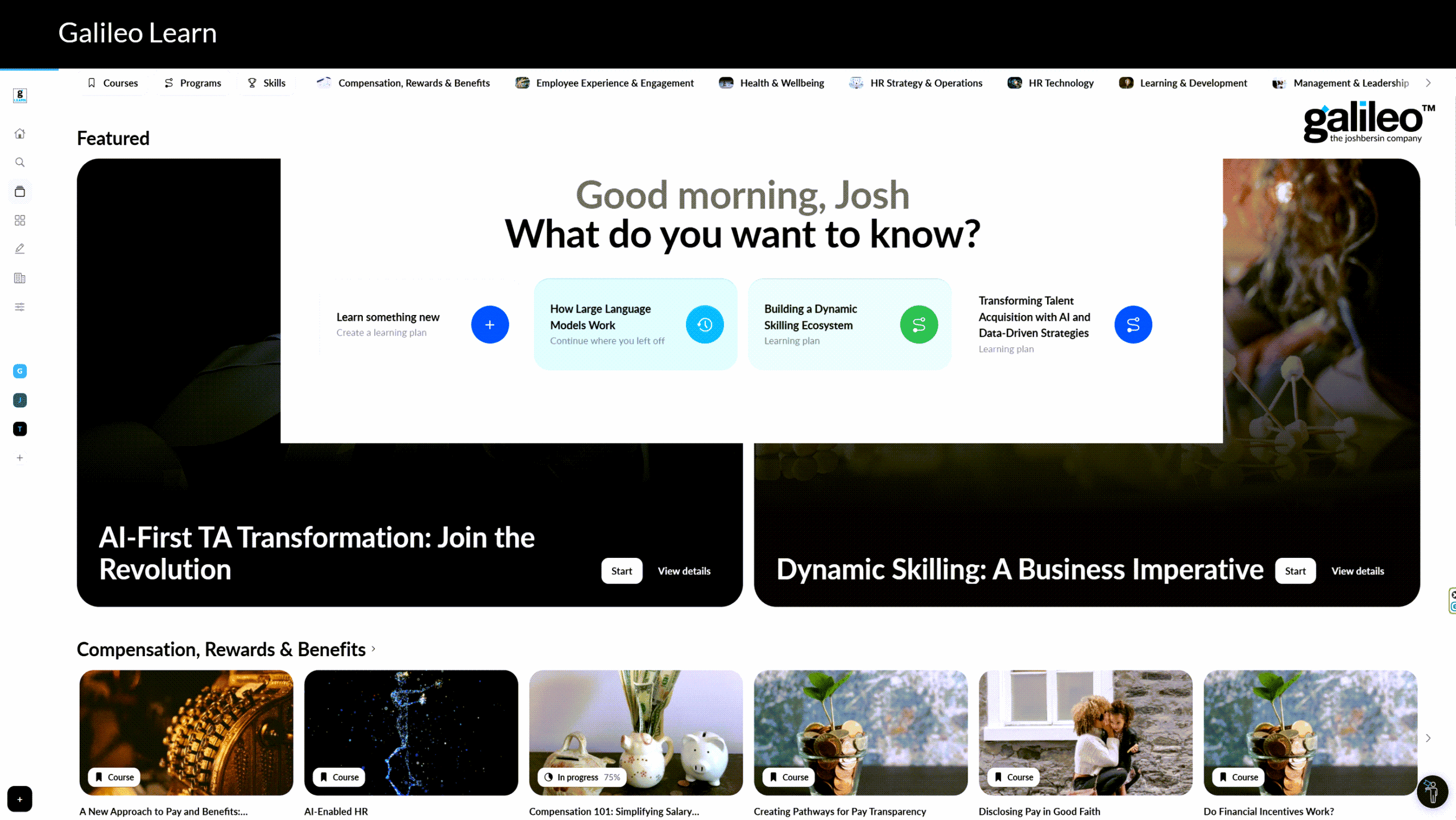 |
We connect Galileo to Galileo Learn, so users can run applications, access a corpus of knowledge, and learn in one integrated experience.
Sana Agent also has a mobile app and has voice generation: Galileo, for example, speaks in my voice.
Workday’s Four Big Announcements
Since the acquisition, Workday and Sana have already made many big plans.
 |
First, effective immediately, all Workday customers have access to a new Workday interface called Sana for Workday.
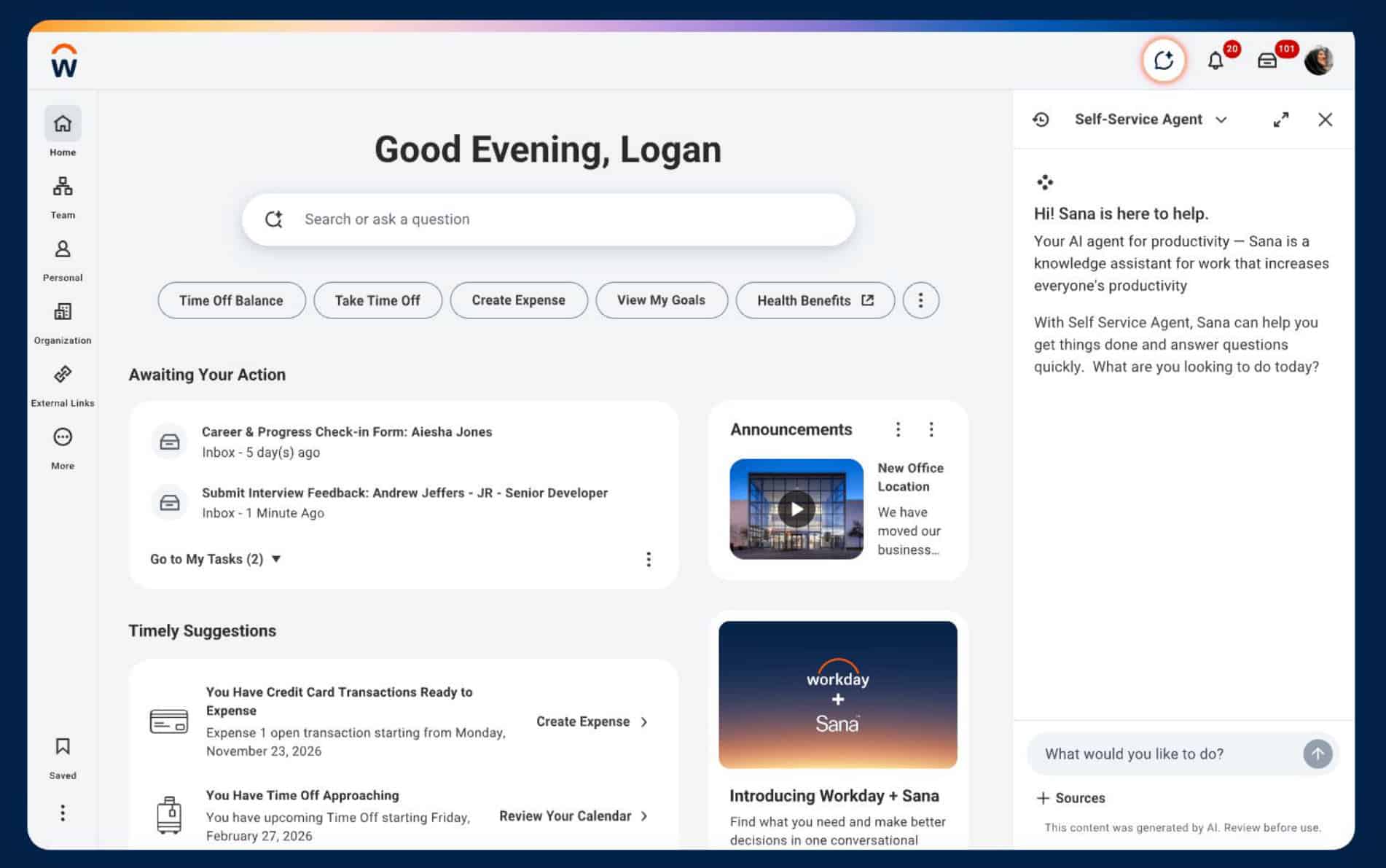 |
This experience brings all the transactions and data from your Workday system right into the Sana Agent. This means that you can ask questions, run reports, invoke transactions, analyze data, or do anything you need as an employee or manager, directly accessing your company’s data.
Workday’s security rules are built in, so each user sees only the data and transactions they are entitled to see. For Galileo users, it means users have the power of Galileo’s intelligence applied directly to all the information in Workday.
This first step is massive: it “unlocks” the Workday system to employees, casual users, managers, and HR and IT teams without the complexity of the Workday interface.
Second, Workday is introducing an upgraded version of Sana called Sana Enterprise.
This platform, which requires an upgraded license, allows Sana users to access other enterprise systems, like Salesforce, Teams, Slack, Sharepoint, and more.
We use this integration feature in Galileo and it is easy to configure and gives users read/write access to these other systems. This means you can deploy Sana Enterprise as “the front door” for all your users, taking on a role that Microsoft Viva, ServiceNow, and other employee experience platforms play.
Since the security layers and job level, job role, and hierarchy are embedded in Workday, Sana Enterprise inherits this information. This means IT teams can deploy it without having to worry about different security, data privacy, and authentication rules.
 |
Third, Sana is now Workday’s Agent Development System; you can build your own Agents in Sana.
Sana uses a workflow development tool (we have built 400 “sub agents” for HR in Galileo, for example) that lets you drag and drop “steps” or “prompt paths” to build apps. In coming quarters Workday plans to integrate the Flowise vibe coding tool into Sana, so this will become an even more robust, drag and drop development studio.
This means users, managers, HR teams, and corporate developers can build internal apps easily. The example demo is an app for employees to book travel, accommodate company travel policies, find flights, ask approval for exceptions, and complete their expense report. Companies will build thousands of these agents and apps, and I’d expect third parties to build them as well.
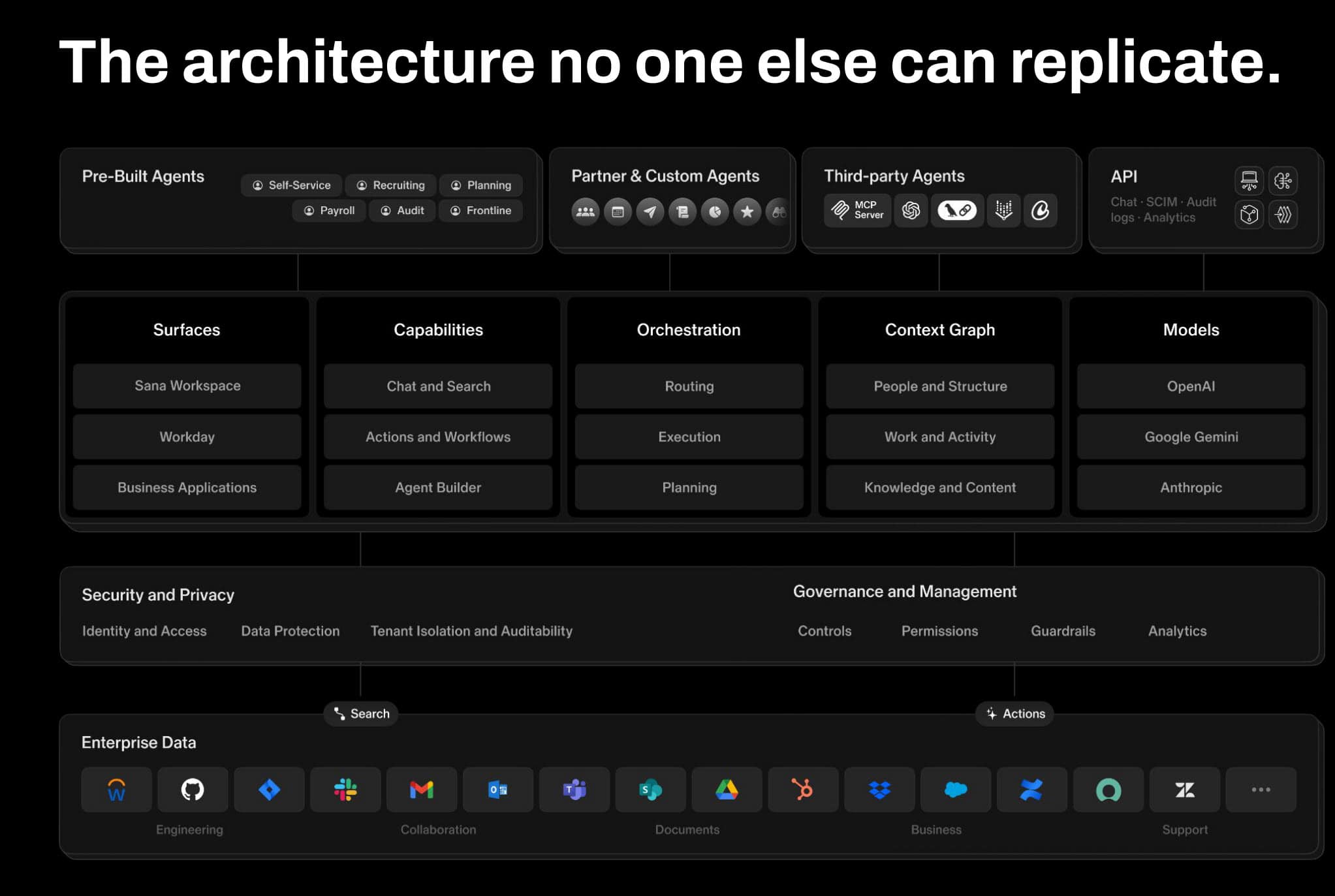
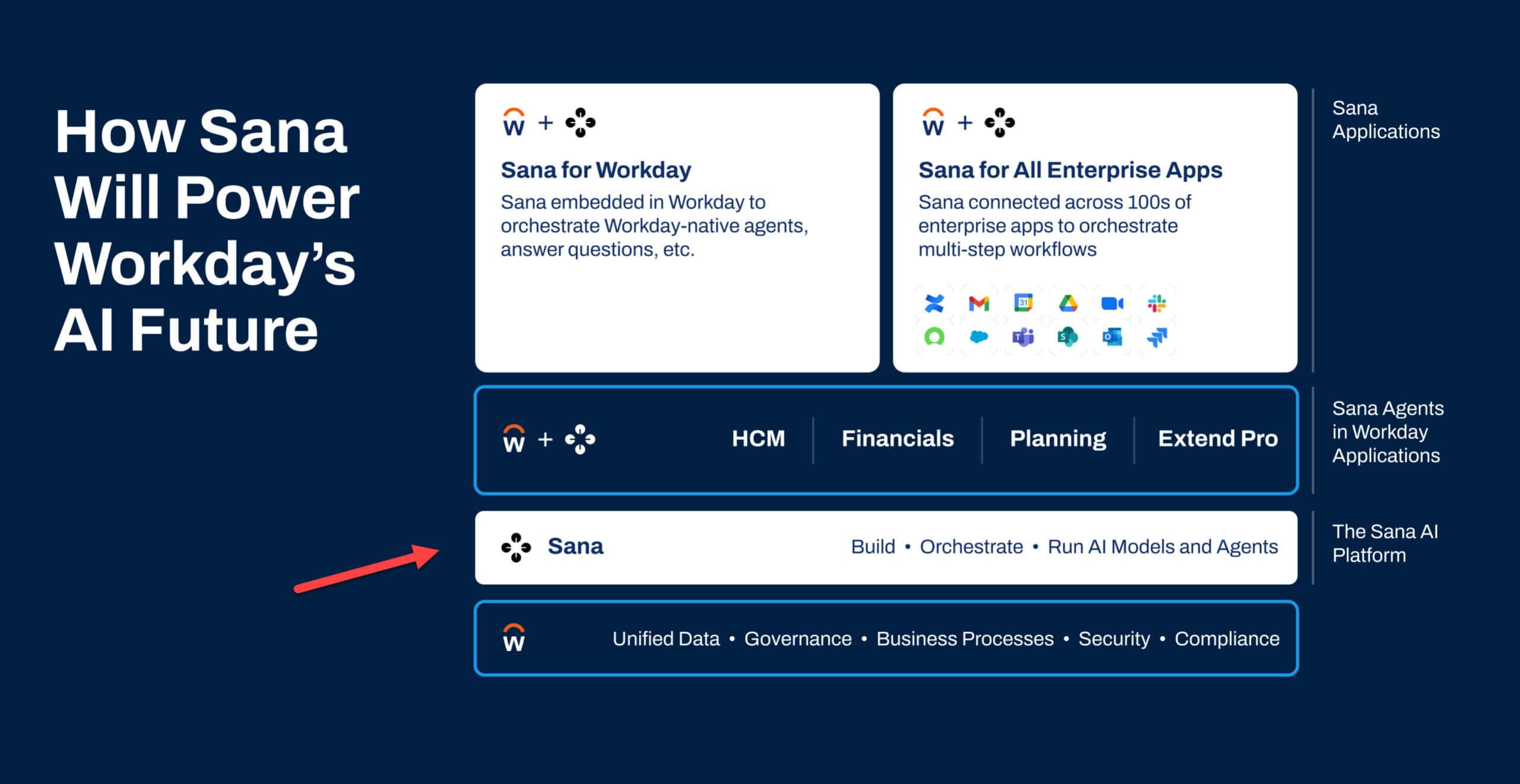
Fourth, as the architecture picture shows, Sana’s AI infrastructure becomes the AI infrastructure for Workday.
In prior years Workday branded its various AI agents as “Illuminate,” a brand to promote the newness of the company’s AI. Going forward, new AI agents built by Workday will work inside and within the Sana infrastructure.
 |
Implications of These Announcements
There are many important changes here, and I will discuss those that impact customers.
(Questions like what happens to Paradox, HiredScore, and third party AI tools will come out over time. Sana-built agents will be 100% integrated with the Workday Agent System of Record, which is a critical component to manage the data usage, user usage, privileges, and security of all these agents.)
First, Workday customers see a massive upgrade to the User Experience.
Having used Sana every day for almost three years, I can tell you that it’s elegant, easy to use, fast, and enjoyable. I doubt most Workday users feel that way about Workday’s UI today.
You can now store documents, integrate Workday into Microsoft and Google tools, and make Sana your primary desktop experience. For companies that upgrade to Sana Enterprise, you have an “employee experience platform” that competes with Microsoft Viva, ServiceNow, Zoom/Workvivo, and others.
I do question how seriously Workday will pursue this market because it’s highly competitive. However the built-in Workday access is a big plus.
Second, Workday customers have a high-productivity way to build apps and teach employees about AI.
As a Sana user any employee can explore, learn, and build AI solutions of their own. Since Sana Agents connect to Sana Learning, employee training or enablement is immediately integrated. (Galileo Learn includes 750+ courses on management, leadership, and HR which are also immediately available.)
If your company uses Claude, OpenAI, Gemini, or an internally developed LLM, your users can access all these models from a single interface. And every employee can “ask a question” and locate or transact with Workday from the same experience.
For users who like to build things, this is an easy-to-use AI studio. Just like you can store prompts and build GPT’s in native LLM platforms, Sana lets you do this in its workflow module. Workflows can have branching, logic, and are visually easy to build and edit.
Third, Workday has an AI engineering powerhouse to support its AI engineering.
The Sana team is very experienced with data labeling, LLM optimization, RAG pipelines, and many of the tuning issues in AI. We know this because we have been working with them directly in Galileo for almost three years.
This means many AI projects in Workday will go faster, become more efficient, and likely be architected to work together. As you can see from the marketing architecture, the Workday native business rule and security architecture remains above Sana to make it easy to build apps.
 |
Fourth, Workday has a world-class AI native learning system.
Sana Learning is one of the most advanced AI-native platforms in the market. This market, which is almost $400 billion in technology and content, represents a new, greenfield opportunity for Workday and its customers.
The Competitive Landscape
While all this is wonderful for Workday, customers have many options.
Oracle’s AI Studio is quite advanced and Oracle has built its own AI stack, running in its own AI infrastructure. And Oracle’s revenues and market cap are significantly larger than Workday.
SAP has embarked on a similar strategy with Joule, the company’s AI Agent designed to access applications and subsystems in SAP and SuccessFactors. In some ways Joule is well ahead of Workday but with Sana firmly in place, the race to see who can “Agentify” its system will now be competitive.
Then there’s Microsoft. MS Copilot, Copilot Studio, Agent365, and the WorkIQ intelligence layer are essentially alternatives to Sana Enterprise. While MS Copilot does not have direct integration to Workday (yet!), the MS Copilot experience is a similarly integrated experience to Sana, albeit dependent on MS 365 applications. We use both Sana as well as Microsoft in our company, and some functions are quite similar (file sharing, meeting recordings, etc.)
Then there are the LLM providers themselves. Prior to this announcement most companies picked OpenAI, Anthropic, or Gemini as their standard AI. Once that budget has been set, it may be hard to cost-justify a new agent front-end. Despite this, however, the integration into Workday and Learning in Sana may be worth it. (I certainly think so.) But customers will have to decide.
Note also that Microsoft and Google are going down the same path as Sana. Each is building integrations into their email and productivity apps, meeting recorders, and search, file management, discovery, and app studio features.
Also, one can never predict when a new development tool or AI product will come to market. In the case of Workday, they’re now in the front-end productivity business. That means keeping up trends (ie. Notion? Vibe coding tools, Anthropic Cowork), new models, LLMs, and a myriad of communication tools. Once Workday customers standardize on Sana, Workday has to keep up.
And then there’s ServiceNow, who recently acquired Moveworks, an agent platform competitive to Sana. They see this market in the center of their target, and ServiceNow is almost twice the size of Workday. So Workday clients have options, even though I know Workday will make it easy and attractive to adopt Sana.
Workday, Sana, and Galileo
Finally, let me briefly address Galileo. Effective today we are partners with Workday. This means that any Workday or Sana customer can get Galileo’s HR Intelligence and corpus directly integrated into Workday. Our HR intelligent agent and the 400+ prompts and workflows we developed can immediately access your Workday data.
The Galileo Learn library (750+ courses in HR, leadership, technology, and management) can also be “turned on” in your version of Sana Learning. So Galileo, in a sense, is an “instant on” solution that leverages the entire Workday Sana experience. Call us if you want to walk through the details.
The AI World Is Open
We know, from talking with many of you, that there is no “one AI platform” for everyone. Companies have a mixture of MS Copilot, OpenAI, Claude, and other AI tools.
Sana and Workday, as a platform which leverages billions of dollars invested in HR data, security, and financial management in Workday, is likely to cut through the noise. Nobody can predict what the big AI companies will do next (many acquisitions are likely) but for Workday customers, Sana is a safe choice.
Additional Information
Agents, Superagents, and Intelligent Orchestration: 2026 Imperatives for Enterprise AI
The L&D Revolution Has Arrived: AI Enables Dynamic Enablement For All
Get Galileo, the AI Superagent for HR (experience Sana for yourself)