Gloat Enters The Crowded War For AI Agents in HR
This week Gloat, a pioneer in skills intelligence and talent marketplace, launched a bold entry into the world of AI Agents for HR. It’s an interesting move, demonstrating how competition for core HR technology has emerged.
Simply explained, Gloat is offering a toolset (Gloat Agentic HR) which uses all the business rules and security you have in Oracle, Workday, or SuccessFactors and lets you quickly build AI Agents that work in MS Copilot, Teams, Slack, and other AI apps.
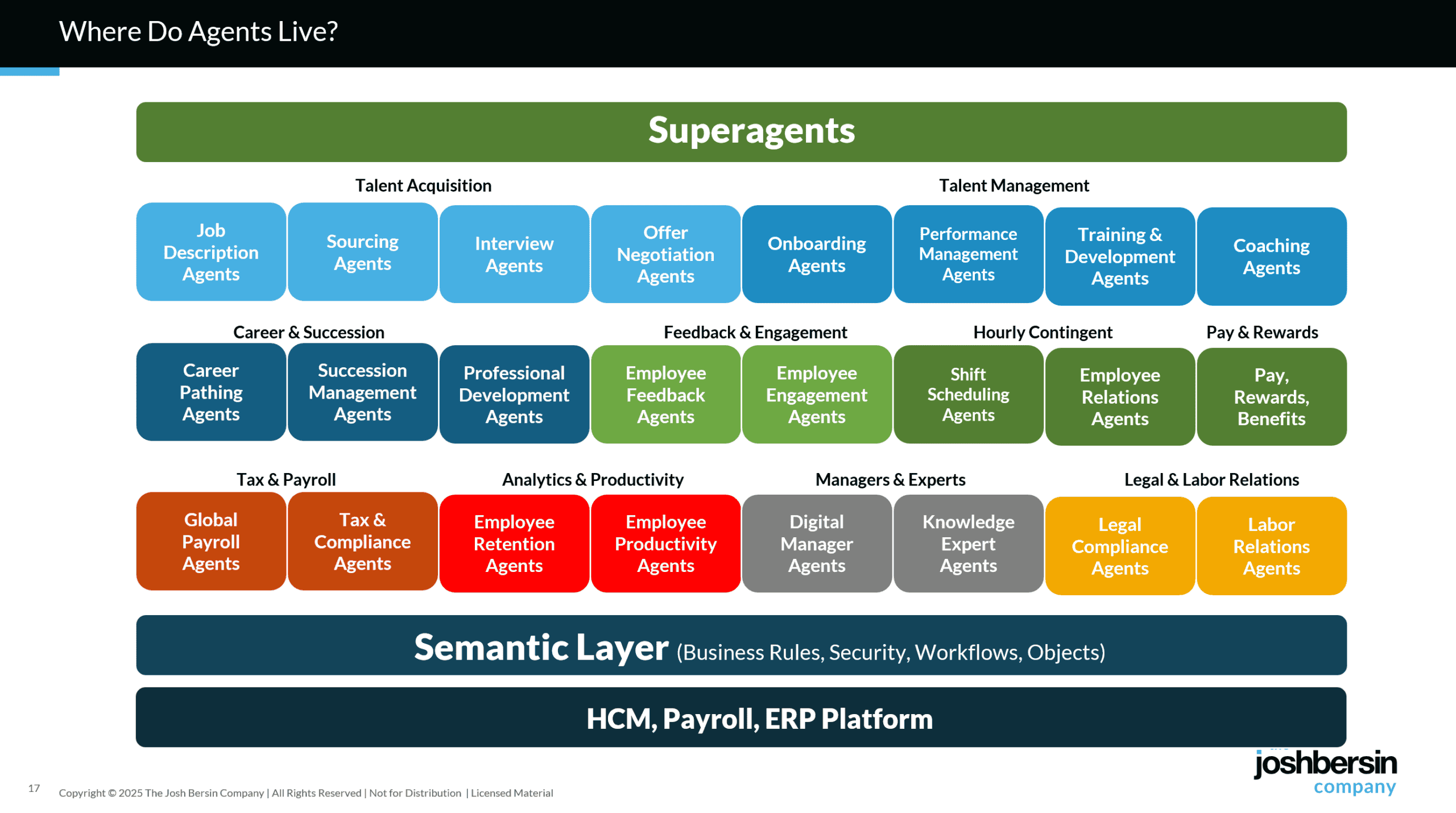
Application Layers of Agentic AI
Let me start with a little architecture discussion.
In the world of AI agents, there are essentially five layers. At the bottom we have the systems of record that store, update, and maintain information about our companies. These HCM applications sit on top of complex databases which hold information about our financials, customers, people, inventory, and products. This is the world of Workday, SAP, Oracle, UKG, and other ERP systems.
On top of these workflow-systems we have a layer of cross system applications. Since no vendor does everything, we build portals, mobile apps, and workflows that traverse these systems as well as hundreds of specialized applications like the time-tracking system, the LMS, the ATS, the IT provisioning system and many more. The average large company has 400 such apps and more than 100 touch employees in some way.
Over the last twenty years, as these systems moved from in-house to the cloud, companies built an ecosystem of solutions. ServiceNow, which is a $13.5 billion company growing at 20% per year, has dominated this layer for global companies. Employee experience apps like Microsoft Viva, Teams, Workvivo (Zoom), Firstup, Staffbase and tools built on Google, Slack, and others are used for this solution, but most were never designed to be “Agentic.”
The third layer is the new breed of Agents. Agents are much more than portals of workflows: they maintain intelligence about you, the user, and can do things on your behalf. So in HR we now see hundreds of Agent tools, often by small startups as well as those embedded in the enterprise systems, to help you build cross-functional solutions for your people.
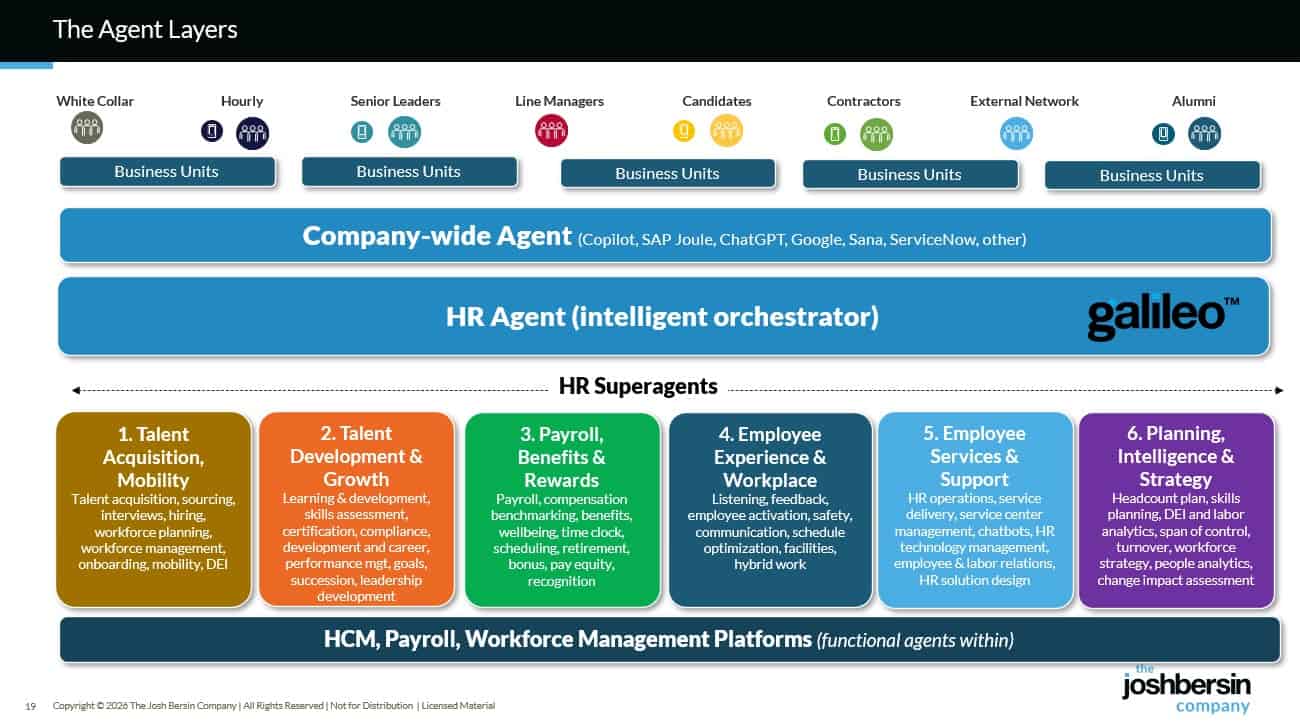
And on top of this is a layer of what we call “Superagents,” and these tools stitch together and access these functional agents to give users an even more “walk up and use” experience.
 |
This new architecture is now flooded with tools. These include Sana (Workday), Oracle Agent Studio, Microsoft Copilot Studio, Leena.ai, ServiceNow (with new agents coming from its MoveWorks acquisition), SAP (Joule Studio), and of course the Agent tools from Anthropic, OpenAI, Google, and others.
Galileo is like an advisor or HR professional agent, by the way, that gives employees a way to ask questions, get answers, and access the agents underneath.
 |
How Does All This Work
While all this looks exciting, there are lots of business rule, security, and legacy systems to consider.
If you buy a payroll reconciliation agent from Workday, SAP, or Oracle, for example, it monitors payroll transactions and reconciles tax, time-card, employee moves, terminations, new hires, and pay adjustments. But it won’t work until it’s “trained” with your company’s rules and security. And if you want it to monitor pay equity or adjust for performance, it has to talk with other agents.
So “agent architecture” is important.
Suppose, for example, you want to redeploy 5,000 people from an existing business to a new set of roles, and you want an agent to look for job fit, skills gaps, and move potential before you do a big layoff or hiring to fill new positions. That “agent” needs to talk with many other agents in order to work.
We actually built an agent like this in Galileo and it needs to understand skill and job requirements and then coach employees and managers on their options. This Superagent should also know what training is available, understand location issues, job licensing, union issues, pay level, and other factors.
As you can see it’s quite complex.
Other common use cases include global onboarding, promotion, annual reviews and compensation, and the entire process of talent acquisition, employee certification, time and schedule management, and more.
The War for Enterprise Agents: Where Do Business Rules Go?
Every HR vendor is building agents to help. Some are simple coaching tools and some go much further. And the bigger vendors (particularly Workday, Oracle, SAP, and ServiceNow), are building AI studios to make this easy.
But the big battle is not just “which agent” to buy or build, it’s how to stitch them together. And this gets to the issue of business rules, security, existing workflows, and business “objects” that each company builds. (A career framework or a performance review model is an object.)
All these rules or rubrics make up the real value and business model of your company, and as the company changes, they change too. We don’t want to hard code them into the agents, so the agents need to tap into a “semantic layer” that maintains all this information.
The HCM vendors (Workday, Oracle, SAP, UKG, etc.) already have semantic layers (Workday’s Business Process Framework, etc.) and they are bringing them into their agent tools.
This means any HR Agent or Agent tool is going to want to tap into this enormously important layer. (This may be why the SaaSpocalypse postulate may be wrong!)
What is Gloat Loomra and What are They Announcing?
Well Gloat wants to liberate you from this legacy approach.
Gloat has built an agent-driven auto-discovery “injestor” that mines entities, workflows, and business rules — and keeps them in sync as the HCM changes. This software replicates the rules and objects in your HCM system so you can easily build apps on top of it. (Loomra is the name of the semantic layer that does this.)
Gloat then offers an agent builder so you can visually build your own agents, directly into MS Teams, Copilot, Slack, and other platforms.
The company has already built agents for Workforce Redeployment, Career Development, Internal Talent Sourcing, Succession Planning, and Learning & Reskilling. These are areas where Gloat has existing expertise.
How Does Gloat Compare?
In many ways this is a wonderful idea – you could “start with Gloat” and build on top of your existing HCM without waiting for your legacy vendor to build what you need. And since the Gloat platform is open, you can connect your agents to other internal systems.
On the other hand, this is a a brutally competitive space.
ServiceNow shops do this in ServiceNow; Workday customers will use Sana; Oracle customers have the Oracle AI Studio; and SAP customers have Joule Studio. (Read this new blog explaining Workday’s agent strategy.)
Gloat has to convince you that their tools are easier to use, fully integrated with your HCM, and able to stay up to date. And for many fast-moving companies, this is just what they need.
Let’s See How This Plays Out
I’ve watched the application development tools market evolve for many decades. New platforms appear (Dreamweaver, Cold Fusion, Cursor, and now Anthropic Cowork and Microsoft Github Copilot), and companies tend to pick a toolset that matches their infrastructure.
It’s hard to believe that every HCM vendor will build these types of tools, so Gloat could have big market. And their integrated solution will definitely push incumbents to move faster.
We’ll talk with Gloat’s early customers and I look forward to sharing stories.
Additional Information
Workday and Sana Unveil A Bold New Strategy For AI
Agents, Superagents, and Intelligent Orchestration: 2026 Imperatives for Enterprise AI
The L&D Revolution Has Arrived: AI Enables Dynamic Enablement For All
Get Galileo, the AI Superagent for HR